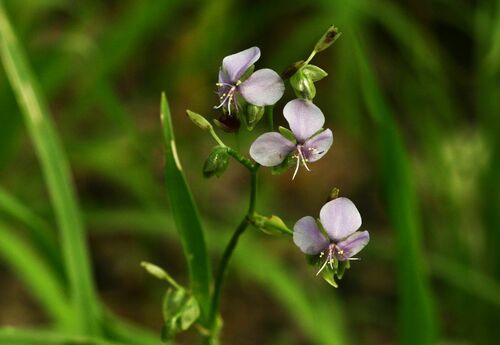
Tradescantia occidentalis
(Britton) Smyth
Prairie spiderwort
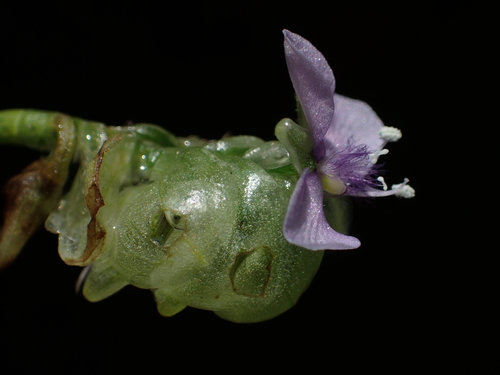
iNaturalist· cc-by-nc
(c) Tabby Brobston, some rights reserved (CC BY-NC), uploaded by Tabby Brobston
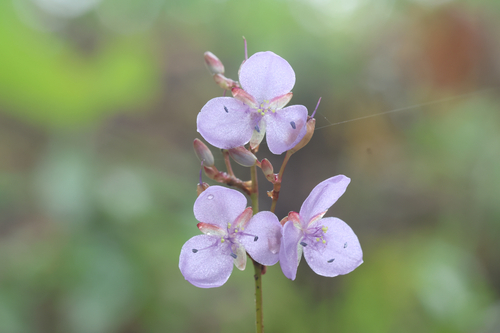
iNaturalist· cc-by-nc
(c) vrusczyk, some rights reserved (CC BY-NC)
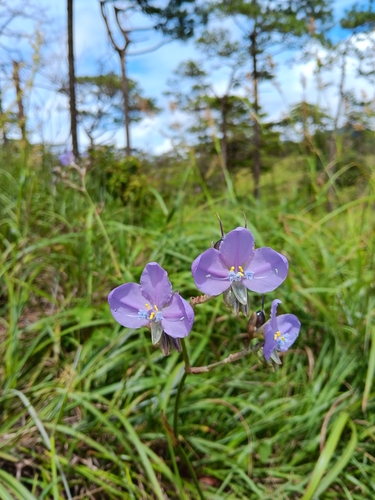
iNaturalist· cc-by-nc
(c) vrusczyk, some rights reserved (CC BY-NC)
Summary
Source: WikipediaTradescantia occidentalis, the prairie spiderwort or western spiderwort, is a plant in the dayflower family, Commelinaceae. It is common and widespread across the western Great Plains of the United States, as well as in Arizona, New Mexico, southern Utah, and Sonora, but is listed as a threatened species in Canada. Like in a few other species of Tradescantia, the cells of the stamen hairs of Western spiderwort are normally colored blue, but when exposed to neutron radiation or other forms of ionizing radiation, the cells mutate and change color to pink. Thus the plant can be used as a bioassay for radiation.
Description
A herb. The stems are 5-90 cm long. The leaves are arranged in spirals. They are narrowly sword shaped and 5-50 cm long by 0.2-3 cm wide. They taper to the tip. The flowers are blue to red and 12-16 mm long. The fruit are capsules 4-7 mm long and the seeds are 2-4 mm.
Edible Uses
The tender shoots are eaten raw or used as a potherb. The flowers are added to salads.
Traditional Uses
The tender shoots are eaten raw. They are also used as a potherb. The flowers are added to salads.
This uses section is brief — help expand it
Distribution
It is a temperate plant. It grows in the dry prairie.
Where It Grows
North America, USA,
Notes
There are about 65-70 Tradescantia species.
Synonyms
References (3)
- Beckstrom-Sternberg, Stephen M., and James A. Duke. "The Foodplant Database." http://probe.nalusda.gov:8300/cgi-bin/browse/foodplantdb.(ACEDB version 4.0 - data version July 1994)
- Kermath, B. M., et al, 2014, Food Plants in the Americas: A survey of the domesticated, cultivated and wild plants used for Human food in North, Central and South America and the Caribbean. On line draft. p 871
- Moerman, D. F., 2010, Native American Ethnobotany. Timber Press. p 563