Trachyspermum roxburghianum
(DC.) H. Wolff
Wild celery, Randhuni
wikimedia· cc-by-sa
Wikimedia Commons - Badagnani (talk)
wikimedia· cc-by-sa
Wikimedia Commons - Dinesh Valke from Thane, India
Description
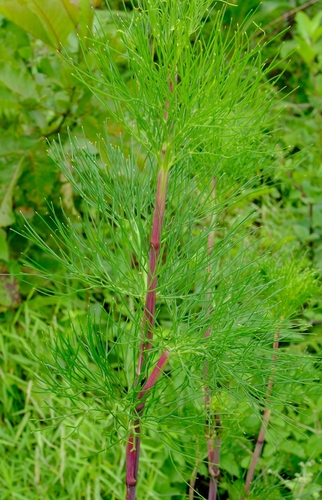
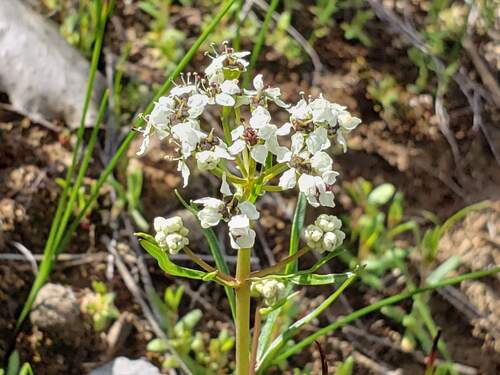
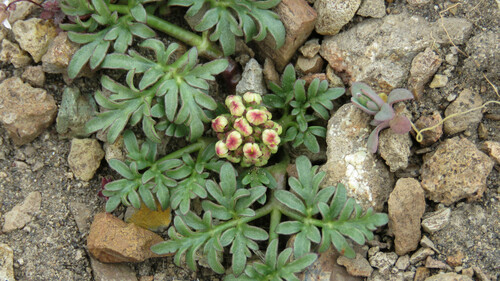
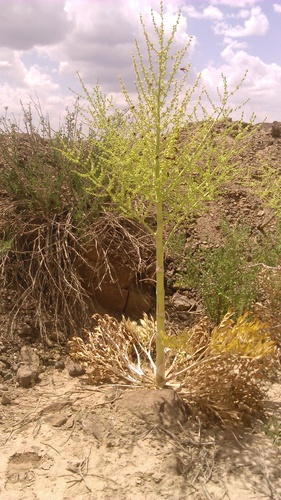
An annual herb. It is erect and has an aroma. It grows 90 cm tall. The stem is branched. The leaves are alternate and compound. There are leaflets along the stalk. The flowers are in a compound group in the axils of leaves or at the top of the plant. The fruit is flattened and splits open into 2 one seeded sections.
Edible Uses
The young leaves are eaten raw or steamed as a flavouring, served as a side dish or added to soup, and can substitute for parsley in chutney. The dried whole plant including flowers is used as a flavouring in curries, and the seeds are also used in curries.
Traditional Uses
The young leaves are eaten raw or steamed as a flavouring. They are eaten as a side dish or added to soup. The dried whole plant including flowers is used as a flavouring in curries. The seeds are used in curries. The leaves can be used as a substitute for parsley. They are also used in chutney.
Medicinal Uses
The fruits are a reputed medicine in Indian medicine where they are used as a cardiotonic, carminative, emmenagogue and stimulant. They are used in the treatment of dyspepsia, bronchitis and asthma. The fruits yield up to 2.5% essential oil, up to 4.5% fixed oil, and up to 0.1% of a crystalline ketonic compound. This latter has powerful antispasmodic activity, it lowers blood pressure by direct action on the blood vessels. The essential oil can be obtained by steam distillation. It is greenish-yellow and its main components are limonene 35.1%, 'ALFA'-terpinene 19.4%, piperitone 13.6%, terpineol 5.7%, linalool 4.7%, and thymol 1.7%. The essential oil also lowers blood pressure and has diuretic properties. The fruit residue after essential-oil extraction has cardiotonic properties.
Distribution
A tropical plant. In Yunnan.
Where It Grows
Asia, Bangladesh, China, India, Indochina, Indonesia, Laos, Malaysia, Myanmar, Northeastern India, SE Asia, Thailand,
Cultivation
Plants can be grown from seeds.
Other Uses
Extracts, or powders, from various parts of the plant are very effective against insect pests of stored grains such as Callosobruchus chinensis, Sitophilus oryzae and Trogoderma granarium; they are also used against housefly (Musca domestica).
Production
It can be grown in multi-cropping gardens during the rainy season.
Other Information
Leaves are sold in local markets. It is cultivated.
Synonyms
Also Known As
Ajmod, Ajmoda-vova, Ajmodavoma, Ajmot, Ajmud, Ajnud, Ajumoda-vaamu, Ashamtagam, Ashamtavomam, Ashumadagavaamu, Bodiajamo, Chanu, Kant-balu, Koranza, Par-di, Phakchee rai, Phak sangae, Randhuni
References (18)
- Ambasta, S.P. (Ed.), 2000, The Useful Plants of India. CSIR India. p 643
- Ara, R. I. T., 2015, Leafy Vegetables in Bangladesh. Photon eBooks. p 99
- Arora, R. K., 2014, Diversity in Underutilized Plant Species - An Asia-Pacific Perspective. Bioversity International. p 109
- Burkill, I.H., 1966, A Dictionary of the Economic Products of the Malay Peninsula. Ministry of Agriculture and Cooperatives, Kuala Lumpur, Malaysia. Vol 2 (I-Z) p 2212 (As Trachyspermum involucratum)
- Facciola, S., 1998, Cornucopia 2: a Source Book of Edible Plants. Kampong Publications, p 17 (As Carum roxburghianum)
Show all 18 references Hide references
- Fl. siam. 1:788. 1931
- Heyne, K., 1927, p 1214 (As Trachyspermum involucratum)
- Hossain, U. & Rahman, A., 2018, Study and quantitative analysis of wild vegetable floral diversity available in Barisal district, Bangladesh. Asian J. Med. Biol. Res. 2018, 4 (4), 362-371
- Japanese International Research Centre for Agricultural Science www.jircas.affrc.go.jp/project/value_addition/Vegetables
- Kar, A., et al, 2013, Wild Edible Plant Resources used by the Mizos of Mizoram, India. Kathmandu University Journal of Science, Engineering and Technology. Vol. 9, No. 1, July, 2013, 106-126
- Khodram,S. D., et al, 2019, Local knowledge of edible flowers used in Mizoram. Indian Journal of Traditional Knowledge Vol 18(40 pp 715-723
- Martin, F.W. & Ruberte, R.M., 1979, Edible Leaves of the Tropics. Antillian College Press, Mayaguez, Puerto Rico. p 99 (As Trachyspermum involucratum)
- Nakahara, K. et al, 2002, Antimutagenicity of Some Edible Thai Plants, and a Bioactive Carbazole Alkaloid, Mahanine, Isolated from Micromelum minutum. Journal of Agricultural and Food Chemistry. 50: 4796-4892
- Ochse, p 702 (As Trachyspermum involucratum)
- Sukenti, K., et al, 2016, Ethnobotanical study on local cuisine of the Sasak tribe in Lombok Island, Indonesia. Journal of Ethnic Foods. 3 (2016) 189-200 p 198
- Wiersema, J. H. & Leon, B., 2013, World Economic Plants. A Standard Reference CRC Press. 2nd Ed. p 690
- World Checklist of Useful Plant Species 2020. Royal Botanic Gardens, Kew
- Zeven, A. C. & de West, J. M. J., 1982, Dictionary of cultivated plants and their regions of diversity. Wageningen. p 64 (As Carum)