Tordylium apulum
L.
Roman pimpernel, Tordylium, Small hartwort
iNaturalist· cc-by-nc
(c) mick_photo, some rights reserved (CC BY-NC), uploaded by mick_photo
iNaturalist· cc-by-nc
(c) fotis-samaritakis, some rights reserved (CC BY-NC), uploaded by fotis-samaritakis
iNaturalist· cc-by
(c) Eleftherios Katsillis, some rights reserved (CC BY), uploaded by Eleftherios Katsillis
Summary
Source: WikipediaTordylium apulum, commonly known as the Mediterranean hartwort, is an annual forb or herb. It is classified within the family Apiaceae, the carrot family. It is native to Europe and Western Asia, but has been introduced to the United States, where it is now found only in Arizona. This plant's seeds are suggested as the plant model used for the famous gold "Malia Pendant", a jewel of high quality gold-smithery of the Minoan times now on display at the Heraklion Archaeological Museum.
Description
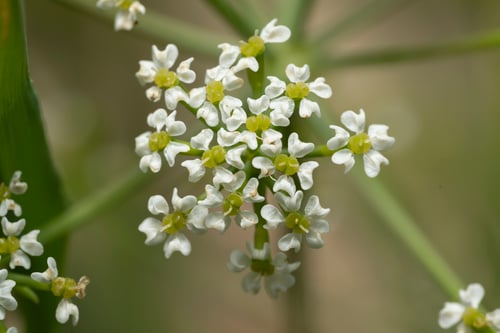
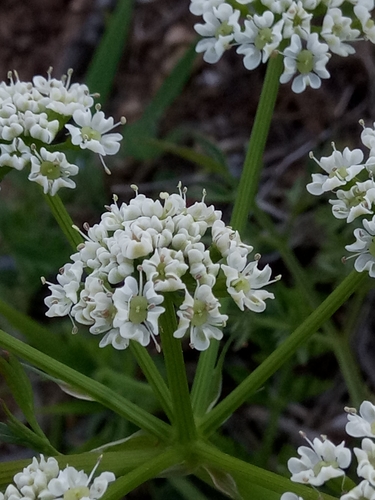
A short, fairly stout herb. It can have hairs and is an annual plant. The stems are erect. The stems have ridges and is branched. The leaves have leaflets along the stalk and the leaflet lobes are oval and have teeth. The leaf lobes on upper leaves are narrow and untoothed. The flowers are in white umbels with 3-8 rays. There are bracts less than 10 mm long. The outer flowers have large petals with 2 equal lobes. This is 5-9 mm long and there are 4 smaller petals 4-6 mm long. The fruit are 5-8 mm long and have a pale beaded edge.
Edible Uses
The young plant is used as a vegetable in Greece and as a condiment in Italy.
Traditional Uses
The young plants are eaten as a vegetable. They are boiled in mixtures and in soups.
This uses section is brief — help expand it
Medicinal Uses
None known.
Distribution
It is a Mediterranean climate plant. It grows on waste ground and sea shores.
Where It Grows
Asia, Balkans, Bosnia, Crete, Croatia, Europe, France, Greece, Italy, Mediterranean, Portugal, Sicily, Spain, Turkey, Türkiye,
Cultivation
We have very little information on this species and do not know if it will be hardy in Britain, though judging by its native range it could succeed outdoors in many parts of the country. See the plants native habitat for ideas on its cultivation needs.
Propagation
No specific information is available for this species. It is suggested to sow seed in a cold frame or greenhouse in early spring, pricking seedlings out into individual pots once large enough to handle and growing them on under glass through their first winter before planting out after the last expected frosts. Division in spring may also be possible.
Other Uses
None known.
Nutrition
| Part | Moisture | kJ | kcal | Protein | Vit A | Vit C | Iron | Zinc |
|---|---|---|---|---|---|---|---|---|
| Leaves | 85.2 | 217 | 53 | 2.7 | — | — | 2.1 | 0.6 |
Synonyms
Also Known As
Boncuk otu, Calcandrisc, Davul cicegi, Davul otu, Kafkalithra, Misotu, Muzobrad, Spiccialiccia, Vrati muz
References (15)
- Ahiskali, M., Ari, C. & Selvi, S., Edible wild plants and their consumption during winterin a rural village of Kazdagi (Mount Ida)
- Biscotti, N. et al, 2018, The traditional food use of wild vegetables in Apulia (Italy) in the light of Italian ethnobotanical literature. Italian Botanist 5:1-24
- Blamey, M and Grey-Wilson, C., 2005, Wild flowers of the Mediterranean. A & C Black London. p 162
- Dogan, A., et al, 2014, A review of edible plants on the Turkish Apiaceae species. J. Fac. Pharm. Istanbul, 44(2) pp 251-262
- Dolina, K. & Luczaj, L., 2014, Wild food plants used on the Dubrovnik coast (south-eastern Croatia) Acta Soc Bot Pol 83(3):175–181
Show all 15 references Hide references
- Dretakis, M. et al, 2012, Flora and Fauna Biodiversity in an ancient olive grove in Crete (Greece) in Calabrese G. (Ed.) Study on Biodiversity in Century-Old Olive Groves. CIHEAM - Mediterranean Agronomic Institute of Bari. p 94
- Ertug, F, Yenen Bitkiler. Resimli Türkiye Florası -I- Flora of Turkey - Ethnobotany supplement
- Facciola, S., 1998, Cornucopia 2: a Source Book of Edible Plants. Kampong Publications, p 22
- Geraci, A., et al, 2018, The wild taxa utilized as vegetables in Sicily (Italy): a traditional component of the Mediterranean diet. Journal of Ethnobiology and Ethnomedicine (2018) 14:14
- Luczaj et al, 2013, Wild vegetable mixes sold in the markets of Dalmatia (southern Croatia). Journal of Ethnobiology and Ethnomedicine. 8:2
- Luczaj, L. et al, 2014, Wild Food Plants of Dalmatia (Croatia). in A. Pieroni, C. L. Quave (eds.), Ethnobotany and Biocultural Diversities in the Balkans, p 143
- Pasta, S., et al, 2020, An Updated Checklist of the Sicilian Native Edible Plants: Preserving the Traditional Ecological Knowledge of Century-Old Agro-Pastoral Landscapes. Frontiers in Plant Science. Volume 11|Article 388
- Plants for a Future database, The Field, Penpol, Lostwithiel, Cornwall, PL22 0NG, UK. http://www.scs.leeds.ac.uk/pfaf/
- Skoula, M & Sarpaki, A., 2005, Traditional knowledge on the uses of wild plants in Crete, Greece.
- Trichopoulou, A., & Vasilopoulou, E., 2000, Mediterranean diet and Longevity. British Journal of Nutrition (2000), 84, Suppl. 2, S205-S209