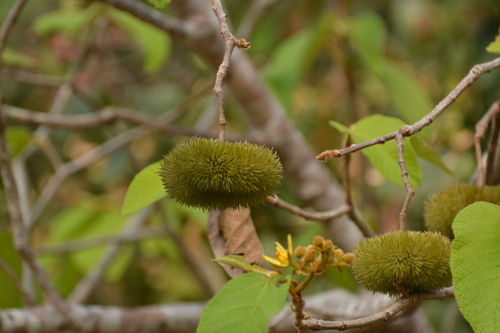
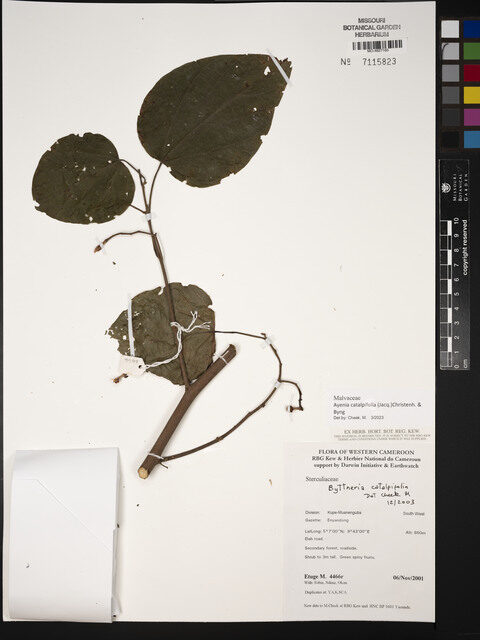
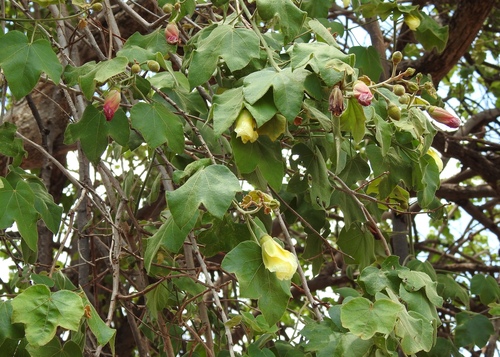
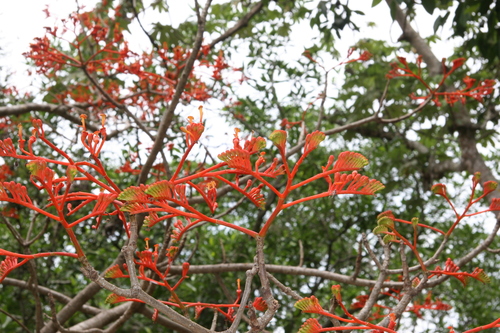
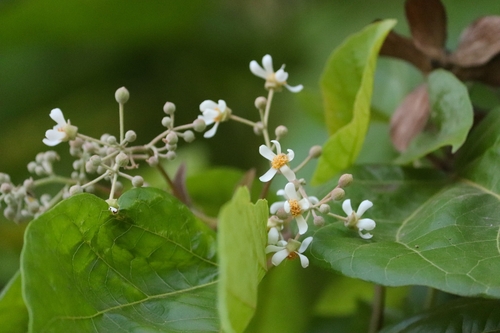
Theobroma angustifolium
Moc. & Sesse ex DC.
Mura, Narrow leaf chocolate tree
iNaturalist· cc-by
(c) Alexis López Hernández, some rights reserved (CC BY), uploaded by Alexis López Hernández
iNaturalist· cc-by
(c) Alexis López Hernández, some rights reserved (CC BY)
Description
An evergreen tree in the Malvaceae family that grows 8–26 m tall with a trunk around 30 cm across. Native to tropical rainforests in America, it thrives in temperatures of 20–30°C and areas with high rainfall (200–800 cm annually).
Edible Uses
Several species of Theobroma produce edible seeds, notably cacao, cupuaçu, and mocambo. Cacao is commercially valued as the source of cocoa and chocolate. Theobroma species are used as food plants by the larvae of some moths of the genus Endoclita, including E. chalybeatus, E. damor, E. hosei and E. sericeus. The larvae of another moth, Hypercompe muzina, feed exclusively on Theobroma cacao. An active ingredient of cacao, theobromine, is named for the genus.
Traditional Uses
The seeds are collected and included with commercial cacao. The pulp is eaten or used for drinks.
This uses section is brief — help expand it
Medicinal Uses
Although no specific reports of medicinal use have been seen for this plant, the seed is a source of cacao powder and butter. These products have the following medicinal uses:- Cacao powder and butter, which are obtained from the seed, are nutritive. The butter is also applied externally as an emollient. Cacao powder is taken internally in the treatment of angina and high blood pressure. Cacao butter is an excellent emollient, being applied to the skin to soothe and soften it. It is used traditionally to treat chapped skin and burns, and is also rubbed into bruises. Research has shown that it can help to counter the bacteria responsible for boils and septicaemia.
Distribution
A tropical plant. It grows in the rainforest. It grows in areas with a temperature range 20-30°C. It suits areas with a rainfall 200-800 cm per year.
Where It Grows
Belize, Central America, Costa Rica, El Salvador, Guatemala, Honduras, Mexico, Nicaragua, North America, Panama, South America, Trinidad,
Cultivation
Plants can be grown from fresh seeds.
Propagation
Seed - it has a very short viability, requiring high humidity and optimum temperatures to remain viable. There is no dormancy, the seed often germinating whilst still inside the pod.
Other Uses
An oil, known as cacao butter, which is solid at room temperature, is obtained from the seed. In addition to being used locally as a food and medicine, cacao butter is important in the cosmetics and pharmaceutical industries.
Notes
There are 20 Theobroma species. They are in tropical America. The Theobroma were previously placed in the Sterculiaceae and the Byttneriaceae.
Also Known As
Cacao de montana, Cacao cimarron, Soro
References (14)
- Castaneda, H., & Stepp, J. R., 2007, Ecosystems as Sources of Useful Plants for the Guaymi People of Costa Rica. Ethnobotany Journal. 5:249-257
- Garcia-Serrano, C. R., & Del Monte, J. P., 2004, The Use of Tropical Forest (Agroecosystems and wild Plant harvesting) as a Source of Food in the Bribri and Cabecar Cultures in the Caribbean Coast of Costa Rica. Economic Botany 58(1) pp 58-71
- Hazlett, D. L., 1986, Ethnobotanical Observations from Cabecar and Guaymi Settlements in Central America. Economic Botany 40(3): 339-352
- Hellmuth, N. M., 2011, Maya Ethnobotany. Complete Inventory of plants. Associacion FLAAR Mesoamerica. Tenth edition.
- Heywood, V.H., Brummitt, R.K., Culham, A., and Seberg, O. 2007, Flowering Plant Families of the World. Royal Botanical Gardens, Kew. p 76
Show all 14 references Hide references
- Langlois, H. C., 2004, Ethnobotanical analysis of different successional stages as sources of wild edible plants for the Guaymi people in Costa Rica. M. Sc. thesis University of Florida.
- Prodr. 1:484. 1824 [As DC.]
- Purseglove, J.W., 1968, Tropical Crops Dicotyledons, Longmans. p 571
- Segura, S., et al, 2018, The edible fruit species in Mexico. Genet Resour Crop Evol (2018) 65:1767–1793
- USDA, ARS, National Genetic Resources Program. Germplasm Resources Information Network - (GRIN). [Online Database] National Germplasm Resources Laboratory, Beltsville, Maryland. Available: www.ars-grin.gov/cgi-bin/npgs/html/econ.pl (10 April 2000)
- Useful Tropical Plants.
- Wiersema, J. H. & Leon, B., 2013, World Economic Plants. A Standard Reference CRC Press. 2nd Ed. p 682
- World Checklist of Useful Plant Species 2020. Royal Botanic Gardens, Kew
- Zaldivar, M. E., et al, 2002, Species Diversity of Edible Plants Grown in Homegardens of Chibehan Amerindians from Costa Rica. Human Ecology, Vol. 30, No. 3, pp. 301-316