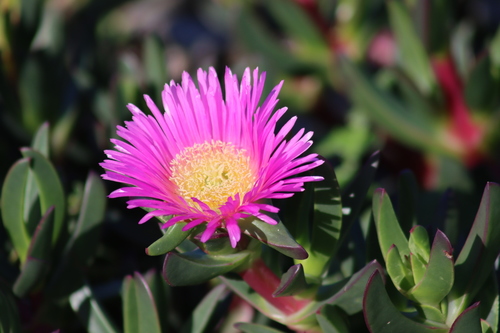
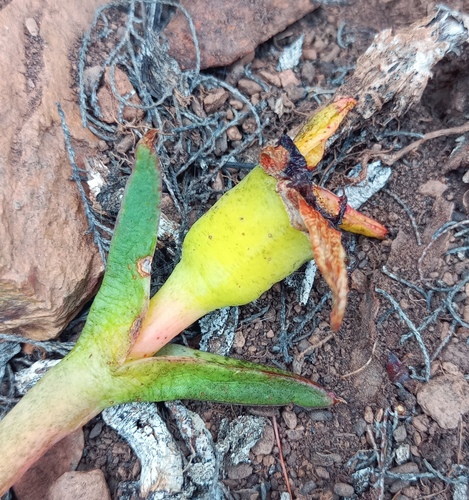
Tetragonia tetragonoides
(Pallas) O. Kuntze
New Zealand Spinach
iNaturalist· cc-by-nc
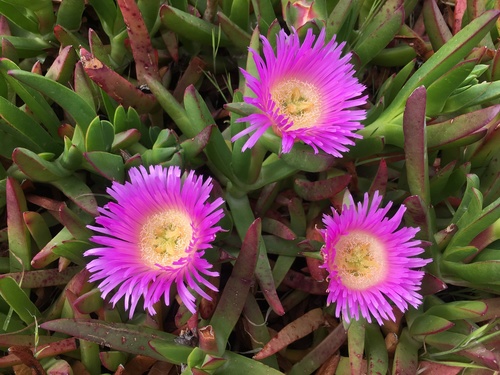
(c) 小铖/Smalltown, some rights reserved (CC BY-NC), uploaded by 小铖/Smalltown
iNaturalist· cc-by-nc
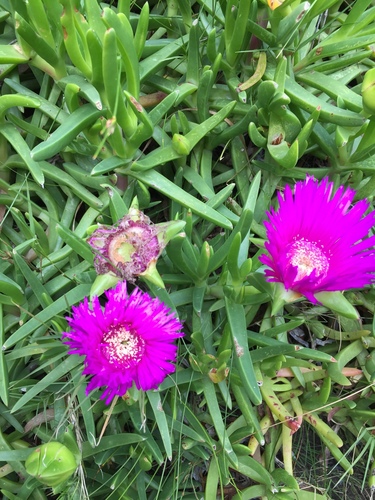
(c) James Bailey, some rights reserved (CC BY-NC), uploaded by James Bailey
iNaturalist· cc-by
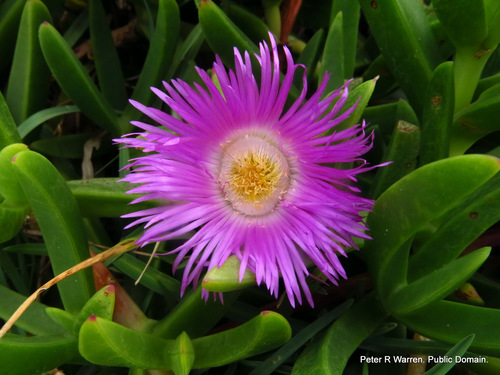
(c) Cheng-Tao Lin, some rights reserved (CC BY), uploaded by Cheng-Tao Lin
Description
A perennial branched herb. It starts growing erect but after this lies over. It then grows along the ground. It grows to 12 cm high. The stems can spread out to 1 m along the ground. The leaves are small and thick on round fleshy stems. They are triangle shaped. They are 4-6 cm long. They have distinct veins underneath. The flowers are yellow and 8 mm across. They are hidden at the base of the leaves. The fruit is up to 1 cm long and with 4 or 5 horns on top.
Edible Uses
The species, rarely used by indigenous people as a leaf vegetable, was first documented by Captain Cook. It was immediately picked, cooked, and pickled to help fight scurvy, and taken with the crew of the Endeavour. It spread when the explorer and botanist Joseph Banks took seeds back to Kew Gardens during the latter half of the 18th century. For two centuries, T. tetragonioides was the only cultivated vegetable to have originated from Australia and New Zealand. There are some indications that Māori did eat kōkihi perhaps more regularly. According to Murdoch Riley, "to counteract the bitterness of the older leaves of this herb, the Māori boiled it with the roots of the convolvulus (pōhue)", in reference to species of Convolvulaceae now classified as Calystegia. The tips of the spinach can be pinched off and eaten raw or cooked.
Traditional Uses
The fleshy leaves and tops are eaten. They can be eaten raw, steamed, boiled, stir-fried, creamed, served with mushrooms, or made into quiche. CAUTION They can contain oxalates and nitrates which can be poisonous.
Medicinal Uses
The plant is used medicinally. The leaves are antiscorbutic. Whole plants showed distinct anti-ulcerogenic activity in tests. The active principles were determined as sterylglucosides and cerebrosides.
Known Hazards
The plant contains calcium oxylate and saponins. Perfectly alright in small quantities, leaves containing oxalic acid should not be eaten in large amounts since it can lock-up other nutrients in the food, especially calcium, thus causing mineral deficiencies. The oxalic acid content will be reduced if the plant is cooked. People with a tendency to rheumatism, arthritis, gout, kidney stones or hyperacidity should take especial caution if including this plant in their diet since it can aggravate their condition. Although poisonous, saponins are poorly absorbed by the human body and so most pass through without harm. Saponins are quite bitter and can be found in many common foods such as some beans. They can be removed by carefully leaching in running water. Thorough cooking, and perhaps changing the cooking water once, will also normally remove most of them. However, it is not advisable to eat large quantities of raw foods that contain saponins. Saponins are much more toxic to some creatures, such as fish, and hunting tribes have traditionally put large quantities of them in streams, lakes etc in order to stupefy or kill the fish.
Distribution
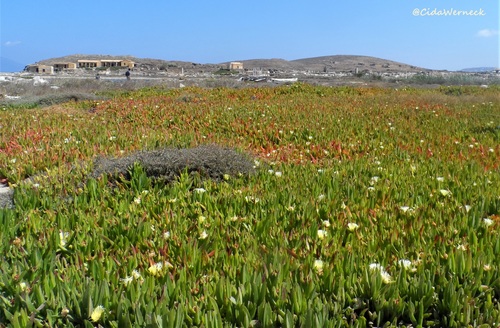
A temperate plant. It will grow in hot dry climates. It is better suited to high altitude areas above 1000 m in tropical countries. It grows to 2700 m in Papua New Guinea. It grows on rocky or sandy ground often close to the seashore. It can grow in salty soils. It requires good drainage and full sun. It can grow in arid places. It suits hardiness zones 7-9. Tasmania Herbarium.
Where It Grows
Africa, Angola, Argentina, Asia, Australia*, Balkans, Brazil, Britain, Cape Verde, Central Africa, Chile, China, Comoros, Congo, Costa Rica, Cuba, East Africa, Easter Island, Ecuador, Europe, France, Hawaii, India, Indochina, Indonesia, Japan, Kenya, Korea, Libya, Macedonia, Madagascar, Malawi, Malaysia, Mauritius, Mediterranean, Morocco, Mozambique, Myanmar, New Caledonia, New Zealand*, North Africa, North America, Pacific, Philippines, SE Asia, Senegal, Slovenia, Somalia, South Africa, Southern Africa, South America, St Helena, Taiwan, Tanzania, Tasmania*, Uganda, Uruguay, USA, Vietnam, West Africa, West Indies, Zambia, Zimbabwe,
Cultivation
It is grown from seeds or cuttings. It is easy to save seed. Seed can be bought in stores. Seeds often grow better if soaked in water overnight. Seedlings are not easy to transplant so it is better to sow direct. Often 3-4 seeds are planted in a mound with the mounds 70 cm apart. Cuttings form roots quickly.
Propagation
Seed - sow in situ. The seeds germinate quite irregularly - pre-soaking them for 24 hours in warm water can speed up their germination. Cuttings root very easily.
Production
Plants grow rapidly. The tips of plants can be cut regularly.
Other Information
It is a cultivated food plant. At present only very rarely grown in Papua New Guinea.
Notes
There are about 50-60 Tetragonia species.
Nutrition
| Part | Moisture | kJ | kcal | Protein | Vit A | Vit C | Iron | Zinc |
|---|---|---|---|---|---|---|---|---|
| Leaves | 88.6 | 63 | 15 | 4.1 | — | 36 | 2.5 | — |
| Leaves | 90.9 | 61 | 15 | 1.7 | 600 | 50 | 2.6 | 0.5 |
Synonyms
Also Known As
Cai bapxoi, Chikesoppu, Fan xing, Ka, Kabak, Kokihi, Novozelandska špinača, Sacha espinacam Tsuru-na, Warragul greens, Warrigal
References (88)
- Alice, L. & O'Quinn, T., Australian Bush Superfoods. Explore Australia p 174
- Ambasta, S.P. (Ed.), 2000, The Useful Plants of India. CSIR India. p 630
- Arora, R. K., 2014, Diversity in Underutilized Plant Species - An Asia-Pacific Perspective. Bioversity International. p 46
- Bianchini, F., Corbetta, F., and Pistoia, M., 1975, Fruits of the Earth. Cassell. p 78 (As Tetragona expansa)
- Bindon, P., 1996, Useful Bush Plants. Western Australian Museum. p 249
Show all 88 references Hide references
- Bodkin, F., 1991, Encyclopedia Botanica. Cornstalk publishing, p 971
- Bonney, N., 2012, Edible Wild Native Plants for Southern Australia. p 82
- Burkill, H. M., 1985, The useful plants of west tropical Africa, Vol. 1. Kew.
- Burkill, I.H., 1966, A Dictionary of the Economic Products of the Malay Peninsula. Ministry of Agriculture and Cooperatives, Kuala Lumpur, Malaysia. Vol 2 (I-Z) p 2182 (As Tetragonia expansa)
- Caton, J.M. & Hardwick, R. J., 2016, Field Guide to Useful Native Plants from Temperate Australia. Harbour Publishing House. p 102
- Centofanti, T. & Banuelos, G., 2019, Practical uses of Halophytic Plants as Sources of Food and Fodder. CAB International. p 331
- Chen, B. & Qiu, Z., Consumer's Attitudes towards Edible Wild Plants, Ishikawa Prefecture, Japan. p 26 www.hindawi.com/journals/ijfr/aip/872413.pdf
- Cheifetz, A., (ed), 1999, 500 popular vegetables, herbs, fruits and nuts for Australian Gardeners. Random House p 104
- Cherikoff V. & Isaacs, J., The Bush Food Handbook. How to gather, grow, process and cook Australian Wild Foods. Ti Tree Press, Australia p 191, 197
- Clarke, P. A., 2013, The Aboriginal Ethnobotany of the Adelaide Region, South Australia. Transactions of the Royal Society of South Australia. (2013), 137(1): 97-126
- Cribb, A.B. & J.W., 1976, Wild Food in Australia, Fontana. p 131
- Crowe, A., 1997, A Field Guide to the Native Edible Plants of New Zealand. Penguin. p 90
- Cundall, P., (ed.), 2004, Gardening Australia: flora: the gardener's bible. ABC Books. p 1407
- Curtis, W.M., 1963, The Students Flora of Tasmania Vol 2 p 240 (As Tetragonia expansa)
- De Angelis, D., 2005, Aboriginal Plant Use of the Greater Melbourne Area. La Trobe University Environment Collective
- Duarte, M. C., et al, 2022, Diversity of Useful Plants in Cabo Verde Islands: A Biogeographic and Conservation Perspective. Plants 2022, 11, 1313 p 7
- Facciola, S., 1998, Cornucopia 2: a Source Book of Edible Plants. Kampong Publications, p 241
- Flora of Australia, Volume 4, Phytolaccaceae to Chenopodiaceae, Australian Government Publishing Service, Canberra (1984) p 42
- Flora of Austra languages. Economic Botany, Vol. 49, No. 2, pp. 115-152
- Fox, F. W. & Young, M. E. N., Food from the Veld. Delta Books. p 68
- Grubben, G. J. H. and Denton, O. A. (eds), 2004, Plant Resources of Tropical Africa 2. Vegetables. PROTA, Wageningen, Netherlands. p 527
- Hastings Advance Community College, 2017, Uses for Native Plants of the Mornington Peninsula. 86pp. p 75
- http://www.botanic-gardens-ljubljana.com/en/plants
- Hwang, H., et al, 2013, A Study on the Flora of 15 Islands in the Western Sea of Jeollanamdo Province, Korea. Journal of Asia-Pacific Biodiversity Vol. 6, No. 2 281-310
- JSTOR Global Plants edible
- King Island Natural Resource Management Group, 2002, King Island Flora: A Field Guide. p 22
- Kiple, K.F. & Ornelas, K.C., (eds), 2000, The Cambridge World History of Food. CUP p 1822 (As Tetragonia expansa)
- Kuo, W. H. J., (Ed.) Taiwan's Ethnobotanical Database (1900-2000), http://tk.agron.ntu.edu.tw/ethnobot/DB1.htm
- Lamp, C & Collet F., 1989, Field Guide to Weeds in Australia. Inkata Press. p 297
- Lazarides, M. & Hince, B., 1993, Handbook of Economic Plants of Australia, CSIRO. p 235
- Low, T., 1991, Wild Herbs of Australia and New Zealand. Angus & Robertson. p 95 (Drawing)
- Low, T., 1991, Wild Food Plants of Australia. Australian Nature FieldGuide, Angus & Robertson. p 29
- Low, T., 1992, Bush Tucker. Australia’s Wild Food Harvest. Angus & Robertson. p 21
- LU De-quan; Aizoaceae, Flora of China
- Macmillan, H.F. (Revised Barlow, H.S., et al), 1991, Tropical Planting and Gardening. Sixth edition. Malayan Nature Society. Kuala Lumpur. p 370 (As Tetragonia expansa)
- Mahklouf, M. H., 2019, Ethnobotanical Study of Edible Wild Plants in Libya. European Journal of Ecology. 5(2): 30-40
- Martin, F.W. & Ruberte, R.M., 1979, Edible Leaves of the Tropics. Antillian College Press, Mayaguez, Puerto Rico. p 172 (As Tetragonia expansa)
- Martin, F.W., & Ruberte, R.M., 1979, Edible Leaves of the Tropics. Mayaguez, Puerto Rico p 19
- Miguel, E., et al, 1989, A checklist of the cultivated plants of Cuba. Kulturpflanze 37. 1989, 211-357
- Morley, B.D., & Toelken, H.R., (Eds), 1983, Flowering Plants in Australia. Rigby. p 73
- Ochse, J. J. et al, 1931, Vegetables of the Dutch East Indies. Asher reprint. p 6 (As Tetragonia expansa)
- Oomen, H.A.P.C., & Grubben, G.J.H., 1978, Tropical Leaf Vegetables in Human Nutrition, Communication 69, Department of Agricultural research, RTI Amsterdam, p 36, 48, 66, 89 (As Tetragonia expansa)
- Paczkowska, G. & Chapman, A.R., 2000, The Western Australian Flora. A Descriptive Catalogue. Western Australian Herbarium. p 135
- Pham-Hoang Ho, 1999, An Illustrated Flora of Vietnam. Nha Xuat Ban Tre. p 720
- Plants for a Future database, The Field, Penpol, Lostwithiel, Cornwall, PL22 0NG, UK. http://www.scs.leeds.ac.uk/pfaf/
- Revis. gen. pl. 1:264. 1891 "tetragoniodes"
- Robins, J., 1996, Wild Lime. Cooking from the Bush food garden. Allen & Unwin p 144
- Royal Botanic Gardens, Kew (1999). Survey of Economic Plants for Arid and Semi-Arid Lands (SEPASAL) database. Published on the Internet; http://www.rbgkew.org.uk/ceb/sepasal/internet [Accessed 24th March 2011]
- Ruiters-Welcome, A. K., 2019, Food plants of southern Africa. Ph.D. thesis. Univ. of Johannesburg p 8
- Ryan, M. (Ed.), 2003, Wild Plants of Greater Brisbane. Queensland Museum. p 41
- Schneider, E., 2001, Vegetables from Amaranth to Zucchini: The essential reference. HarperCollins. p 421
- Sharma, B.B., 2005, Growing fruits and vegetables. Publications Division. Ministry of Information and broadcasting. India. p 198 (As Tetragonia expansa)
- Smith, K., 1998. Growing Uncommon Fruits and Vegetables. New Holland. p 94
- Smith, K & I., 1999, Grow your own bushfoods. New Holland. Australia. p 72
- Staples, G.W. and Herbst, D.R., 2005, A tropical Garden Flora. Bishop Museum Press, Honolulu, Hawaii. p 98
- Terra, G.J.A., 1973, Tropical Vegetables. Communication 54e Royal Tropical Institute, Amsterdam, p 79 (As Tetragonia expansa)
- The Pacific Islands Food Composition Tables http://www.fao.org/docrep No C001
- Tindall, H.D., 1983, Vegetables in the Tropics, Macmillan p 388
- Torre, de la L., et al, 2008, Enciclopedia de las Plantas Útiles del Ecuador. Herbario QCA. Pontificia Universidad Católica del Ecuador. p 151
- Tronickova, E. & Krejcova, Z., 1987, Ortaggi, Instituto Geografico de Agostini, Cecoslovacchia. p 110
- USDA, ARS, National Genetic Resources Program. Germplasm Resources Information Network - (GRIN). [Online Database] National Germplasm Resources Laboratory, Beltsville, Maryland. Available: www.ars-grin.gov/cgi-bin/npgs/html/econ.pl (10 April 2000)
- van Wyk, Be., & Gericke, N., 2007, People's plants. A Guide to Useful Plants of Southern Africa. Briza. p 76
- Whiting, J. et al, 2004, Tasmania's Natural Flora. Tasmania's Natural Flora Editorial Committee PO Box 194, Ulverstone, Tasmania, Australia 7315 p 15
- Williamson, J., 2005, Useful Plants of Malawi. 3rd. Edition. Mdadzi Book Trust. p 245 (As Tetragona expansa)
- Woolmore, E et al, 2002, King Island Flora: A Field Guide. p 22
- Yuncker, T.G., 1959, Plants of Tonga, Bernice P. Bishop Museum, Hawaii, Bulletin 220. p 111 (As Tetragonia expansa)pansa)
- Smith, K., 1998. Growing Uncommon Fruits and Vegetables. New Holland. p 94
- Smith, K & I., 1999, Grow your own bushfoods. New Holland. Australia. p 72
- Staples, G.W. and Herbst, D.R., 2005, A tropical Garden Flora. Bishop Museum Press, Honolulu, Hawaii. p 98
- Terra, G.J.A., 1973, Tropical Vegetables. Communication 54e Royal Tropical Institute, Amsterdam, p 79 (As Tetragonia expansa)
- The Pacific Islands Food Composition Tables http://www.fao.org/docrep No C001
- Tindall, H.D., 1983, Vegetables in the Tropics, Macmillan p 388
- Tronickova, E. & Krejcova, Z., 1987, Ortaggi, Instituto Geografico de Agostini, Cecoslovacchia. p 110
- USDA, ARS, National Genetic Resources Program. Germplasm Resources Information Network - (GRIN). [Online Database] National Germplasm Resources Laboratory, Beltsville, Maryland. Available: www.ars-grin.gov/cgi-bin/npgs/html/econ.pl (10 April 2000)
- van Wyk, Be., & Gericke, N., 2007, People's plants. A Guide to Useful Plants of Southern Africa. Briza. p 76
- Welcome, A. K. & Van Wyk, B.-E., 2019, An inventory and analysis of the food plants of southern Africa. South African Journal of Botany 122 (2019) 136–179
- Whiting, J. et al, 2004, Tasmania's Natural Flora. Tasmania's Natural Flora Editorial Committee PO Box 194, Ulverstone, Tasmania, Australia 7315 p 15
- Wiersema, J. H. & Leon, B., 2013, World Economic Plants. A Standard Reference CRC Press. 2nd Ed. p 681
- Williamson, J., 2005, Useful Plants of Malawi. 3rd. Edition. Mdadzi Book Trust. p 245 (As Tetragona expansa)
- Woolmore, E et al, 2002, King Island Flora: A Field Guide. p 22
- World Checklist of Useful Plant Species 2020. Royal Botanic Gardens, Kew
- Yuncker, T.G., 1959, Plants of Tonga, Bernice P. Bishop Museum, Hawaii, Bulletin 220. p 111 (As Tetragonia expansa)
- Zizka, G., 1991, Flowering Plants of Easter Island. Palmarum Hortus Francofurtensis