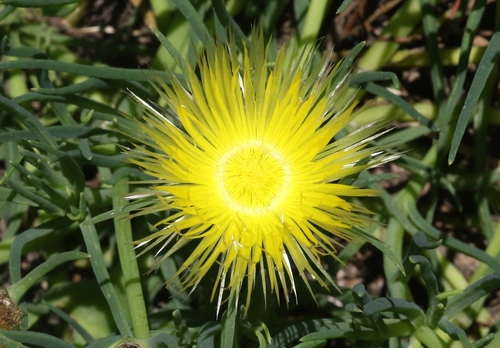
Carpobrotus glaucescens
(Haw.) Schwantes
Pigface, Coastal Noonflower, Angular pigface, Iceplant
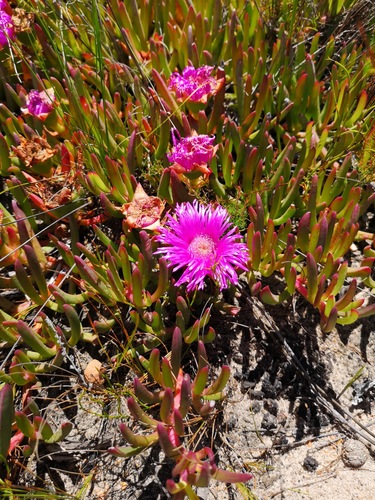
iNaturalist· cc-by-nc
(c) Mike Letnic, some rights reserved (CC BY-NC), uploaded by Mike Letnic
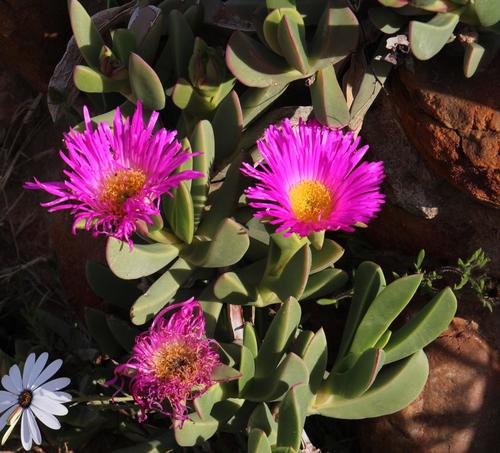
iNaturalist· cc-by-nc
(c) leithallb, some rights reserved (CC BY-NC), uploaded by leithallb
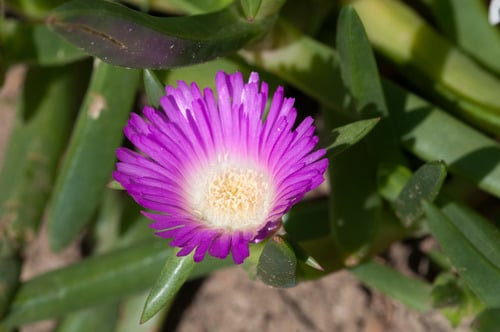
iNaturalist· cc-by
(c) ronavery, some rights reserved (CC BY), uploaded by ronavery
Summary
Source: WikipediaCarpobrotus glaucescens, commonly known as pigface or iceplant, is a species of flowering plant in the family Aizoaceae and is endemic to eastern Australia. It is a succulent, prostrate plant with stems up to 2 m (6 ft 7 in) long, glaucous leaves, daisy-like flowers with 100 to 150 light purple to deep pinkish-purple, petal-like staminodes and red to purple fruit. The fruits ripen mainly in Summer and Autumn. It usually only grows very close to the sea.
Description
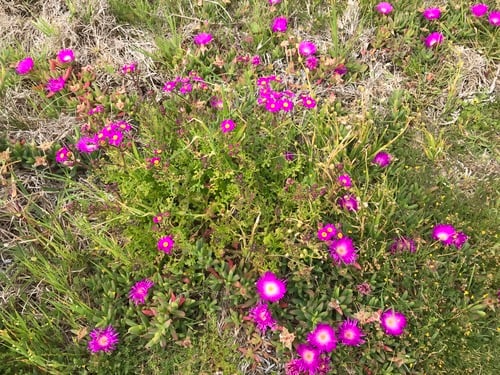
A spreading succulent plant. It keeps growing from year to year and creeps over the ground. The stems are reddish brown. The leaves are opposite and 3 sided. They are fleshy. The leaves can be curved inwards. They are 3.5-10 cm long by 1-1.5 cm wide. The flowers are daisy like. The petals are light purple becoming white towards the centre. They are 4-6 cm across. The fruit is fleshy and oblong. It is purple or red and 2-3 cm long by 1.5-2.5 cm wide.
Edible Uses
The fruit is eaten raw and considered a delicacy by native peoples, with a soft, wet pulp tasting of salty strawberries or fresh, juicy figs. The red to purple fruit measures 20–30mm long. The leaves are also edible and have a distinctly salty flavour.
Traditional Uses
The leaves and pulp of the ripe fruit are edible. They have a salty taste.
This uses section is brief — help expand it
Medicinal Uses
The leaves are antiscorbutic. Juice pressed from the succulent leaves can be applied externally to relieve pain from insect bites.
Distribution
It grows in tropical and subtropical places. It grows in coastal areas of Queensland on sand dunes. It can withstand dry periods. It can tolerate salt spray. It grows on coastal cliffs.
Where It Grows
Australia*, Norfolk Island,
Cultivation
Plants can be grown from seed, cuttings or division of the stem.
Propagation
Surface sow seed in containers, as lower night-time temperatures aid germination. Seed typically germinates in 7–10 days at 23°C. Once seedlings are large enough to handle, prick them out into individual pots and grow on until ready to plant out. The easiest propagation method is layering from horizontal stem cuttings, which mirrors the plant's natural spread. Layers should be around 30cm long and planted with at least 5cm remaining above the sand or soil surface. The plant can also be propagated from cut pieces or by dividing large established plants.
Other Uses
This species has a vigorous, prostrate growth habit, forming a dense carpet of foliage that makes very effective ground cover. It is well suited to maritime planting, particularly in Mediterranean climates, where it prevents soil erosion on sandy soils, dunes, and banks. The plant can stabilise sand dunes even when partially buried by sand, helping to create conditions for other species to establish. Its very fleshy leaves make it moderately fire-resistant, and it can be used in barrier plantings to slow the spread of forest fires.
Notes
There are about 25 Carpobrotus species. Also put in the family Mesembryanthemaceae.
Synonyms
References (21)
- Blomberry, A.M., 1979, Australian Native Plants. Angus and Robertson p 90
- Bodkin, F., 1991, Encyclopedia Botanica. Cornstalk publishing, p 217
- Caton, J.M. & Hardwick, R. J., 2016, Field Guide to Useful Native Plants from Temperate Australia. Harbour Publishing House. p 82
- Cribb, A.B. & J.W., 1976, Wild Food in Australia, Fontana. p 71
- Cronin, L., 1989, The Concise Australian Flora. Reed. p 103
Show all 21 references Hide references
- Edible and Useful Native Plants (off internet)
- Elliot, W.R., & Jones, D.L., 1982, Encyclopedia of Australian Plants suitable for cultivation. Vol 2. Lothian. p 466
- Flora of Australia, Volume 4, Phytolaccaceae to Chenopodiaceae, Australian Government Publishing Service, Canberra (1984) p 26
- Flora of Australia Volume 49, Oceanic Islands 1, Australian Government Publishing Service, Canberra. (1994) p 77
- Greig, D., 1996, Flowering Natives for Home Gardens. Angus & Robertson. p 107
- Hardwick, R.J., 2000, Nature's Larder. A Field Guide to the Native Food Plants of the NSW South Coast. Homosapien Books. p 36
- Haslam, S., 2004, Noosa's Native Plants. Noosa Integrated Catchment Assn. Inc. p 19
- Hibbert, M., 2002, The Aussie Plant Finder 2002, Florilegium. p 60
- Lazarides, M. & Hince, B., 1993, Handbook of Economic Plants of Australia, CSIRO. p 49
- Low, T., 1991, Wild Food Plants of Australia. Australian Nature FieldGuide, Angus & Robertson. p 30
- Low, T., 1992, Bush Tucker. Australia’s Wild Food Harvest. Angus & Robertson. p 58
- Melzer, R. & Plumb, J., 2011, Plants of Capricornia. Belgamba, Rockhampton. p 510
- Ryan, M. (Ed.), 2003, Wild Plants of Greater Brisbane. Queensland Museum. p 22
- Smith, K & I., 1999, Grow your own bushfoods. New Holland. Australia. p 69
- Townsend, K., 1994, Across the Top. Gardening with Australian Plants in the tropics. Society for Growing Australian Plants, Townsville Branch Inc. p 124
- Wrigley, J.W., & Fagg, M., 1982, Australian Native Plants. Collns. p 77