Terminalia solomonensis
Exell
Keari tree
gbif· cc0
Botanical Research Institute of Texas
gbif· cc-by
Royal Botanic Gardens, Kew
gbif· cc-by
Royal Botanic Gardens, Kew
Description
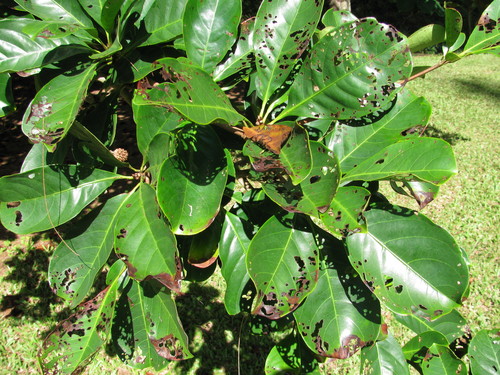
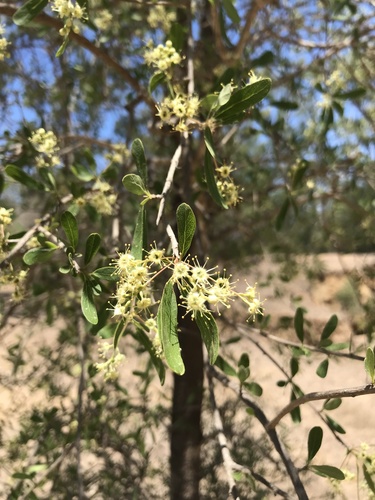
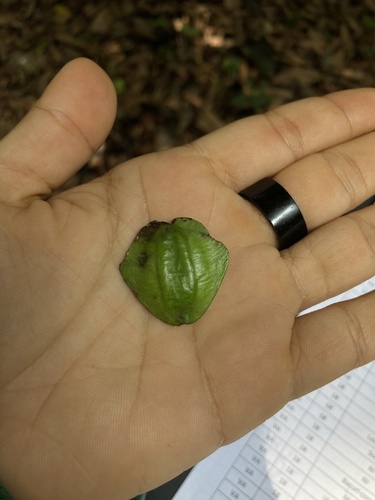
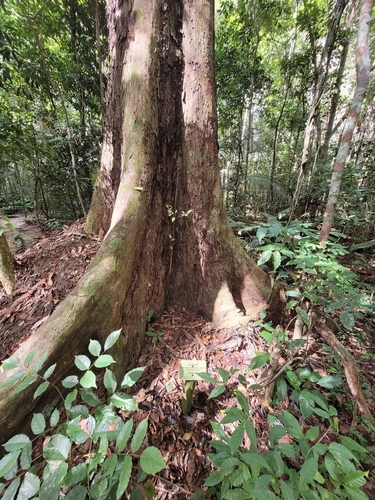
Trees from 25 to 40 m tall. The trunk can be 3.3 m around. The bark is dark brown and thick. It peels in strips from below and the lower part bends outwards. The crown is small and cone shaped. The branches are not in distinct layers. The leaves are generally in clusters on the ends of twigs. The leaf stalk is 2-3 cm long and often curved. The leaves are 10-18 cm long and 6-9 cm wide. The tip is rounded but the base is tapering. The flowers are about 3 mm long and on spikes about 18 cm long. Male and female flowers are separate on the same spike. The fruit is 4-5 cm long and 2-3.5 cm wide. It is mostly smooth and unwrinkled but sometimes flattened. It does not have a distinct wing. The fruit is red and firmly fleshy when ripe.
Edible Uses
The flesh of ripe fruit can be eaten and is preferred cooked, either baked or roasted. Unripe fruit can also be eaten but must be cooked. Seeds and fruit are edible portions.
Traditional Uses
The flesh of the ripe fruit can be eaten. They are preferred cooked. They can be baked or roasted. The unripe fruit can be eaten but must be cooked.
Distribution
A tropical plant. It is mostly in the lowland areas but can be up to 1,200 m altitude. It can grow on swampy ground.
Where It Grows
Asia, Indonesia, Pacific, Papua New Guinea, PNG, SE Asia, Solomon Islands,
Cultivation
Plants are grown from seed.
Other Uses
Said to be a major exportable timber in New Guinea. There are indications that the wood splits too easily to be of real use.
Production
In Papua New Guinea trees are in flower in July and August with fruit in December.
Notes
There are about 200-250 Terminalia species. They are tropical.
Also Known As
Aitanga, Gari mwara, Kalalamo, Nambisi, Nona daulwa, Nyia tekalamo, Papagoma, Phopoi, Pohon ketapang, keari, Popoli, Tohoma, To'oma
References (8)
- Altschul, S.V.R., 1973, Drugs and Foods from Little-known Plants. Notes in Harvard University Herbaria. Harvard Univ. Press. Massachusetts. no. 3045
- Henderson, C.P. and I.R.Hancock, 1988, A Guide to the Useful Plants of the Solomon Islands. Res. Dept. Min of Ag. & Lands. Honiara, Solomon Islands. p 45
- Coode, M.J.E., in Womersley, J.S. (ed.), 1978, Handbooks of the Flora of Papua New Guinea. Vol 1 p 104.
- French, B.R., 2010, Food Plants of Solomon Islands. A Compendium. Food Plants International Inc. p 189
- Peekel, P.G., 1984, (Translation E.E.Henty), Flora of the Bismarck Archipelago for Naturalists, Division of Botany, Lae, PNG. p 407, 405
Show all 8 references Hide references
- Powell, J.M., Ethnobotany. In Paijmans, K., 1976, New Guinea Vegetation. Australian National University Press. p 112
- Sukarya, D. G., (Ed.) 2013, 3,500 Plant Species of the Botanic Gardens of Indonesia. LIPI p 549
- World Checklist of Useful Plant Species 2020. Royal Botanic Gardens, Kew