Terminalia arostrata
Ewart et Davies
Nutwood, Crocodile tree
iNaturalist· cc-by
(c) M. Fagg, some rights reserved (CC BY)
iNaturalist· cc-by-nc
(c) Tony Rodd, some rights reserved (CC BY-NC)
Summary
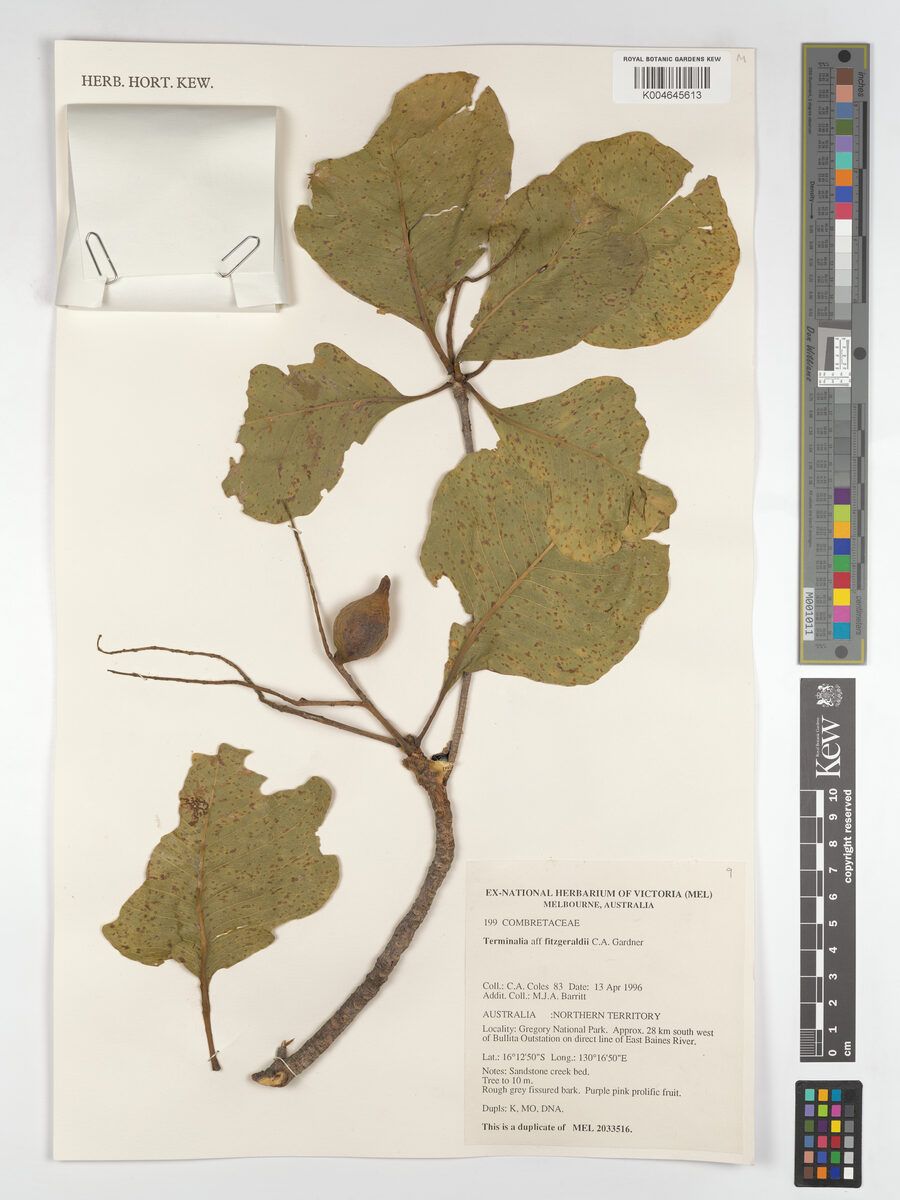
Source: WikipediaTerminalia arostrata, commonly known as crocodile tree or nutwood, is a tree of the family Combretaceae native to northern parts of Australia. The tree typically grows to a height of 4.5 to 12 metres (15 to 39 ft) in height and deciduous to semi-deciduous. It blooms between July and November producing white, orange and red flowers. The tree has a rounded crown and pendulous branches and produces edible seeds. The leaves are 3 to 13 centimetres (1.2 to 5.1 in) long and 10 to 45 centimetres (3.94 to 17.72 in) wide and has beaked fruit that persists year round. The species was first described by botanists Alfred James Ewart and O.B.Davies in 1917 in The Flora of the Northern Territory. It is found on flat to slightly undulating places in swampy areas and on basaltic plains in the Kimberley region of Western Australia, the Northern Territory and Queensland growing in alluvium and heavy soils.
Description
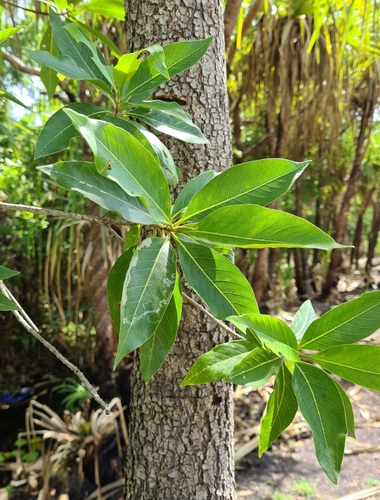
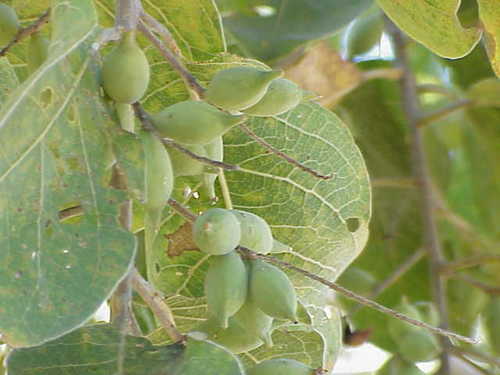
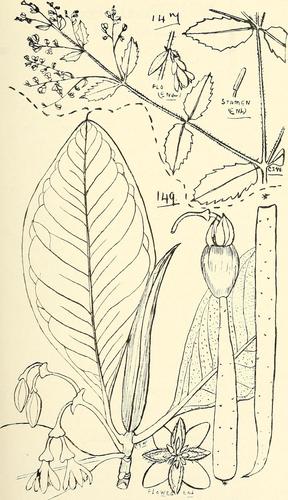
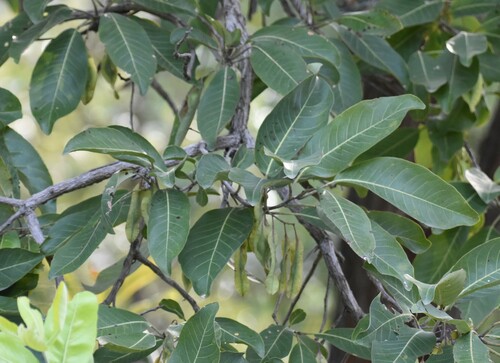
A medium sized tree which loses many of its leaves during the year. It grows to 7-12 m tall and spreads to 3 m across. The stem is erect and the branches hang downwards. The bark is dark grey or black, corky and deeply cracked. The tree has a rounded crown. The leaves are arranged in spirals. The leaves are oval and broad. They are leathery with a blunt tip. They narrow towards the base. They are 3-8 cm long and 1.5-3 cm across. They are slightly shiny and light to dark green. The leaf stalk is 1-3 cm long. The flowers are cream coloured but not easily seen. They occur on spikes 5-10 cm long in the axils of leaves towards the ends of small branches. The fruit are dark purple of black and round. They are 2.5 cm across. They have thin flesh and a smooth, hard woody shell around the one seed. The flesh of the fruit is edible but sour. The kernel is edible.
Edible Uses
The sour fruit flesh is edible, and the kernel tastes similar to a peanut and can be eaten raw.
Traditional Uses
The seeds are eaten raw. They are similar in size and taste to a peanut.
This uses section is brief — help expand it
Distribution
It is a tropical and subtropical plant. It occurs naturally in the Northern Territory and in Western Australia in Australia. It occurs in woodland in dry regions often in sandy soils. It prefers light to medium soils. It needs well drained soils. It suits an open sunny position. It is drought resistant. It is damaged by frost. It grows in areas with a temperature between 22°-38° C and a rainfall of 400-650 mm. It grows in acid soils with a pH between 5-6. It suits hardiness zones 9-11.
Where It Grows
Australia*,
Cultivation
Plants are grown from fresh seed. Seed is slow to start to grow.
Other Uses
The wood can be used as a fuel.
Production
Flowers occur in summer - October to January in Australia. Fruiting in Australia is January to May. The fruit may stay on the tree for several months.
Notes
There are about 200-250 Terminalia species. They are tropical.
Also Known As
Badijiy, Partiki
References (19)
- ABC Gardening Australia Flora CD Rom
- Bodkin, F., 1991, Encyclopedia Botanica. Cornstalk publishing, p 971
- Brock, J., 1993, Native Plants of Northern Australia, Reed. p 312
- Cherikoff V. & Isaacs, J., The Bush Food Handbook. How to gather, grow, process and cook Australian Wild Foods. Ti Tree Press, Australia p 201
- Cundall, P., (ed.), 2004, Gardening Australia: flora: the gardener's bible. ABC Books. p 1405
Show all 19 references Hide references
- Doran, J.C., & Turnbull, J.W. (Eds), 1997, Australian Trees and Shrubs: species for land rehabilitation and farm plantings in the tropics. ACIAR Monograph No 24. p 340
- Hardwick, G., 2001, Economically Useful Plants for Northern Australia: Master Species List. Crusader eBooks.
- Hearne, D.A., & Rance, S.J., 1975, Trees for Darwin and Northern Australia. AGPS, Canberra p 111
- Lazarides, M. & Hince, B., 1993, Handbook of Economic Plants of Australia, CSIRO. p 234
- Low, T., 1991, Wild Food Plants of Australia. Australian Nature FieldGuide, Angus & Robertson. p 44
- Paczkowska, G. & Chapman, A.R., 2000, The Western Australian Flora. A Descriptive Catalogue. Western Australian Herbarium. p 215
- Petheram, R.J. and Kok, B., 2003, Plants of the Kimberley Region of Western Australia. UWA Press p 523
- Smith, K & I., 1999, Grow your own bushfoods. New Holland. Australia. p 44
- Smith, N. M., 1991, Ethnobotanical Field Notes from the Northern Territory, Australia, J. Adelaide Bot. Gard. 14(1): 1-65
- Smith, Nicholas et al. 1993, Ngarinyman Ethnobotany: Aboriginal Plant Use from the Victoria River Area Northern Australia. Northern Territory Botanical Bulletin No 16. Parks and Wildlife Commission of the Northern Territory. p 45, 44.
- Wheeler, J.R.(ed.), 1992, Flora of the Kimberley Region. CALM, Western Australian Herbarium, p 553
- Wightman, Glenn et al. 1991.Alawa Ethnobotany: Aboriginal Plant Use from Minyerri, Northern Australia. Northern Territory Botanical Bulletin No 11. Parks and Wildlife Commission of the Northern Territory. p 25.
- Wightman, Glenn et al. 1992, Mangarrayi Ethnobotany: Aboriginal Plant Use from the Elsey Area Northern Australia. Northern Territory Botanical Bulletin No 15. Parks and Wildlife Commission of the Northern Territory. p 44, 43.
- Wightman, Glenn et al. 1994, Gurindji Ethnobotany: Aboriginal Plant Use from Daguragu Northern Australia. Northern Territory Botanical Bulletin No 18. Parks and Wildlife Commission of the Northern Territory. p 50, 51.