Conocarpus lancifolius
Engl. & Diels
Damask, Common tug tree
iNaturalist· cc0
no rights reserved, uploaded by Ajit Ampalakkad
iNaturalist· cc0
no rights reserved, uploaded by Ajit Ampalakkad
iNaturalist· cc-by-nc
(c) pantanico, some rights reserved (CC BY-NC)
Summary
Source: WikipediaConocarpus lancifolius, one of two species in the genus Conocarpus, is a tree in the family Combretaceae native to coastal and riverine areas of Somalia, Djibouti, and Yemen. It is found throughout the Horn of Africa, the Arabian Peninsula, and South Asia. The tree has no common name in English. In Somali, it is called qalab or dhamas; in Arabic, the name is damas. It is also commonly found in residential compounds in Dubai.
Description
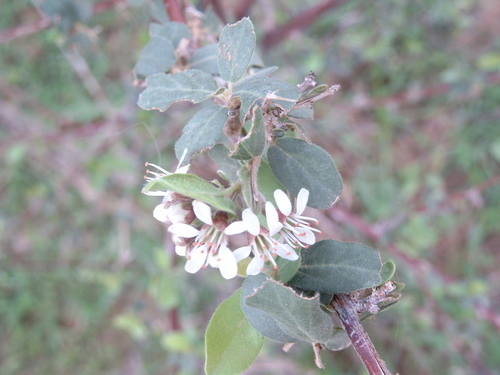
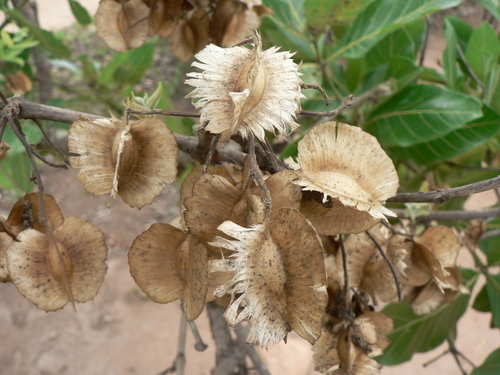
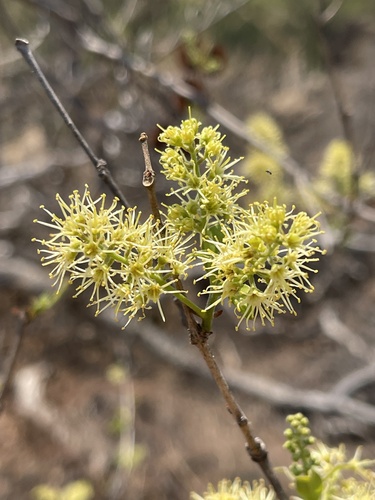
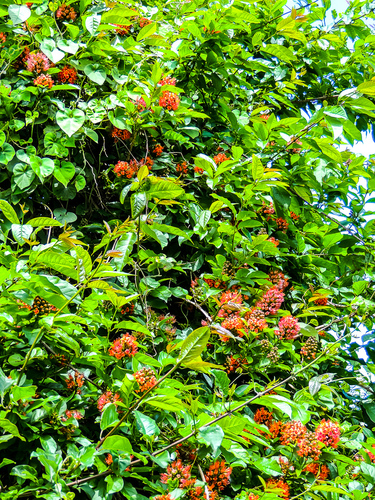
An evergreen tree. It can grow to 30 m high. The flowers are cream coloured and in dense heads. These are in clusters near the ends of branches. They have a scent. The fruit are like cones and are 6 mm long and wide.
Edible Uses
The tree's wood is dense and suitable for charcoal. Goats use the young trees and shoots as fodder, although the leaves contain tannin. Because of its high salt tolerance and relative drought tolerance, the tree is sometimes planted as a pioneer species in reafforestation projects in its native habitat. The tree has a symmetrical growth habit and can easily be shaped into a variety of different forms. It can be shaped into short and tall hedges, and is effective for creating a visual or a noise barrier. With suitable plant spacing it can also be grown as a hardy single-stemmed tree which is good for shade. The tree has been extensively used in Karachi for landscaping along roads and by homeowners as a tall hedging tree for screening purposes. The tree thrives exceptionally well in the hot and dry climate of the city. The leaves of conocarpus lancifolius have an antidiabetic effect.
Traditional Uses
The flowers are used for making alcoholic drinks.
This uses section is brief — help expand it
Medicinal Uses
A gum obtained from the tree is used to treat chest and bowel complaints.
Known Hazards
The crushed leaves are used as a fish poison.
Distribution
A subtropical plant. It grows in hot, arid zones. It grows in areas with a rainfall between 55-1,200 mm per year. It can grow in salty and alkaline soils. It grows from sea level to 1,000 m above sea level. It grows in areas with a temperature between 10°-45°C and best with an average temperature about 30°C. It can grow in arid places.
Where It Grows
Africa, Djibouti, East Africa, Kenya, Mediterranean, Middle East, Pakistan, Saudi Arabia, Somalia, Sudan, Syria, Yemen,
Cultivation
Plants are grown from seeds. Plants need to be 4-5 m apart. Seedlings can be transplanted when 6-19 months old or when 4-5 leaves are present.
Other Uses
The wood is durable in water. An excellent timber, it can be used for ship building. The wood provides a good fuel and a high quality charcoal can be made from it.
Production
It is fast growing.
Also Known As
Damas, Dhamas, Ghalab, Hodeti, Rawakib
References (2)
- Royal Botanic Gardens, Kew (1999). Survey of Economic Plants for Arid and Semi-Arid Lands (SEPASAL) database. Published on the Internet; http://www.rbgkew.org.uk/ceb/sepasal/internet [Accessed 10th April 2011]
- World Checklist of Useful Plant Species 2020. Royal Botanic Gardens, Kew