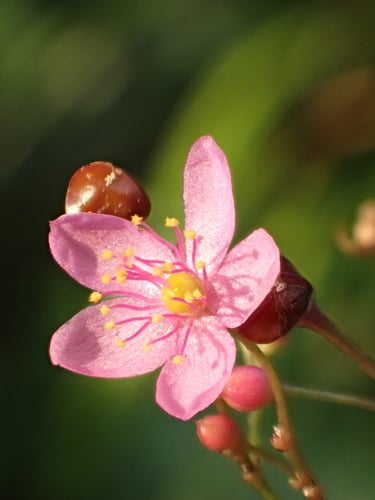
Talinum portulacifolium
(Forssk.) Asch. ex Schweinf.
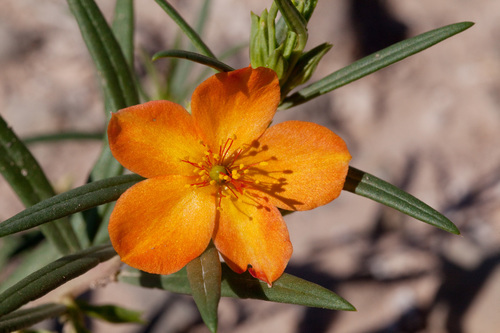
iNaturalist· cc-by-nc
(c) Bart Wursten, some rights reserved (CC BY-NC), uploaded by Bart Wursten
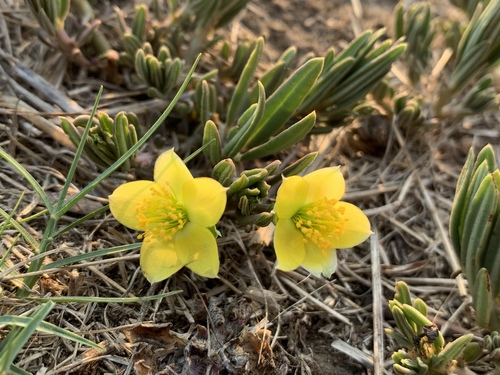
iNaturalist· cc-by-nc
(c) Dewald du Plessis, some rights reserved (CC BY-NC), uploaded by Dewald du Plessis
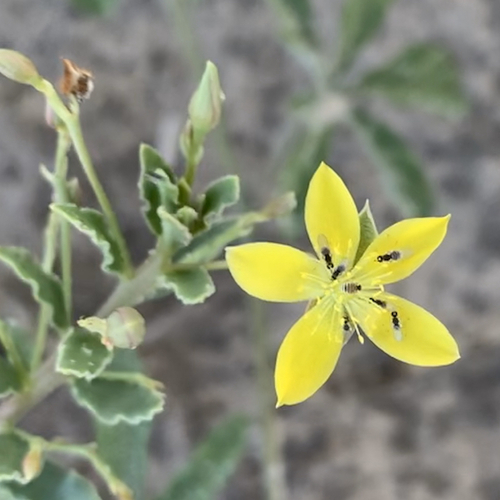
iNaturalist· cc-by-nc
(c) Dewald du Plessis, some rights reserved (CC BY-NC), uploaded by Dewald du Plessis
Description
A stout herb. It keeps growing from year to year. It can be softly woody. The stems are grey and sprawling. The root is thickened. The flowering stems are succulent. It grows 1 m high or 2 m long if lying over. The leaves are slightly fleshy. They are broadly oval and 2-8 cm long by 1-3 cm wide. The flowers are in groups at the top of the plant. They are along a 30 cm logn stalk. Flowers have both sexes. The fruit is a round capsule. It has 3 valves.
Edible Uses
The whole plant is boiled and eaten as a vegetable or eaten raw in salads; the leaves can also be dried for later use.
Traditional Uses
The whole plant is cut and boiled and used as a vegetable. It is also eaten raw in salads. The leaves can be dried for later use.
This uses section is brief — help expand it
Medicinal Uses
Used in traditional medicine practices.
Distribution
It is a tropical plant. It grows between 300-1,850 m above sea level. It grows in dry soils often over limestone material. It can grow in arid places. It grows in the lowlands.
Where It Grows
Africa, Angola, Arabia, Asia, Benin, Botswana, Burundi, Cameroon, Central Africa, Congo, East Africa, Eritrea, Ethiopia, Ghana, India, Kenya, Malawi, Middle East, Mozambique, Myanmar, Nepal, Niger, Nigeria, Oman, Saudi Arabia, SE Asia, Senegal, Socotra, Somalia, South Africa, Southern Africa, South America, South Sudan, Sudan, Tanzania, Togo, Uganda, West Africa, Yemen, Zambia, Zimbabwe,
Cultivation
It can be grown by seeds or cuttings.
Production
Leaves are collected during the rainy season.
Other Information
It is a minor vegetable. Leaves are sold in local markets.
Notes
There are about 50 Talinum species. They grow in warm places. Also put in the family Portulacaceae.
Nutrition
| Part | Moisture | kJ | kcal | Protein | Vit A | Vit C | Iron | Zinc |
|---|---|---|---|---|---|---|---|---|
| Leaves | 90 | — | — | 1.9 | — | 175.6 | 1.4 | 0.5 |
Synonyms
Also Known As
Aby, Amondi, Arum, Chiniasag , Dongdongi, Leshursin, Lokoromolok, Longoromolok, Mama, Mobatow, Moshkabati, Muiki, Nanki-Lani, Ndele, Sambarcheera, Spinach, Tonge
References (28)
- Ambasta, S.P. (Ed.), 2000, The Useful Plants of India. CSIR India. p 618
- Anywar, G., et al, 2014, Wild Plants Used as Nutraceuticals from Nebbi District, Uganda. European Journal of medicinal Plants. 4(6):641-660
- Anywar, G., et al, 2017, Proximate Nutrient Composition of some wild edible medicinal plants from Uganda. AJFAND 17(3)
- Burkill, H. M., 1985, The useful plants of west tropical Africa, Vol. 4. Kew.
- East African Herbarium records, 1981,
Show all 28 references Hide references
- Facciola, S., 1998, Cornucopia 2: a Source Book of Edible Plants. Kampong Publications, p 187
- Grivetti, L. E., 1980, Agricultural development: present and potential role of edible wild plants. Part 2: Sub-Saharan Africa, Report to the Department of State Agency for International Development. p 48, 71
- Grubben, G. J. H. and Denton, O. A. (eds), 2004, Plant Resources of Tropical Africa 2. Vegetables. PROTA, Wageningen, Netherlands. p 519
- Harkonen, M. & Vainio-Mattila, K., 1998, Some examples of Natural Products in the Eastern Arc Mountains. Journal of East African Natural History 87:265-278
- Ichikawa, M., 1980, The Utilization of Wild Food Plants by the Suiei Dorobo in Northern Kenya. J. Anthrop. Soc. Nippon. 88(1): 25-48
- Jardin, C., 1970, List of Foods Used In Africa, FAO Nutrition Information Document Series No 2.p 105
- Johns, T., and Kokwaro, J.O., 1991, Food Plants of the Luo of Siayo District, Kenya. Economic Botany 45(1), pp 103-113
- Joshi, N. & Siwakoti, M., 2012, Wild Vegetables Used by Local Community of Makawanpur District and Their Contribution to Food Security and Income Generation. Nepal Journal of Science and Technology Vol. 13, No. 1 (2012) 59-66 (As Talinum cuneifolium)
- Kokwaro, J. O. and Johns. T., Luo Biological Dictionary. p 16
- Lulekal, E., et al, 2011, Wild edible plants in Ethiopia: a review on their potential to combat food insecurity. Afrika Focus - Vol. 24, No 2. pp 71-121
- Martin, F.W. & Ruberte, R.M., 1979, Edible Leaves of the Tropics. Antillian College Press, Mayaguez, Puerto Rico. p 215
- Mutie, F. G., 2020, Conservation of Wild Food Plants and Their Potential for Combatting Food Insecurity in Kenya as Exemplified by the Drylands of Kitui County. Plants 2020, 9, 1017
- Mutie, F. M., et al, 2023, Important Medicinal and Food Taxa (Orders and Families) in Kenya, Based on Three Quantitative Approaches. Plants 2023, 12, 1145
- Narayanan Ratheesh, M. K. et al, 2011, Wild edible plants used by the Kattunaikka, Paniya and Kuruma tribes of Wayanad District, Kerala, India. Journal of Medicinal Plants Research Vol. 5(15), pp. 3520-3529 (As Talinum cuneifolium)
- Peters, C. R., O'Brien, E. M., and Drummond, R.B., 1992, Edible Wild plants of Sub-saharan Africa. Kew. p 163
- Royal Botanic Gardens, Kew (1999). Survey of Economic Plants for Arid and Semi-Arid Lands (SEPASAL) database. Published on the Internet; http://www.rbgkew.org.uk/ceb/sepasal/internet [Accessed 6th June 2011]
- Ruffo, C. K., Birnie, A. & Tengnas, B., 2002, Edible Wild Plants of Tanzania. RELMA p 656
- SAXENA,
- Scudder, 1971,
- Terra, G.J.A., 1973, Tropical Vegetables. Communication 54e Royal Tropical Institute, Amsterdam, p 77
- Vainio-Mattila, K., 2000, Wild vegetables used by the Sambaa in the Usumbara Mountains, NE Tanzania. Ann. Bot. Fennici 37:57-67
- World Checklist of Useful Plant Species 2020. Royal Botanic Gardens, Kew
- Zon, A.P.M. van der, Grubben, G.J.H., 1976, Les legumes-feuilles spontanes et cultives du Sud-Dahomey, Communication 65, Royal Tropical Institute, Amsterdam, p 97, 98