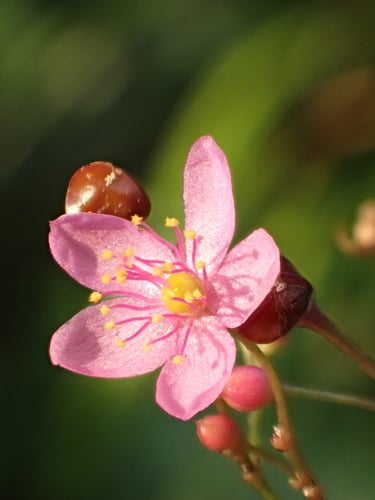
Talinum crispatulum
Dinter ex Poelln.
iNaturalist· cc-by-nc
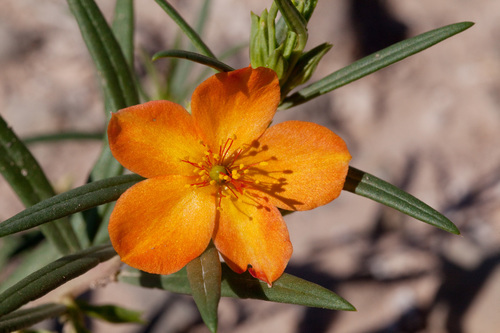
(c) Riana Fourie, some rights reserved (CC BY-NC), uploaded by Riana Fourie
iNaturalist· cc-by-nc
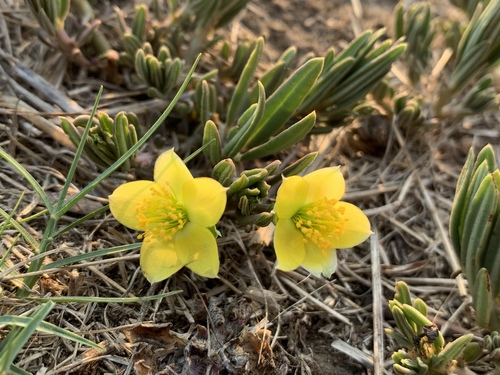
(c) Tony Benn, some rights reserved (CC BY-NC), uploaded by Tony Benn
iNaturalist· cc-by-nc
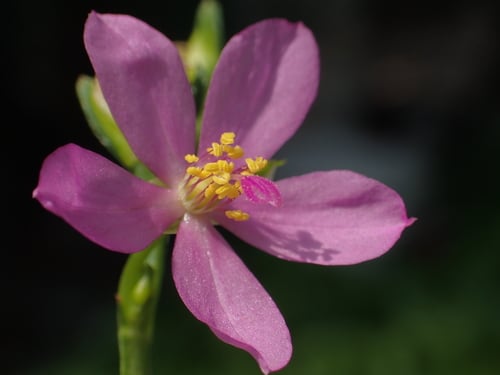
(c) Judy Flatt, some rights reserved (CC BY-NC), uploaded by Judy Flatt
Description
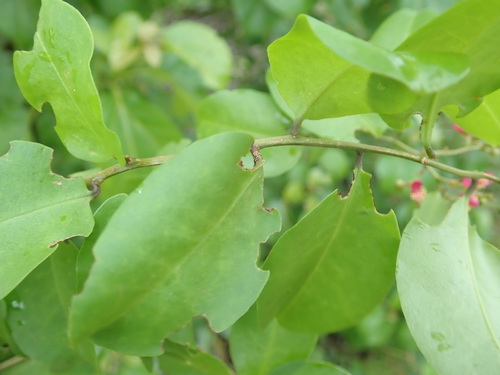
A herb. It lies along the ground. It is an annual plant and can keep growing for a few years. It grows 40 cm high. The leaves have wavy edges.
This description is brief — help expand it
Edible Uses
The leaves and stems are eaten raw, used in savory preparations, or boiled.
Traditional Uses
The leaves and stems are eaten raw. They are also used in savoury preparations. They are also boiled.
This uses section is brief — help expand it
Distribution
A tropical plant. It grows in dry sandy soils. It grows between 850-1,550 m above sea level. It grows in areas with an annual rainfall between 50-700 mm. It can grow in arid places.
Where It Grows
Africa, Botswana, East Africa, Malawi, Mozambique, Namibia, South Africa, Southern Africa, Zambia, Zimbabwe,
Notes
There are about 50 Talinum species. They grow in warm places. Also put in the family Portulacaceae.
Nutrition
| Part | Moisture | kJ | kcal | Protein | Vit A | Vit C | Iron | Zinc |
|---|---|---|---|---|---|---|---|---|
| Leaves | 91 | 120 | 29 | 3.4 | — | 8 | — | 0.3 |
Also Known As
Chisseladana, Xlabe, Xlare
References (16)
- Fox, F. W. & Young, M. E. N., 1982, Food from the Veld. Delta Books. p 311
- Lee, 1979,
- Grivetti, L. E., 1980, Agricultural development: present and potential role of edible wild plants. Part 2: Sub-Saharan Africa, Report to the Department of State Agency for International Development. p 71
- Grubben, G. J. H. and Denton, O. A. (eds), 2004, Plant Resources of Tropical Africa 2. Vegetables. PROTA, Wageningen, Netherlands. p 518
- Heinz & Maguire, 1974,
Show all 16 references Hide references
- http://aflora.africa.kyoto-u.ac.jp
- Maguire, 1978,
- Peters, C. R., O'Brien, E. M., and Drummond, R.B., 1992, Edible Wild plants of Sub-saharan Africa. Kew. p 163
- Royal Botanic Gardens, Kew (1999). Survey of Economic Plants for Arid and Semi-Arid Lands (SEPASAL) database. Published on the Internet; http://www.rbgkew.org.uk/ceb/sepasal/internet [Accessed 6th June 2011]
- Ruiters-Welcome, A. K., 2019, Food plants of southern Africa. Ph.D. thesis. Univ. of Johannesburg p 91
- Scudder, 1971,
- Tanaka, 1980,
- van Wyk, Be., & Gericke, N., 2007, People's plants. A Guide to Useful Plants of Southern Africa. Briza. p 76
- Wehmeyer, A. S, 1986, Edible Wild Plants of Southern Africa. Data on the Nutrient Contents of over 300 species
- Welcome, A. K. & Van Wyk, B.-E., 2019, An inventory and analysis of the food plants of southern Africa. South African Journal of Botany 122 (2019) 136–179
- World Checklist of Useful Plant Species 2020. Royal Botanic Gardens, Kew