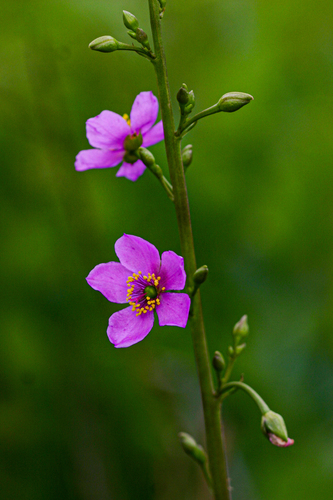
Talinum aurantiacum
Engl.
Orange Fameflower
iNaturalist· cc0
no rights reserved
iNaturalist· cc-by-nc
(c) Chuck Sexton, some rights reserved (CC BY-NC), uploaded by Chuck Sexton
iNaturalist· cc-by-nc
(c) blake hendon, some rights reserved (CC BY-NC), uploaded by blake hendon
Summary
A perennial growing to 0.4 m (1ft 4in) with hermaphroditic flowers blooming May to October. Adapts to light sandy, medium loamy, and heavy clay soils across mildly acidic, neutral, and basic pH ranges. Grows in semi-shade or full sun with preference for moist soil.
Description
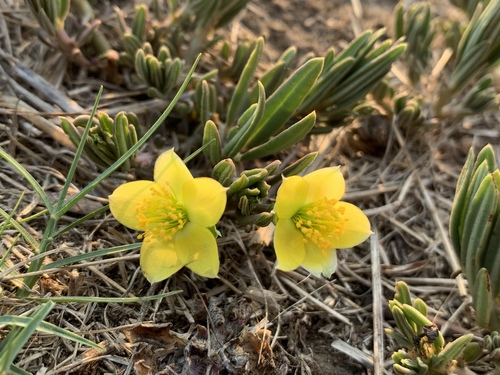
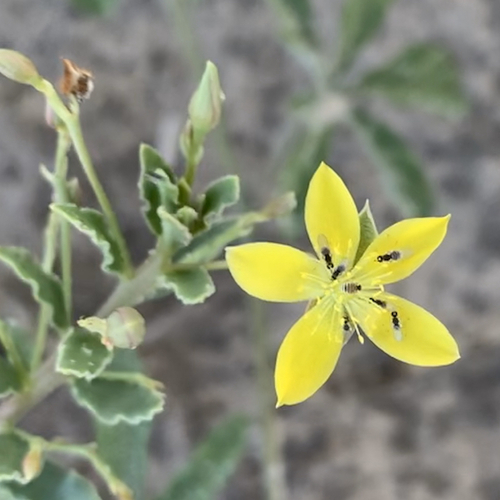
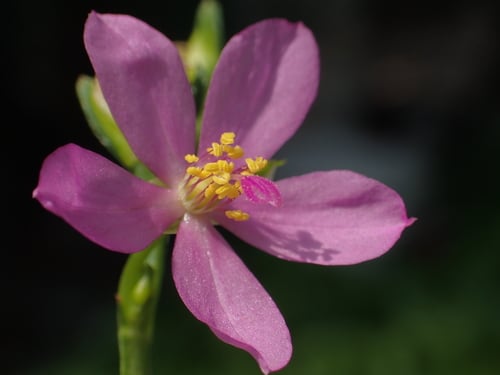
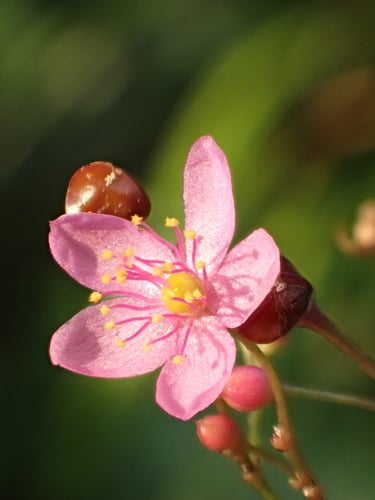
An erect showy herb. It has underground tubers. These can be straight or branches. They can be 10 cm long. The annual stems are thick and have a few branches. They can be 15-30 cm tall. The leaves are flat and narrow. They are 8 cm long and alternate. They do not have leaf stalks. The flowers have 5 petals. They open on hot afternoons. The flowers are about 1.5 cm across. They are self fertile.
Edible Uses
The woody, tuberous roots are edible when cooked.
Traditional Uses
The roots are cooked and eaten.
This uses section is brief — help expand it
Medicinal Uses
None known.
Distribution
It is a subtropical plant. It grows well between 1,300-2,000 m altitude in Texas. It grows in grassland plains.
Where It Grows
Central America, Mexico, North America, USA,
Cultivation
Plants can be grown from seed or cuttings.
Propagation
Seed.
Other Uses
None known.
Notes
There are about 50 Talinum species. They grow in warm places. Also put in the family Portulacaceae.
References (6)
- Anderson, M., 2002, The World Encyclopedia of Cacti and Succulents. Hermes House, New York. p 205
- Beckstrom-Sternberg, Stephen M., and James A. Duke. "The Foodplant Database." http://probe.nalusda.gov:8300/cgi-bin/browse/foodplantdb.(ACEDB version 4.0 - data version July 1994)
- Kermath, B. M., et al, 2014, Food Plants in the Americas: A survey of the domesticated, cultivated and wild plants used for Human food in North, Central and South America and the Caribbean. On line draft. p 852
- Kiple, K.F. & Ornelas, K.C., (eds), 2000, The Cambridge World History of Food. CUP p 1865
- Loughmiller, C & L., 1985, Texas Wildflowers. A Field Guide. University of Texas, Austin. p 201
Show all 6 references Hide references
- Plants for a Future database, The Field, Penpol, Lostwithiel, Cornwall, PL22 0NG, UK. http://www.scs.leeds.ac.uk/pfaf/