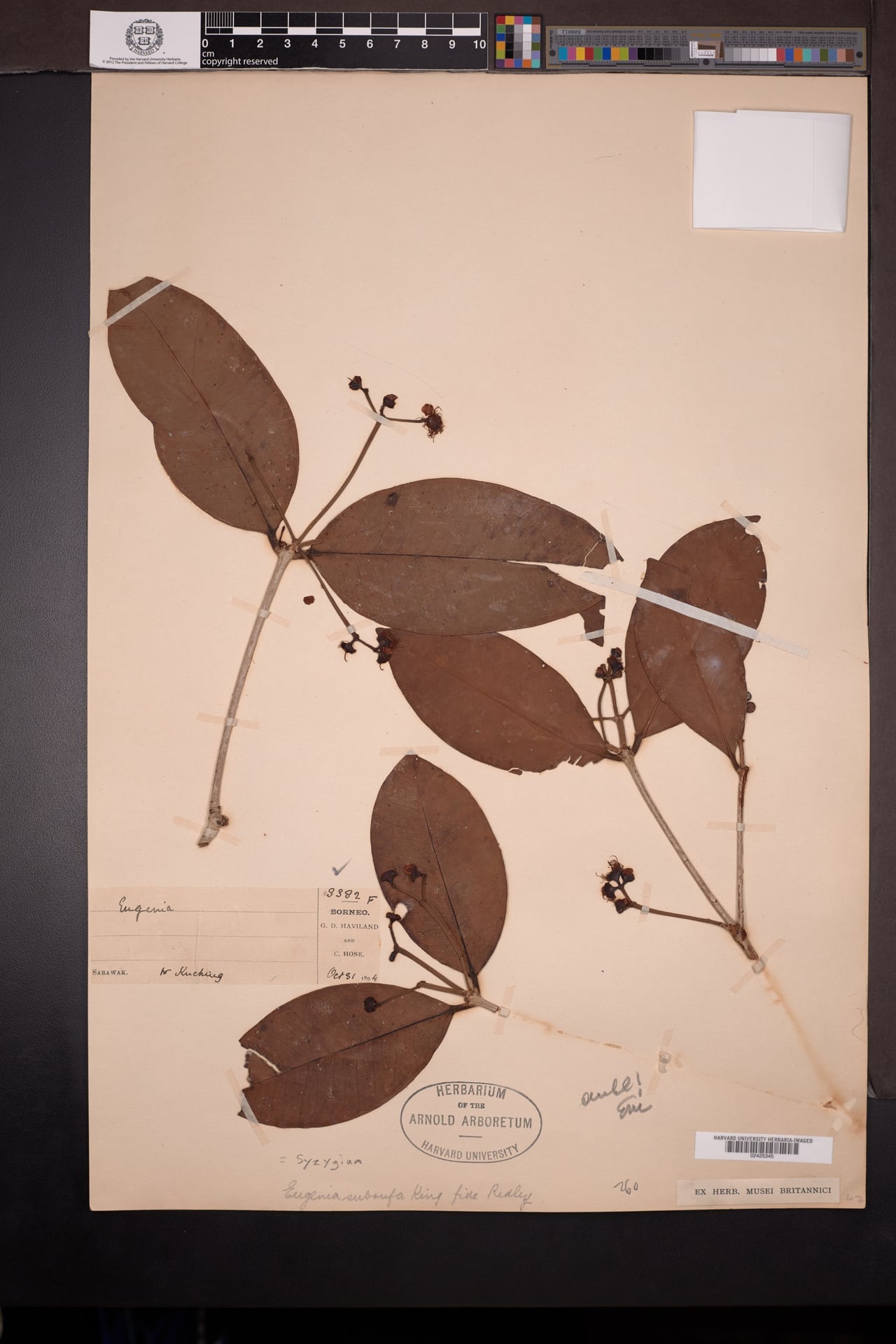
Syzygium guineense
(Willd.) DC.
Water berry, Woodland waterberry, Water pear
iNaturalist· cc-by
(c) Robert Taylor, some rights reserved (CC BY)
iNaturalist· cc-by-nc
(c) Gerhard Malan, some rights reserved (CC BY-NC), uploaded by Gerhard Malan
iNaturalist· cc-by
(c) Robert Taylor, some rights reserved (CC BY)
Summary
Source: WikipediaSyzygium guineense (Bambara: Kokisa) is an evergreen leafy forest tree of the family Myrtaceae, found in many parts of Africa both wild and domesticated. Both its fruits and leaves are edible; the pulp and the fruit skin are sucked and the seed discarded. It is sometimes called "waterberry", but this may also refer to other species of Syzygium.
Description
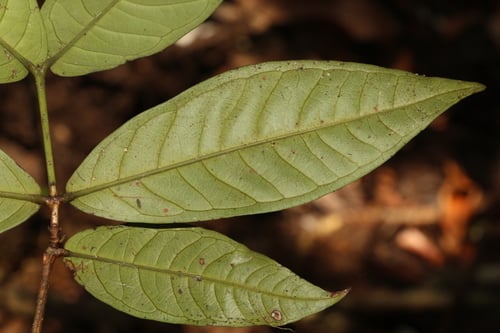
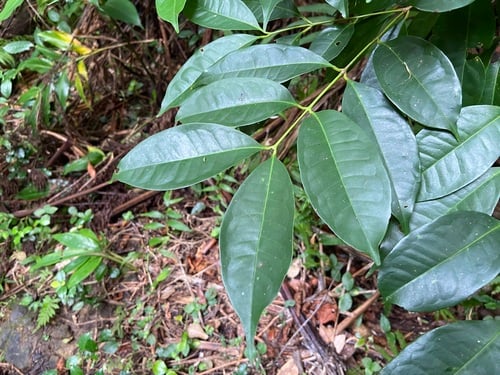
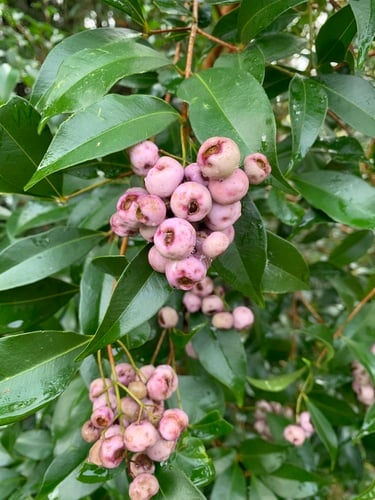
It is a medium sized evergreen tree. It grows 15-30 m tall. This tree varies a lot. The trunk is broad and fluted. The bark is rough, greyish white and flaky. It produces a red watery sap if cut. The young branches are four sided. The branches tend to hang over. The leaves are simple and opposite one another along the stem. They are shiny, dark green and leathery. Underneath the leaves is paler green. Young leaves are purple red. Leaves are 5-16 cm long by 1.3-7 cm across. The leaf stalk is about 1 cm long. The leaves do not have as many side veins as Syzygium gerrardii. The flowers are white. They have a honey sweet scent. The flowers occur in clusters at the ends of branches. Clusters can be 10 cm across. The fruit are oval and 2-3 cm long. They are whitish green when young and turn dark purple when ripe. Clumps of 20-30 fruit occur together. The fruit contains one large seed. The seed is 1.4 cm across. The fruit is edible. There are about 10 subspecies.
Edible Uses
In southern Ethiopia S. guineense is a much-appreciated shade tree for both the homestead and the home garden. It is considered a famine food, eaten by subsistence farmers when their crops fail.
Traditional Uses
The ripe fruit is eaten raw. They are also used for drinks. They are used in relishes and chutneys. The bark is used for tea. The roots are eaten.
Medicinal Uses
The plant is widely used in traditional medicine in Africa, but some caution should be observed as the bark may be poisonous, and death after its use has been recorded. Various studies have been carried out into the medicinal activities of the plant. Extracts of the stem bark, leaves and seeds have shown antibacterial and antifungal activity. Methanol extracts of the stem bark have shown molluscicidal activity. Triterpenes with antibacterial activity have been isolated from a methanol leaf extract; the most active of these being arjunolic acid and asiatic acid. They have demonstrated activity against Escherichia coli, Bacillus subtilis and Shigella sonnei. The roots are anthelmintic purgative and tonic. A decoction is used as a remedy for stomach ache and intestinal worms. The root is soaked in water and then used for drinking and bathing in to treat epilepsy. The bark is anthelmintic, antispasmodic, laxative, purgative and tonic. A decoction or infusion is used as a remedy for stomach ache, diarrhoea, malaria, intestinal worms, coughs, asthma, throat problems and intercostal pain. Twig bark preparations are applied against paralysis. The bark is applied externally to treat broken bones and wounds. The fruits are used as a remedy for dysentery. A decoction of the twigs and leaves is drunk or used as an enema for its purgative properties and against colic, diarrhoea and abdominal pain. It is also used as drink or bath against insanity, amenorrhoea and cerebral malaria. Leaf decoctions are used as a treatment for intestinal parasites, stomach-ache, insanity and possession. They are used as a tonic for pregnant women. A leaf decoction is used as an enema as a remedy for diarrhoea. The crushed leaf is applied as a poultice on wounds and boils. A decoction of the leaves is used as an embrocation to bathe and then massage into areas of sprain. A liquid of chewed leaves mixed with water is used as eye drops to treat ophthalmia..
Known Hazards
The poisonous bark has been reported to cause human deaths.
Distribution
A tropical plant. It occurs in most of Africa. It grows from sea level to 1350 m in Tanzania and up to 2,100 m in Uganda. It requires plenty of water. It grows in areas with annual rainfalls of 743 mm to 2340 mm but in the drier areas relies on underground water. It occurs in areas with temperatures between 16°C and 30°C. It grows on a range of soils. It commonly occurs in rainforest or swamp forest. It suits humid locations. Seedlings need adequate light. It can grow in arid places.
Where It Grows
Africa, Angola, Benin, Botswana, Burkina Faso, Burundi, Cabinda, Cameroon, Central Africa, Central African Republic, CAR, Chad, Congo DR, Côte d'Ivoire, East Africa, Equatorial Guinea, Eritrea, Eswatini, Ethiopia, Gabon, Gambia, Ghana, Guinea, Guinée, Guinea-Bissau, Ivory Coast, Kenya, Lesotho, Liberia, Libya, Malawi, Mali, Mozambique, Namibia, Niger, Nigeria, North Africa, Rwanda, Sao Tome and Principe, Senegal, Sierra Leone, Somalia, South Africa, Southern Africa, South Sudan, Sudan, Swaziland, Tanzania, Togo, Uganda, West Africa, Zambia, Zimbabwe,
Cultivation
Plants are grown from fresh seed. Seed need to be sown within 24 hours. Seed germination is good and seeds grow within 25 days. Seeds can be sown into pots then relocated into the field. (There are 2,400 - 3,700 seeds per kg. )
Propagation
Seed - it has a very short viability and so is best sown as soon as it is ripe.
Other Uses
The bark is a source of tannins. It can be used as a dye. Bark extracts are sometimes used to harden lateritic floors or to glaze pottery. A purple dye is obtained from the fruit. The heartwood is greyish red, brown or pink; it is not clearly demarcated from the 3 - 4cm wide sapwood. The grain is straight; texture fine to medium; growth rings are distinct. The wood is moderately heavy, strong, and probably non-durable, though reports on this vary. The wood saws easily, but sawdust tends to adhere to the blades when the wood is fresh; it works easily with machine and hand tools, but is liable to splitting; it planes easily; pre-boring is necessary for nailing; nail-holding properties are good. It is used for construction, railway ties, flooring, panelling, furniture, utensils, tool handles, plates, stools, carvings and poles299, ]. It is also suitable for vehicle bodies, interior trim, joinery, toys, novelties, boxes, crates, mine props, veneer, plywood, hardboard and particle board. Its flexibility makes it suitable for bows and ribs of canoes. Traditionally, the bole is made into dugout canoes. A good fuel wood, it is also used for making charcoal. The tree is used to provide shade in coffee plantations in Ethiopia. The presence of the tree in the wild is considered to be a fairly good indication that the groundwater table is near the surface. The flowers are a good source of nectar for bees.
Production
Flowering is April to August (October to November) in the southern hemisphere. Fruit are mostly ripe from February to May. Sometimes flowering occurs twice where there are two seasonal fluctuations of rainfall. Fresh fruit cannot be stored for long.
Other Information
It is commonly used in West Africa. Fruit are sold in local markets. Fruit tend to be available in the drier more hungry season.
Notes
Syzygium guineense var littorale and Syzygium guineense var. macrocarpum have edible fruit but Syzygium guineense var. guineense does not.
Synonyms
Also Known As
Adere, Akalacer, Baddesaa, Badesa, Bedessa, Chorut, Daguwa, Dinntho, Diwa, Dokima, Dokma, Duuwancho, Elecer, Isenren, Kada, Kano, Kayinata, Lungama, Mchovozi, Metucuria, Mhlangu, Mho, Mivengi lutanana, Mkowosi, Mlama, Mmako, Mmasai, Mshihwi, Msiu, Msu, Mubowa, Mucotamu, Mufinsa, Muhuu, Mukute, Mukuti dombo, Mumawa, Mundurunduru, Munhene, Musafwa, Musombo, Musom-bosombo, Musu, Muthwa, Mutoya, Muvengi, Mzambarau pori, Nkisu, N'kizu, Ocha, Ochi, Okak, Olairagai, Sansan boto, Shiringi, Tukuma, Unhlulwozi, Water umdoni, Xikwathi
References (66)
- Abbiw, D.K., 1990, Useful Plants of Ghana. West African uses of wild and cultivated plants. Intermediate Technology Publications and the Royal Botanic Gardens, Kew. p 48
- Addis, G., Asfaw, Z & Woldu, Z., 2013, Ethnobotany of Wild and Semi-wild Edible Plants of Konso Ethnic Community, South Ethiopia. Ethnobotany Research and Applications. 11:121-141
- Akinnifesi, F. K., et al, 2006, Towards the development of Miombo fruit trees as commercial crops in Southern Africa. Forests, Trees and Livelihoods. Vol. 16 pp 1-3-121
- Alemneh, D., 2020, Ethnobotany of wild edible plants in Yilmana Densa and Quarit Districts of West Gojjam Zone, Amhara Region, Ethiopia. Ethnobotany Research & Applications. 20:47
- Alyegba, S. S. et al, 2013, Ethnobotanical Survey of Edible Wild Plants in Tiv Communities of Benue State, Nigeria. Journal of Natural Sciences Research. Vol.3, No.7
Show all 66 references Hide references
- Ambe, G., 2001, Les fruits sauvages comestibles des savanes guinéennes de Côte-d’Ivoire : état de la connaissance par une population locale, les Malinké. Biotechnol. Agron. Soc. Environ. 5(1), 43-48
- Atato, A., et al, 2010, Diversity of Edible Wild Fruit Tree Species of Togo. Global Science Books.
- Atato, A.,et al, 2011, Edible Wild Fruit Highly Consumed during Food Shortage Period in Togo: State of Knowledge and Conservation Status. Journal of Life Sciences 5 (2011) 1046-1057
- Balemie, K., & Kebebew, F., 2006, Ethnobotanical study of wild edible plants in Derashe and Kucha Districts, South Ethiopia. Journal of Ethnobiology and Ethnomedicine. 2:53
- Bekele-Tesemma A., Birnie, A., & Tengnas, B., 1993, Useful Trees and Shrubs for Ethiopia. Regional Soil Conservation Unit. Technical Handbook No 5. p 424
- Berihun, T. & Molla, E., 2017, Study on the Diversity and Use of Wild Edible Plants in Bullen District Northwest Ethiopia. Hindawi Journal of Botany. Article ID 8383468
- Burkill, H. M., 1985, The useful plants of west tropical Africa, Vol. 4. Kew.
- Bussman, R. W., et al, 2011, Plant Use in Odo-Bulu and Demaro, Bale region, Ethiopia. Journal of Ethnobiology and Ethnomedicine. 2011, 7:28
- Codjia, J. T. C., et al, 2003, Diversity and local valorisation of vegetal edible products in Benin. Cahiers Agricultures 12:1-12
- Dale, I. R. and Greenway, P. J., 1961, Kenya Trees and Shrubs. Nairobi. p 335
- Demise, S. & Asfaw, Z., 2020, Ethno Botanical Study of Wild Edible Plants in Adola District, Southern, Ethiopia. International Journal of Research and Analytical Reviews (IJRAR) 7(2).
- Duguma, H. T., 2020, Wild Edible Plant Nutritional Contribution and Consumer Perception in Ethiopia. Hindawi International Journal of Food Science Volume 2020, Article ID 2958623, 16 pages
- Edwards. S., et al, (Eds), 1995, Flora of Ethiopia and Eritrea. Vol.2, Part 2 Canellaceae to Euphorbiaceae. Uppsala, Sweden. p 92
- Emire, A., et al, 2021, Ethnobotanical Study of Wild Edible Fruit Tree and Shrub Species in Adola Rede and Odo Shakiso Midland Districts of Guji Zone, Southern Ethiopia. Int. J. Adv. Res. Biol. Sci. (2021). 8(12): 96-109
- FAO. 1983, Food and fruit-bearing forest species 1: Examples from Eastern Africa. FAO Food and Forestry Paper 44/1 p 107
- Fongnzossie Fedoung, E., et al, 2020, Wild edible plants and mushrooms of the Bamenda Highlands in Cameroon: ethnobotanical assessment and potentials for enhancing food security. Journal of Ethnobiology and Ethnomedicine 16:12
- Fox, F. W. & Young, M. E. N., 1982, Food from the Veld. Delta Books. p 277
- Grivetti, L. E., 1980, Agricultural development: present and potential role of edible wild plants. Part 2: Sub-Saharan Africa, Report to the Department of State Agency for International Development. p 42, 45
- Gueye, M., et al, 2014, Wild Fruits Traditionally Gathered by the Malinke Ethnic Group in the Edge of Niokolo Koba Park (Senegal). American Journal of Plant Sciences 5, 1306-1317
- Hines, D. A. & Eckman, K., 1993, Indigenous multipurpose trees of Tanzania: Uses and economic benefits for people. FAO Forestry Department. p 208
- INFOODS:FAO/INFOODS Databases
- Jardin, C., 1970, List of Foods Used In Africa, FAO Nutrition Information Document Series No 2.p 164
- JSTOR Global Plants edible
- Katende, A.B., Birnie, A & Tengnas B., 1995, Useful Trees and Shrubs for Uganda. Identification, Propagation and Management for Agricultural and Pastoral Communities. Technical handbook No 10. Regional Soil Conservation Unit, Nairobi, Kenya. p 604
- Keay, R.W.J., 1989, Trees of Nigeria. Clarendon Press, Oxford. p 78
- Kidane, B., et al, 2014, Ethnobotany of Wild and Semi-wild Edible Fruit Species used by Maale and Ari Ethnic Communities in South Ethiopia. Ethnobotany Research and Applications. Vol. 12, 1546-3465-12-455
- Latham, P., 2004, Useful Plants of Bas-Congo province. Salvation Army & DFID p 271 (As Syzygium guineense subsp. macrocarpum)
- Lautenschläger, T., et al, 2018, First large-scale ethnobotanical survey in the province of Uíge, northern Angola. Journal of Ethnobiology and Ethnomedicine (2018) 14:51
- Le Houerou, H. N., (Ed.), 1980, Browse in Africa. The current state of knowledge. International Livestock Centre for Africa, Ethiopia. p 163
- Lulekal, E., et al, 2011, Wild edible plants in Ethiopia: a review on their potential to combat food insecurity. Afrika Focus - Vol. 24, No 2. pp 71-121
- Mahklouf, M. H., 2019, Ethnobotanical Study of Edible Wild Plants in Libya. European Journal of Ecology. 5(2): 30-40
- Mangambu Mokoso Jean De Dieu, et al, 2015, Etudes ethnobotanique et ethnolinguistique des ressources forestieres ligneuses utilisees par la population du coulour Ecologique du Parc National de Kahuzi-biega (R. D. Congo). European Journal of Scientific Research May 2015.
- Martin, F. W., et al, 1987, Perennial Edible Fruits of the Tropics. USDA Handbook 642 p 44
- Masters, T., 2021, Traditional food plants of the upper Aswa River catchment of northern Uganda—a cultural crossroads. Journal of Ethnobiology and Ethnomedicine (2021) 17:24
- Mawunu, M., et al, 2020, First Survey of the Edible Non-Wood Forest Products Sold in Uige Province, Northern Angola. European Journal of Agriculture and Food Sciences. Vol. 2, No. 6
- Mawunu, M., et al, 2022, Ethnobotanical uses of wild edible plants of Mucuba municipality, Angola. Natural Resources for Human Health. 2022, 0:1-10
- Mbuvi, M. T. E., et al, 2019, Annonated checklist of plant species of Loita Forest Narok County, Kenya. Int. J. Adv. Res. Biol. Sci. (2019). 6(3): 54-110
- Mbuya, L.P., Msanga, H.P., Ruffo, C.K., Birnie, A & Tengnas, B., 1994, Useful Trees and Shrubs for Tanzania. Regional Soil Conservation Unit. Technical Handbook No 6. p 466
- Mengistu, F. & Hager, H., 2008, Wild Edible Fruit Species Cultural Domain, Informant Species Competence and Preference in Three Districts of Amhara Region, Ethiopia. Ethnobotany Research & Applications 6:487-502
- Mpasiwakomu, R. A., 2017, The Diversity and Utilization of Wild Edible and Medicinal Plant Species found in Uvinza Miombo Woodlands, Tanzania. M. Sc. thesis University of Tanzania.
- Msola, D. K., 2007, The role of Wild Foods in Household Income and Food Security in Mufundi District, Tanzania. Morogoro, Tanzania. p 44
- Msuya, T. S., et al, 2010, Availability, Preference and Consumption of Indigenous Foods in the Eastern Arc Mountains, Tanzania, Ecology of Food and Nutrition, 49:3, 208-227
- Mutie, F. M., et al, 2023, Important Medicinal and Food Taxa (Orders and Families) in Kenya, Based on Three Quantitative Approaches. Plants 2023, 12, 1145
- Oryema, C., et al, 2013, Edible wild fruit species of Gulu District, Uganda. International Journal of Biology and Biological Sciences Vol 2(4) pp 068-082
- Palgrave, K.C., 1996, Trees of Southern Africa. Struik Publishers. p 691
- Palmer, E and Pitman, N., 1972, Trees of Southern Africa. Vol. 3. A.A. Balkema, Cape Town p 1681
- Royal Botanic Gardens, Kew (1999). Survey of Economic Plants for Arid and Semi-Arid Lands (SEPASAL) database. Published on the Internet; http://www.rbgkew.org.uk/ceb/sepasal/internet [Accessed 4th May 2011]
- Ruffo, C. K., Birnie, A. & Tengnas, B., 2002, Edible Wild Plants of Tanzania. RELMA p 650
- Ruiters-Welcome, A. K., 2019, Food plants of southern Africa. Ph.D. thesis. Univ. of Johannesburg p 81
- Schmidt, E., Lotter, M., & McCleland, W., 2007, Trees and shrubs of Mpumalanga and Kruger National Park. Jacana Media p 480
- Segnon, A. C. and Achigan-Dako, E. G., 2014, Comparative analysis of diversity and utilization of edible plants in arid and semi-arid areas in Benin. Journal of Ethnobiology and Ethnomedicine. 10:80
- Seyoum, Y., et al, 2015, Edible Wild Fruit Trees and Shrubs and Their Socioeconomic Significance in Central Ethiopia. Ethnobotany Research & Applications. 14:183-197
- Sina, B. & Degu, H. D., 2015, Knowledge and use of Wild Edible Plants in the Hula District of the Sidama Zone. International Journal of Bio-resource and Stress Management 6(3):352-365
- Tebkew, M. et al, 2014, Underutilized wild edible plants in the Chilga District, northwestern Ethiopia: focus on wild woody plants. Agriculture & Food Security 3:12
- Tebkew, M., et al, 2018, Uses of wild edible plants in Quara district, northwest Ethiopia: implication for forest management. Agriculture and Food Security (2018) 7:12
- Van Wyck, B., & Van Wyck, P, 1997, Field Guide to Trees of Southern Africa. Struik. p 322
- von Katja Rembold, 2011, Conservation status of the vascular plants in East African rain forests. Dissertation Universitat Koblenz-Landau p 183
- Welcome, A. K. & Van Wyk, B.-E., 2019, An inventory and analysis of the food plants of southern Africa. South African Journal of Botany 122 (2019) 136–179
- World Checklist of Useful Plant Species 2020. Royal Botanic Gardens, Kew
- www.worldagroforestrycentre.org/treedb/
- Yimer, A., et al, 2021, Ethnobotanical study of wild edible plants used by Meinit Ethnic Community at Bench-Maji Zone, Southwest Ethiopia. Research Square. p 6