Syzygium gerrardii
(Harv. ex Hook.f.) Burtt Davy
Forest water berry, Bush waterwood
iNaturalist· cc-by-nc
(c) Ricky Taylor, some rights reserved (CC BY-NC), uploaded by Ricky Taylor
iNaturalist· cc-by-nc
(c) Troos van der Merwe, some rights reserved (CC BY-NC), uploaded by Troos van der Merwe
iNaturalist· cc-by-nc
(c) graham_g, some rights reserved (CC BY-NC)
Description
A medium sized tree. It grows up to 25 m tall. The trunk is often very white or silver and can be 2.5 m across. The leaves grow in opposite pairs. The leaf stalk has a groove along it. The leaves are 3.5-9 cm long by 1.3-5 cm wide. They are egg shaped and the tip tapers to a point. The edge of the leaves are rolled inwards and wavy. The midrib is sunken on the upper leaf surface and raised underneath the leaf. There are up to 20 pairs of very fine side veins. Leaves are dark green and shiny above and paler underneath. The flowers are white or with a purple tinge. They occur in clusters in the angles of leaves or at the ends of branches. The fruit are 1.9 cm long and red when ripe. They have a crown at the top. They are juicy. The fruit is edible.
Edible Uses
The fruit are eaten as a snack.
Traditional Uses
The fruit is eaten as a snack.
This uses section is brief — help expand it
Distribution
A tropical plant. It occurs in South Africa. It grows in a range of different environments. Often they are in mist forests or near water.
Where It Grows
Africa, Botswana, Eswatini, South Africa, Southern Africa, Swaziland,
Cultivation
It is grown from fresh seed.
Production
It is fast growing.
Other Information
The fruit are not very tasty.
Synonyms
Also Known As
Boswaterbessie, Forest umdoni, Mupone, Muphone
References (14)
- Fox, F. W. & Young, M. E. N., 1982, Food from the Veld. Delta Books. p 276
- Jardin, C., 1970, List of Foods Used In Africa, FAO Nutrition Information Document Series No 2.p 135
- Long, C., 2005, Swaziland's Flora - siSwati names and Uses http://www.sntc.org.sz/flora/
- Magwede, K., van Wyk, B.-E., & van Wyk, A. E., 2019, An inventory of Vhavenḓa useful plants. South African Journal of Botany 122 (2019) 57–89
- Palmer, E and Pitman, N., 1972, Trees of Southern Africa. Vol. 3. A.A. Balkema, Cape Town p 1679
Show all 14 references Hide references
- Peters, C. R., O'Brien, E. M., and Drummond, R.B., 1992, Edible Wild plants of Sub-saharan Africa. Kew. p 154
- Ruiters-Welcome, A. K., 2019, Food plants of southern Africa. Ph.D. thesis. Univ. of Johannesburg p 81
- Schmidt, E., Lotter, M., & McCleland, W., 2007, Trees and shrubs of Mpumalanga and Kruger National Park. Jacana Media p 480
- Swaziland's Flora Database http://www.sntc.org.sz/flora
- Van Wyck, B., & Van Wyck, P, 1997, Field Guide to Trees of Southern Africa. Struik. p 322
- van Wyk, B., 2005, Food Plants of the World. An illustrated guide. Timber press. p 358
- van Wyk, Be., & Gericke, N., 2007, People's plants. A Guide to Useful Plants of Southern Africa. Briza. p 58
- Welcome, A. K. & Van Wyk, B.-E., 2019, An inventory and analysis of the food plants of southern Africa. South African Journal of Botany 122 (2019) 136–179
- Wild, 1975,
More from Myrtaceae
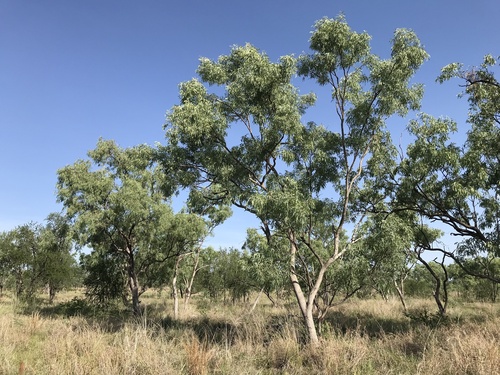
Eucalyptus microtheca
Coolabah, Coolibah, Flooded Box
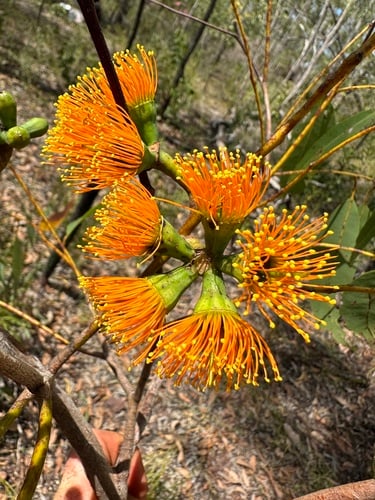
Eucalyptus miniata
Darwin Woolybutt, Manowan, Northern Woollybutt
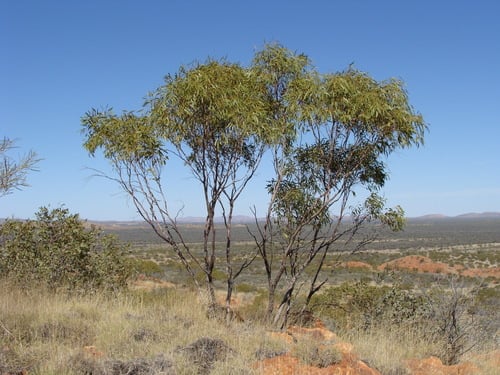
Eucalyptus normantonensis
Normanton Box
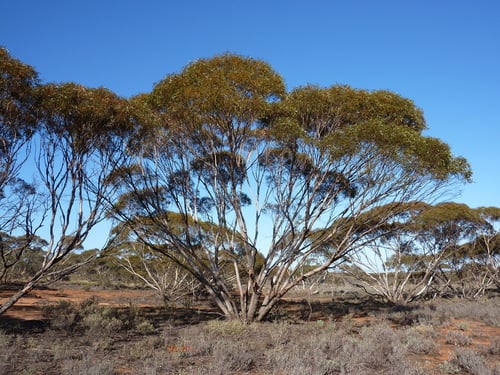
Eucalyptus oleosa
Giant Mallee, Great Mallee, Red Mallee
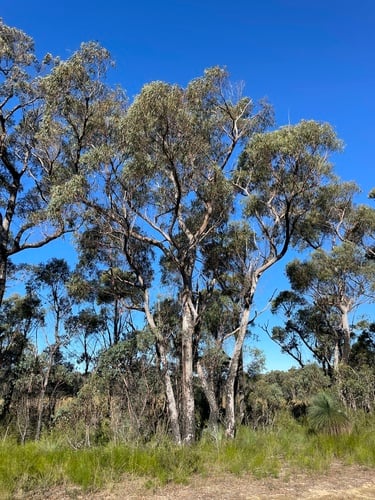
Eucalyptus olida
Strawberry gum
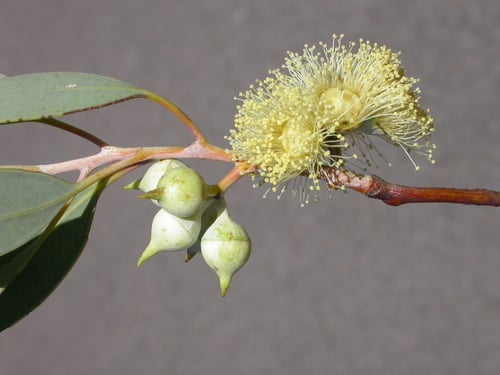
Eucalyptus oxymitra
Sharp-capped Mallee, Blue Mallee