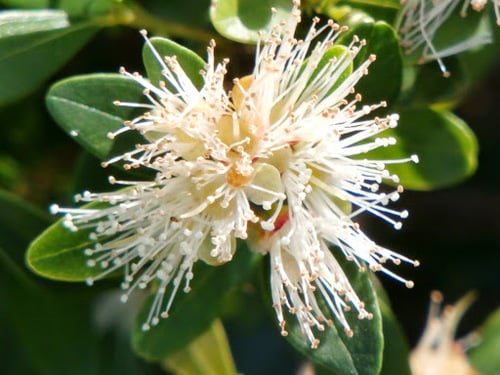
Eucalyptus robusta
Sm.
Swamp mahogany
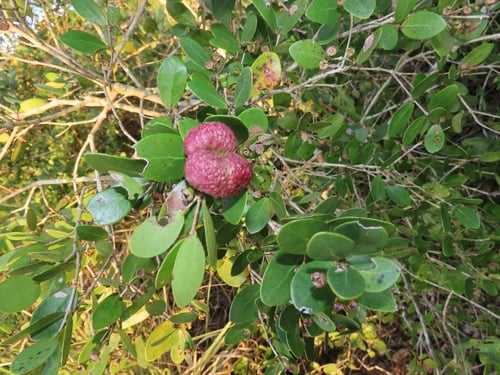
iNaturalist· cc-by-nc
(c) Scott W. Gavins, some rights reserved (CC BY-NC), uploaded by Scott W. Gavins
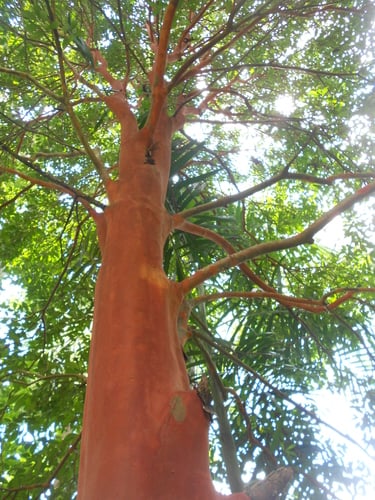
iNaturalist· cc-by-sa
(c) Greg Tasney, some rights reserved (CC BY-SA), uploaded by Greg Tasney
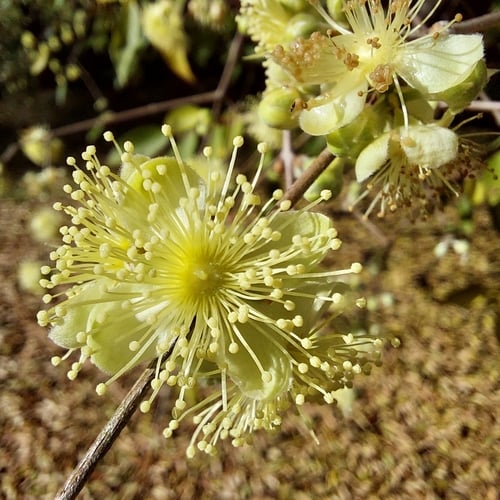
iNaturalist· cc-by
(c) Jay Horn, some rights reserved (CC BY), uploaded by Jay Horn
Summary
Source: WikipediaEucalyptus robusta, commonly known as swamp mahogany or swamp messmate, is a tree native to eastern Australia. Growing in swampy or waterlogged soils, it is up to 30 m (100 ft) high with thick spongy reddish-brown bark and dark green broad leaves, which help form a dense canopy. The white to cream flowers appear in autumn and winter. The leaves are commonly eaten by insects and are a food item for the koala. It is an important autumn-winter flowering species in eastern Australia and has been planted extensively in many countries around the world. Its timber is used for firewood and in general construction.
Description
A tree. It grows 30 m tall. The bark is rough and fibrous. The fruit are 1.5 cm long by 1 cm wide. They have
This description is brief — help expand it
Edible Uses
No edible uses are known beyond the gum.
Medicinal Uses
The tree has significant antimalarial activity. Leaf infusions are used in Africa and China to treat malarial fever, and in Mauritius and Réunion the leaves are prepared as baths, inhalations, and infusions to treat fever, colds, coughs, and influenza. Inhalation is also recommended for asthma and sinusitis, and infusions are taken for diabetes. Leaf decoctions are used in baths to treat stiffness, rheumatism, and epilepsy. In Madagascar, a handful of buds is rubbed and squeezed, and the sap applied to the nostrils to relieve headache. The essential oil has shown antibacterial and antifungal activity. Ethanol leaf extracts have shown antioxidant activity, and phenolic compounds active against the malaria-causing protozoan Plasmodium berghei have been isolated from the leaf.
Known Hazards
Citronellal, an essential oil found in most Eucalyptus species is reported to be mutagenic when used in isolation. In large doses, oil of eucalyptus, like so many essential oils has caused fatalities from intestinal irritation. Death is reported from ingestion of 4 - 24 ml of essential oils, but recoveries are also reported for the same amount. Symptoms include gastroenteric burning and irritation, nausea, vomiting, diarrhoea, oxygen deficiency, ,weakness, dizziness, stupor, difficult respiration, delirium, paralysis, convulsions, and death, usually due to respiratory failure.
Distribution
It is a tropical plant.
Where It Grows
Africa, Asia, Australia*, Central America, China, East Africa, Gabon, Ethiopia, Madagascar, Mauritius, Pakistan, Reunion, Tanzania, Uganda,
Cultivation
A plant of the lowland subtropics, remarkably, swamp mahogany adapts to a wide variety of conditions, from equatorial regions with maximum temperatures of about 35°c, to more temperate climates where it can endure frost, provided the frosts are not severe. It grows naturally at elevations up to 100 metres in areas where the mean maximum temperature in the hottest month is 30 - 32°c, and the mean minimum of the coldest month is about 3 - 5°c. Throughout its native range, from 5 to 10 light frosts occur each year. It has proved to be very adaptable in the tropics, where it can grow from sea level to elevations of 1,100 metres with a mean annual rainfall that ranges from 1,000 - 6,350 mm. Requires a sunny position. Succeeds on a range of soils, but prefers stiff clays and leached sandy loams. The tree is exceedingly tolerant to prolonged flooding, so it is extensively planted in swampy areas and along rivers. Tolerant of very acid soils. Trees start flowering when they are 3 - 5 years old. Seed dispersal is mainly by wind. The tree regenerates freely, and dense thickets of saplings can be found near old stands. A fast growing tree, it has reached a height of 27 metres in 15 years from seed in tropical plantations. The annual growth in height is usually 1.8 - 2.4 metres during the first few years, slowing down to 1.5 - 1.8 metres later. The plant grows well in plantations on good sites, but because of its ability to grow on both poorly drained and draughty locations, it is usually planted on adverse sites. It regenerates in areas flooded with fresh water, and its roots appear to be able to penetrate the heavy clays found in these conditions to reach the aerated soils below. The growth habit also helps it to establish on difficult but not necessarily flooded soils in localities widely different from its normal habitat. The tree can send out aerial roots from its trunk. Plants coppice well up to the age of 25 years. It recovers well from fire, sending out shoots from relatively small branches a few centimetres in diameter. Under optimal conditions, the tree begins flowering by the end of its third growing season. More commonly, trees begin flowering when they are 5 years old. In tropical areas, such as Hawaii and Puerto Rico, flowers may appear at almost any time of the year. Planted seedlings are susceptible to competition and shading, and generally require two weedings in the first six months. The length of rotation is largely determined by the product desired. For fuel wood, the tree is sometimes grown in plantations on a 4 - 5 year rotation; for pulpwood an 8 - 10 year rotation is appropriate; whilst saw logs can be produced in plantations or natural stands using 30 - 60 year rotations. Most E. Robusta plantations are regenerated from coppice shoots. The leaves are aromatic and, when crushed, have a spicy, resinous odour. Eucalyptus species have not adopted a deciduous habit and continue to grow until it is too cold for them to do so. This makes them more susceptible to damage from sudden cold snaps. If temperature fluctuations are more gradual, as in a woodland for example, the plants have the opportunity to stop growing and become dormant, thus making them more cold resistant. A deep mulch around the roots to prevent the soil from freezing also helps the trees to survive cold conditions. The members of this genus are remarkably adaptable however, there can be a dramatic increase in the hardiness of subsequent generations from the seed of survivors growing in temperate zones. Eucalyptus monocultures are an environmental disaster, they are voracious, allelopathic and encourage the worst possible attitudes to land use and conservation. Flowering Time: Early summer, Early spring, Late summer, Late spring, Mid summer, Mid spring(Mid Winter Blooms repeatedly). Blooming Color: White(Pale Pink White/Near White). Spacing: over 40 ft. (12 m). Drought-tolerant; suitable for xeriscaping.
Propagation
Surface sow seed in a sunny position and keep the compost moist at all times. High-altitude species benefit from 6–8 weeks of cold stratification at 2°c. Germination can occur in as little as 4 days but may take a month or more in cooler conditions. Pot seedlings into individual pots as soon as the second set of seed leaves appears — delay risks poor establishment. Seedlings are ready for field planting when 25–30cm tall, typically after 3–4 months. Seed remains viable for a long time. Vegetative propagation by grafting and rooting stem cuttings has been achieved with young trees but is not a common method.
Other Uses
The trunk gum contains about 30% tannin, the bark over 8%, and dried leaves yield up to 41% tannin. The essential oil yield from leaves is 1.7%, with key constituents including piperitone, rho-cymene, linalool, 1,8-cineole, terpinen-4-ol, citronellyl acetate, and alpha-terpinol. The heartwood is pale red when freshly cut, turning orange-red or red-brown with age, clearly demarcated from the up to 5cm wide pale brown sapwood. The grain is interlocked with a coarse texture; quartersawn surfaces sometimes show a ribbon figure of light and dark stripes. The wood is fairly heavy, moderately hard, strong, and durable in moist conditions. It resists fungi, most insects including marine borers, and is moderately resistant to termites. High shrinkage combined with interlocked grain demands careful drying — air drying to below 30% moisture content before kiln drying avoids serious degrade. The wood is not stable in service but works well and takes a good polish. It is somewhat abrasive and planing is best done at slow speeds with a cutting angle of 20°. Gummy exudates can clog saws. Pre-boring is necessary before nailing to prevent splitting. The wood turns well and accepts paint and wax satisfactorily, though gluing is fairly difficult and steam-bending is not suitable. It is used for general construction, poles, fencing, wharf and bridge work, pallets, house siding, flooring, furniture, interior trim, and panelling. Its strength and durability also make it suitable for mine props, railway sleepers, fence posts, stakes, and gates — the stakes last well in the ground and can be driven repeatedly without splitting. The timber can be used for pulpwood, though the pulp is dark reddish-brown and inferior to that of some other eucalyptus species. The wood is an excellent fuel and makes good charcoal, with an energy value of 19,600–20,500 kJ/kg. The tree is used in reforestation and dune stabilization, and is planted in coastal shelterbelts. Though intolerant of salt spray it is quite wind-firm, often used as a windbreak despite becoming deformed under continuous wind exposure. Like other eucalyptus, its rapid growth and high water use make it effective for lowering the water table and drying wet sites; this species has been used successfully to drain swampy ground.
Synonyms
Also Known As
Swamp Mahogany, Eucalyptus Gum, Blue Gum Eucalyptus
References (1)
- World Checklist of Useful Plant Species 2020. Royal Botanic Gardens, Kew