Syzygium aqueum
(Burm.f.) Alst.
Watery rose apple
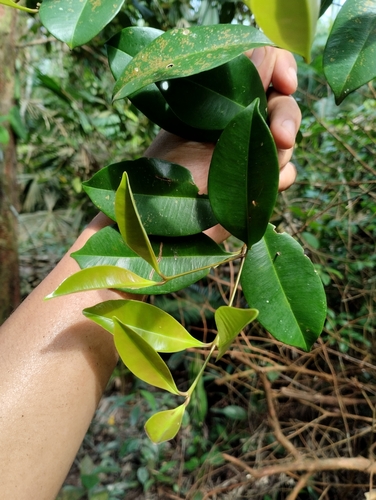
iNaturalist· cc-by-nc
(c) Sachin, some rights reserved (CC BY-NC), uploaded by Sachin
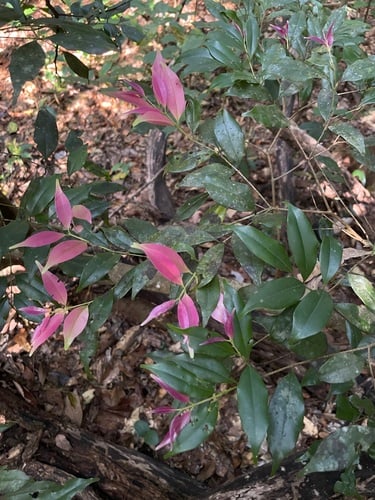
iNaturalist· cc-by-nc
(c) Maje Egento, some rights reserved (CC BY-NC)
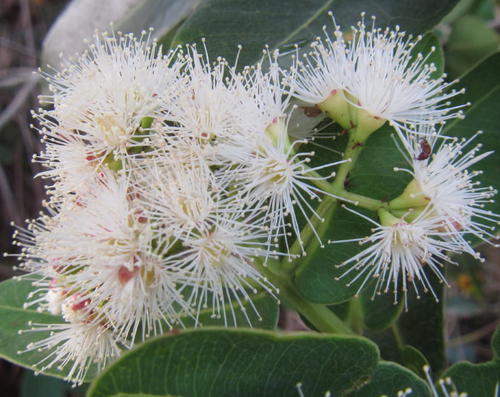
iNaturalist· cc-by-nc
(c) Nur Azleen Jamaluddin, some rights reserved (CC BY-NC)
Summary
Source: WikipediaSyzygium aqueum is a species of brush cherry tree. Its common names include watery rose apple, water apple and bell fruit, and jambu in Malay and several Indian languages. The tree is cultivated for its wood and edible fruit. The fruit is a fleshy, whitish-pinkish to yellowish-pinkish or red berry which is bell-shaped, waxy and crisp. Syzygium aqueum is native to tropical Asia and Queensland. The tree requires heavy rainfalls and can survive in tropical habitats, up to 1600m above sea level. In the Philippines, it is locally known as tambis and is often confused with macopa (Syzygium samarangense). The wood is durable and suitable for making tools. The bark of the tree is sometimes used in herbal medicines. It is grown in orchards and gardens, and parks as an ornamental plant. The leaves are edible and are sometimes used to wrap food. The fruit has a delicate, slightly sweet flavor reminiscent of apples, with a crisp, watery texture similar to the inside of a watermelon. It is a staple of Southeast Asian fruit stands, where it is inexpensive while in season. It does not bruise easily and may be preserved for months in a household refrigerator.
Description
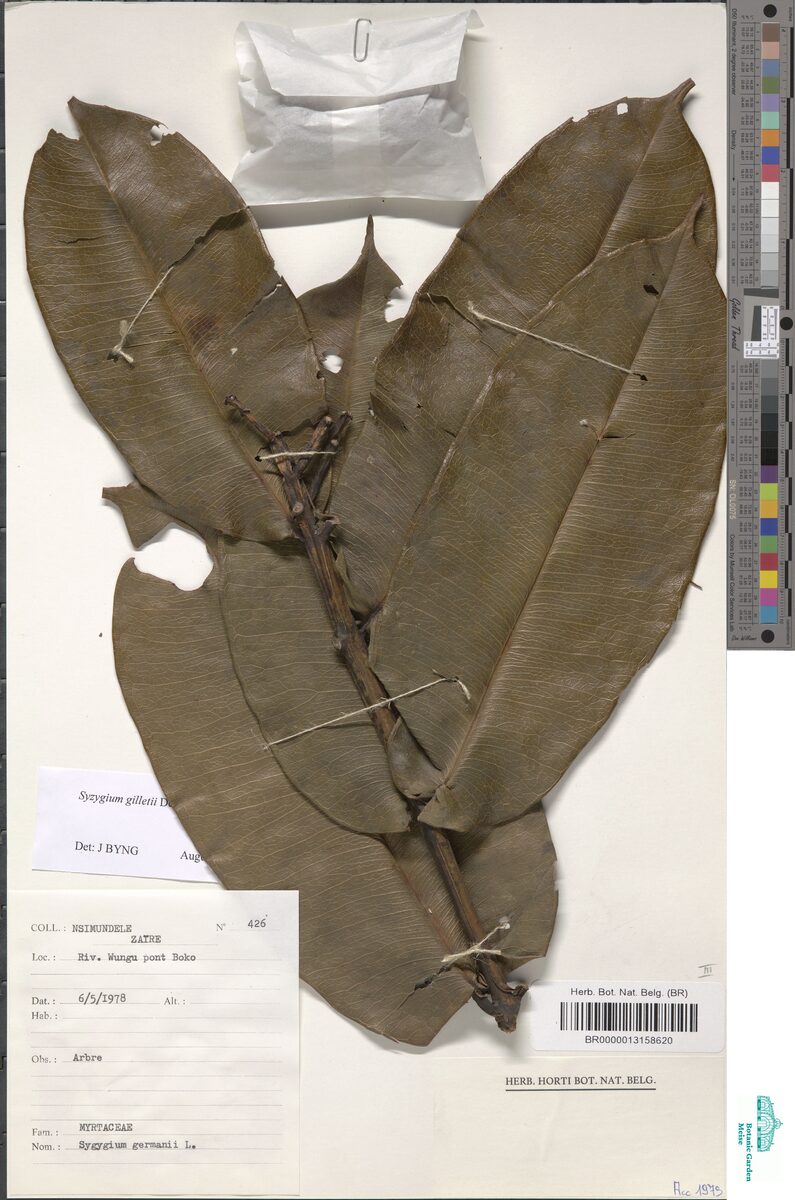
A shrub or small tree. It mostly occurs as just a small shrub with branches near the base. It is 5-8 m tall. But it can occur as a tree up to 10-30 m high with a short crooked trunk. The trunk can be 70 cm across. The twigs are angular and carry simple opposite leaves. The leaves are somewhat narrow and pointed at both ends and they clasp the stem without a stalk. They are stiff. They are from 5 to 23 cm long by 6 cm wide. They have a heart shaped base. The leaves have many oil dots. The flowers are yellowish green. They are about 3 cm across. The flowers occur in many flowered clusters in the angles of leaves. They can also be on the ends of branches and on side shoots from stems. Flowers and fruit are slightly scented. The fruit is a fleshy yellow, white or red berry which is bell shaped. The fruit is about 3-5 cm across. It has a crater in the end with a long thread in it. The fruit is waxy and crisp and is often seedless. When seeds occur there can be one or more seeds. The fruit is edible. The fruit vary a lot and so presumably does the food composition.
Edible Uses
Fruit - usually eaten raw, they can also be made into a syrup. Crunchy, crisp and very juicy, the fruit is often seedless. Mildly fragrant with a sweetish but mild flavour. They are eaten raw to quench the thirst. Superior forms are nice when sliced into salads. The broadly campanulate fruit is about 25mm x 25mm. The fruits have a thin skin and are delicate.
Traditional Uses
The fruit are eaten raw. They are also used for drinks or syrup.
This uses section is brief — help expand it
Medicinal Uses
Various parts of the tree are used in traditional medicine, and some have in fact been shown to possess antibiotic activity. The dried leaves are eaten with vegetables, or the fresh leaves are eaten raw, as a treatment for malaria and pneumonia. An infusion of the leaves is used in the treatment of stomach aches and dysentery.
Distribution
A tropical plant. It occurs in many tropical countries. It suits the hot, wet tropical lowlands. In grows in lower montaine forest. It grows from sea level to 1600 metres near the equator. It grows well in wet places but needs a well drained soil. They can grow in poor alkaline soils. They are found in Samar in the Philippines growing in areas of shrub and forest at low and medium altitudes. Plants are sensitive to frost. It suits hardiness zones 10-12.
Where It Grows
Asia, Australia, Bahamas, Bangladesh, Bermuda, Bougainville, Brazil, British Indian Ocean Terr., BIOT, Cambodia, Central America, China, Cuba, East Timor, Ghana, Guatemala, Guianas, Hawaii, Honduras, India, Indochina, Indonesia, Jamaica, Malaysia, Maldives, Mexico, Myanmar, Pacific, Panama, Papua New Guinea, PNG, Peru, Philippines, Puerto Rico, SE Asia*, Singapore, Solomon Islands, South America, Sri Lanka, Suriname, Tanzania, Thailand, Timor-Leste, Torres Strait, Trinidad, USA, Vanuatu, Vietnam, West Africa, West Indies,
Cultivation
Trees can be grown fairly easily from cuttings but can also be grown by air layering or budding. Buds do not always continue to grow successfully. A spacing of 6-8 metres between trees is suitable. Where seeds occur, plants can be grown from fresh seed. Fruit from these plants can be more oily and acidic. It can be grown as a hedge with heavy pruning.
Propagation
Seeds lose their viability quickly and should be sown fresh from the fruit. Air layering is a simple method of propagation. Cuttings root easily. Budding. The buds do not always continue to grow successfully.
Other Uses
Some plant parts are astringent because of the presence of tannins. The wood is reddish and hard. The bole is generally too small for commercial exploitation, but when large enough makes a useful structural timber. We do not have any more specific information for the wood of this species, but the various species of Syzygium tend to have somewhat similar timber. The general description of syzygium timber is as follows:- The heartwood is a golden brown, greyish brown or brown, with pink or purplish glints; it is not clearly demarcated from the 1 - 4cm wide band of sapwood. The texture is fine; the grain slightly interlocked, sometimes wavy or irregular; there are resin deposits. The wood is heavy; moderately hard; somewhat durable, being moderately resistant to fungi and termites, but susceptible to dry wood borers. It seasons slowly, with a high risk of checking and distortion; once dry it is moderately stable in service. It works well with ordinary tools, nailing and screwing are good so long as the wood is pre-bored; gluing is correct. The wood is used for musical instruments, tool handles, furniture components, ship building, heavy carpentry, flooring, joinery etc.
Production
Fruiting is seasonal but there can be 2 or 3 crops a year. In the southern hemisphere flowering is often about October with fruit from October to January. Fruit develop quickly. Fruit mature in 30-40 days.
Other Information
It is moderately common in lowland areas of Papua New Guinea and suits drier areas than Malay apple. It is cultivated.
Nutrition
| Part | Moisture | kJ | kcal | Protein | Vit A | Vit C | Iron | Zinc |
|---|---|---|---|---|---|---|---|---|
| Fruit | 87 | 189 | 46 | 0.6 | — | 4 | 1.1 | — |
| Fruit | 95 | 70 | 17 | 0.8 | — | 16.7 | 0.2 | — |
Synonyms
Also Known As
Bell fruit, Bogwia, Chom pu pa, Chomphuu-saarek, Chompoo, Dieng-sho-liwa, Gulaabijaamichettu, Gulaabijaamikaayalu, Jambo-branco, Jambu aek, Jambu air, Jambu ayer mawar, Jambu ayer, Jambu darsono, Jambu madu, Jambu uwer, Jambu wer, Jan buroalu, Makopang, Moimbakam, Pani jam, Pini jambu, Pohon jambu mawar, Pomarrosa blanca, ambis, Sangop, Wal jambu, Water apple
References (75)
- Watery rose apple references Syzygium aqueum
- AAK, 1980, Bertanam Pohon Buah-buahan. Penerbitan Yayasan Kanisius, Jogyakarta. p 17
- Ambasta, S.P. (Ed.), 2000, The Useful Plants of India. CSIR India. p 613
- Ann. Roy. Bot. Gard. (Peradeniya) 11:204. 1929
- Argent, G et al, nd, Manual of the Larger and More important non Dipterocarp Trees of Central Kalimantan Indonesia. Volume 2 Forest Research Institute, Samarinda, Indonesia. p 468
Show all 75 references Hide references
- Arora, R. K., 2014, Diversity in Underutilized Plant Species - An Asia-Pacific Perspective. Bioversity International. p 88
- Ashton, P., 1981. A revised handbook to the flora of Ceylon. 2:423-424
- Barrau, J., 1976, Subsistence Agriculture in Melanesia. Bernice P. Bishop Museu, Bulletin 219 Honolulu Hawaii. Kraus reprint. p 60
- Barwick, M., 2004, Tropical and Subtropical Trees. A Worldwide Encyclopedic Guide. Thames and Hudson p 391
- Blench, R., 2004, Fruits and Arboriculture in the Indo-Pacific Region. Indo-Pacific Prehistory Association Bulletin 24. (Taipei Papers Volume 2) p 40
- Bodkin, F., 1991, Encyclopedia Botanica. Cornstalk publishing, p 963
- Bonney, N., 2012, Edible Wild Native Plants for Southern Australia. p 110
- Bourke, R. M., Altitudinal limits of 230 economic crop species in Papua New Guinea. Terra australis 32.
- Borrell, O.W., 1989, An Annotated Checklist of the Flora of Kairiru Island, New Guinea. Marcellin College, Victoria Australia. p 113
- Brown, W.H., 1920, Wild Food Plants of the Philippines. Bureau of Forestry Bulletin No. 21 Manila. p 134
- Burkill, I.H., 1966, A Dictionary of the Economic Products of the Malay Peninsula. Ministry of Agriculture and Cooperatives, Kuala Lumpur, Malaysia. Vol 1 (A-H) p 976 (As Eugenia aquea)
- Chin, H.F., & Yong, H.S., 1996, Malaysian Fruits in Colour. Tropical press, Kuala Lumpur p 34 (As Eugenia)
- Cooper W & Cooper W T, 1994, Fruits of the Rain Forest. RD Press p 268
- Cooper, W. and Cooper, W., 2004, Fruits of the Australian Tropical Rainforest. Nokomis Editions, Victoria, Australia. p 359
- Coronel, R.E., 1982, Fruit Collections in the Philippines. IBPGR Newsletter p 8
- Cundall, P., (ed.), 2004, Gardening Australia: flora: the gardener's bible. ABC Books. p 1392
- Darley, J.J., 1993, Know and Enjoy Tropical Fruit. P & S Publishers. p 118
- Engel, D.H., & Phummai, S., 2000, A Field Guide to Tropical Plants of Asia. Timber Press. p 101
- Facciola, S., 1998, Cornucopia 2: a Source Book of Edible Plants. Kampong Publications, p 160
- French, B.R., 1986, Food Plants of Papua New Guinea, A Compendium. Asia Pacific Science Foundation p 240 (As Eugenia)
- French, B.R., 2010, Food Plants of Solomon Islands. A Compendium. Food Plants International Inc. p 234
- Garner, R.J., and Chaudhri, S.A., (Ed.) 1976, The Propagation of Tropical fruit Trees. FAO/CAB. p 335
- Giesen, W., 2013, Paludiculture: sustainable alternatives on degraded peat land in Indonesia (revised draft)
- Habitat Management Profile – Saibai Island. Appendix C. Preliminary List of Useful Plants for Saibai Island. p 117
- Hardwick, G., 2001, Economically Useful Plants for Northern Australia: Master Species List. Crusader eBooks.
- Hedrick, U.P., 1919, (Ed.), Sturtevant's edible plants of the world. p 296 (As Eugenia aquea)
- Hibbert, M., 2002, The Aussie Plant Finder 2002, Florilegium. p 296
- Hu, Shiu-ying, 2005, Food Plants of China. The Chinese University Press. p 578
- INFOODS:FAO/INFOODS Databases (As Eugenia aqua)
- Jones D, L, 1986, Ornamental Rainforest Plants in Australia, Reed Books, p 75, 340
- Leach, G. J., 1988, Bush Food Plants of the Blackwater and Karawari Rivers Area, East Sepik Province, Papua New Guinea. Science in New Guinea 14(2). p 105
- Lembaga Biologi Nasional, 1977, Buah-Buahan, Balai Pustaka, Jakarta. p 40
- Lepofsky, D., 1992, Arboriculture in the Mussau Islands, Bismarck Archipelago. Economic Botany, Vol 46, No. 2, pp. 192-211
- Lorenzi, H., Bacher, L., Lacerda, M. & Sartori, S., 2006, Brazilian Fruits & Cultivated Exotics. Sao Paulo, Instituto Plantarum de Estuados da Flora Ltda. p 459
- Owen, S., 1993, Indonesian Food and Cookery, INDIRA reprints. p 58
- Macmillan, H.F. (Revised Barlow, H.S., et al) 1991, Tropical Planting and Gardening. Sixth edition. Malayan Nature Society. Kuala Lumpur. p 309
- Martin, F. W., et al, 1987, Perennial Edible Fruits of the Tropics. USDA Handbook 642 p 42
- McMakin, P.D., 2000, Flowering Plants of Thailand. A Field Guide. White Lotus. p 107 (As Eugenia)
- Monsalud, M.R., Tongacan, A.L., Lopez, F.R., & Lagrimas, M.Q., 1966, Edible Wild Plants in Philippine Forests. Philippine Journal of Science. p 509
- Morton, Julia F., 1987, Fruits of Warm Climates. Creative Resources Systems, Inc. . p. 383
- Nathan, A., & Wong Y Chee, 1987, A Guide to Fruits and Seeds, Singapore Science Centre. p 58 (As Eugenia)
- Pasha, M. K. & Uddin, S. B., 2019, Minor Edible Fruits of Bangladesh. Bangladesh J. Plant Taxon. 26(2): 299–313
- Pawera, L., et al, 2020, Wild Food Plants and Trends in Their Use: From Knowledge and Perceptions to Drivers of Change in West Sumatra, Indonesia, Foods. 2020, 9, 1240
- Peekel, P.G., 1984, (Translation E.E.Henty), Flora of the Bismarck Archipelago for Naturalists, Division of Botany, Lae, PNG. p 409, 410
- Rajapaksha, U., 1998, Traditional Food Plants in Sri Lanka. HARTI, Sri Lanka. p 327
- Rukmana, R., 1977, Jambu Air. Penerbit Kanisius. Jogyakarta
- Schmid, R., A Resolution of the Eugenia-Syzygium Controversy (Myrtaceae). Amer. J. Bot. 59(4): 423-436. 1972
- Selvam, V., 2007, Trees and shrubs of the Maldives. RAP Publication No. 2007/12 p 154
- Singh, H.B., Arora R.K.,1978, Wild edible Plants of India. Indian Council of Agricultural Research, New Delhi. p 72
- Siong, K. H., 2003, Indigenous Fruits of Sarawak. Forest Department Sarawak. p 112 (As Eugenia aquea)
- Sujanapal, P., & Sankaran, K. V., 2016, Common Plants of Maldives. FAO & Kerala FRI, p 258
- Sukarya, D. G., (Ed.) 2013, 3,500 Plant Species of the Botanic Gardens of Indonesia. LIPI p 530
- Sukenti, K., et al, 2016, Ethnobotanical study on local cuisine of the Sasak tribe in Lombok Island, Indonesia. Journal of Ethnic Foods. 3 (2016) 189-200 p 198
- Suwardi, A. B., et al, 2020, Wild edible fruits generate substantial income for local people of the Gunung Leuser National Park, Aceh Tamiang Region. Ethnobotany Research & Applications 20:11
- Suwardi, A. B., et al, 2020, Ethnobotany and conservation of indigenous edible fruit plants in South Aceh, Indonesia. Biodiversitas Vol. 21, No. 5, pp 1850-1860
- Tankard, G., 1990, Tropical fruit. An Australian Guide to Growing and using exotic fruit. Viking p 105
- Terrell et al. 1986. Agric. Handb. no. 505.
- Topp, J. M. W., 1988, An Annotated Check List of the Flora of Diego Garcia, British Ocean Territory. Atoll Research Bulletin No. 313
- Townsend, K., 1994, Across the Top. Gardening with Australian Plants in the tropics. Society for Growing Australian Plants, Townsville Branch Inc. p 342
- USDA, ARS, National Genetic Resources Program. Germplasm Resources Information Network - (GRIN). [Online Database] National Germplasm Resources Laboratory, Beltsville, Maryland. Available: www.ars-grin.gov/cgi-bin/npgs/html/econ.pl (10 April 2000)
- van Wyk, B., 2005, Food Plants of the World. An illustrated guide. Timber press. p 361
- Verheij, E. W. M., and R. E. Coronel, eds. 1991. Edible fruits and nuts. In: E. W. M. Verheij & R. E. Coronel (eds.), Plant Resources of South-East Asia (PROSEA). 2:292
- Walter, A. & Sam C., 2002, Fruits of Oceania. ACIAR Monograph No. 85. Canberra. p 251
- Wiersema, J. H. & Leon, B., 2013, World Economic Plants. A Standard Reference CRC Press. 2nd Ed. p 671
- Williams, C.N., Chew, W.Y., and Rajaratnam, J.A., 1989, Tree and Field Crops of the Wetter Regions of the Tropics. Longman, p 137
- Wiriadinata, H., 1995, Ethnobotany of Economic Plants in the Baliem Valley, Jayawijaya, Irian Jaya, Indonesian Institute of Science, Bogor, Indonesia
- World Checklist of Useful Plant Species 2020. Royal Botanic Gardens, Kew
- Yaacob, O., & S. Subhadrabandhu, Oxford Univ. Press. 1995. The production of economic fruits in South-East Asia.
- Zawiah, N. & Othaman, H., 2012, 99 Spesies Buah di FRIM. Institut Penyelidikan Perhutanan Malaysia. p 220
- Zeven, A. C. & de West, J. M. J., 1982, Dictionary of cultivated plants and their regions of diversity. Wageningen. p 60 (As Eugenia aquea)