Synsepalum dulcificum
(Schumach. & Thonn.) Daniell
Sweet berry, Miracle fruit
iNaturalist· cc0
no rights reserved, uploaded by 葉子
iNaturalist· cc0
no rights reserved, uploaded by 葉子
iNaturalist· cc-by-sa
(c) Douglas Goldman, some rights reserved (CC BY-SA), uploaded by Douglas Goldman
Summary
Source: WikipediaSynsepalum dulcificum is a plant in the Sapotaceae family, native to tropical Africa. It is known for its berry that, when eaten, causes sour foods (such as lemons and limes) subsequently consumed to taste sweet. Common names for this species and its berry include miracle fruit, miracle berry, miraculous berry, sweet berry, and in West Africa, where the species originates, àgbáyun (in Yoruba), taami, asaa, and ledidi. The berry itself has a low sugar content and a mildly sweet tang. It contains a glycoprotein molecule, with some trailing carbohydrate chains, called miraculin. When the fleshy part of the fruit is eaten, this molecule binds to the tongue's taste buds, causing sour foods to taste sweet. At neutral pH, miraculin binds and blocks the receptors, but at low pH (resulting from ingestion of sour foods) miraculin binds proteins and becomes able to activate the sweet receptors, resulting in the perception of sweet taste. This effect lasts until the protein is washed away by saliva (up to about 30 minutes). The names miracle fruit and miracle berry are shared by Gymnema sylvestre and Thaumatococcus daniellii, which are two other species used to alter the perceived sweetness of foods.
Description
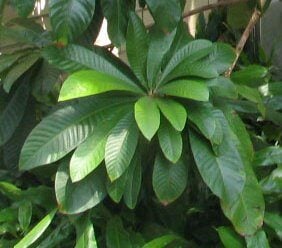
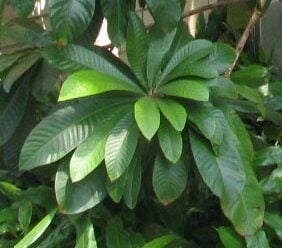
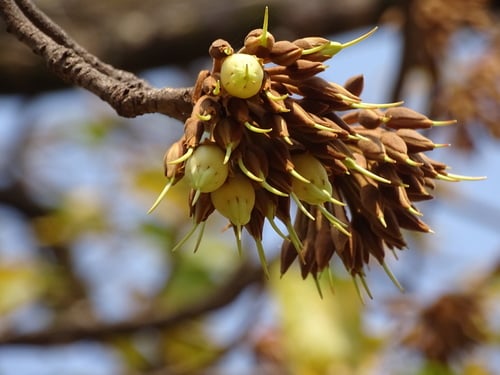
An evergreen bush. It grows to 6 m high in the humid tropics. The leaves are dark green and elongated. Forms with different leaf types are known. The leaves are alternate. The leaves are simple and entire and clustered near the tips of branches. The leaf blade can be 5-10 cm long by 1.5-4 cm wide. There are 8 pairs of side veins. The flowers are small (0.1 cm) and white. The fruit is a small bright red berry 2-3 cm long. It contains a single seed. The seed is large and the flesh is yellow. The fruit is edible but tasteless. It has an interesting side effect of making following foods taste sweet.
Edible Uses
The berries are eaten fresh and used to sweeten sour foods, including sour palm wine and fermented maize bread, or consumed alongside other foods to counter sour or bitter flavors.
Traditional Uses
The fruit itself is not sweet but after eating this fruit, sour fruit taste sweet. (This effect lasts for 30 minutes.) The berries are eaten fresh. The fruit is used to sweeten sour palm wine and fermented maize bread. The fruit can be eaten with others foods to counter sour or bitter flavours.
Distribution
It is a tropical plant. It cannot tolerate frost. Young plants are killed by frost while older plants may survive light frosts. It requires good sunlight. It must grow in acid soil. A pH of 4.5 to 5.8 is suitable. The soil needs to be well drained. It requires humid conditions. Plenty of regular watering is required. It grows naturally in tropical West Africa. In XTBG Yunnan.
Cultivation
It can be grown from seed or by using cuttings. Seed cannot be stored but need to be sown fresh from the fruit. Seeds need to be in a rich well drained soil. They should only be sown shallowly. Seeds germinate in 8-10 weeks. Seedlings grow very slowly in the first year. Cuttings only root slowly and are slow to establish.
Production
Plants grow slowly. Trees take about 4 years to start producing fruit. Flowers occur in flushes in several months of the year. Large numbers of fruit are produced.
Synonyms
Also Known As
Fruta-do-milagre, Irubelemo, Mobogolo, Nkpantung, Ogbegbanyo, Sotonso
References (36)
- Assogbadjo, A. E. et al, 2013, Specific Richness and Cultural Importance of Wild Edible Trees in Benin. Acta Hort. 979, ISHS 2013
- Atato, A., et al, 2010, Diversity of Edible Wild Fruit Tree Species of Togo. Global Science Books.
- Awodoyin, R.O., Olubode, O.S., Ogbu, J.U., Balogun, R.B., Nwawuisi, J.U. and Orji, K.O., 2015, Indigenous Fruit Trees of Tropical Africa: Status, Opportunity for Development and Biodiversity Management. Agricultural Sciences, 6, 31-41
- Baa-Poku, F. & Asante, I. K., 2020, Use of Neglected and Underutilized Crop Species (NUCS) in some farming communities in the Upper Afram and Upper Dayi River Basins in Ghana. International Journal of Technology and Management Research 5 (2): 48-63
- Burkill, H. M., 1985, The useful plants of west tropical Africa, Vol. 5. Kew. (Also as Synsepalum glycydorum)
Show all 36 references Hide references
- Codjia, J. T. C., et al, 2003, Diversity and local valorisation of vegetal edible products in Benin. Cahiers Agricultures 12:1-12
- Dalziel, J. M., 1937, The Useful plants of west tropical Africa. Crown Agents for the Colonies London. (Also as Synsepalum glycydorum)
- Darley, J.J., 1993, Know and Enjoy Tropical Fruit. P & S Publishers. p 131
- Facciola, S., 1998, Cornucopia 2: a Source Book of Edible Plants. Kampong Publications, p 229
- Hedrick, U.P., 1919, (Ed.), Sturtevant's edible plants of the world. p 607 (As Sideroxylon dulcificum)
- Hibbert, M., 2002, The Aussie Plant Finder 2002, Florilegium. p 295
- Jardin, C., 1970, List of Foods Used In Africa, FAO Nutrition Information Document Series No 2.p 22 (As Synsepalum glycydorum)
- Keay, R.W.J., 1989, Trees of Nigeria. Clarendon Press, Oxford. p 398 (As Synsepalum glycydorum)
- Kermath, B. M., et al, 2014, Food Plants in the Americas: A survey of the domesticated, cultivated and wild plants used for Human food in North, Central and South America and the Caribbean. On line draft. p 847
- Kiple, K.F. & Ornelas, K.C., (eds), 2000, The Cambridge World History of Food. CUP p 1815
- Latham, P & Mbuta, A., 2017, Useful Plants of Central Province, Democratic Republic of Congo. Volume 2. Salvation Army p 196
- Llamas, K.A., 2003, Tropical Flowering Plants. Timber Press. p 345
- Lorenzi, H., Bacher, L., Lacerda, M. & Sartori, S., 2006, Brazilian Fruits & Cultivated Exotics. Sao Paulo, Instituto Plantarum de Estuados da Flora Ltda. p 622
- Macmillan, H.F. (Revised Barlow, H.S., et al) 1991, Tropical Planting and Gardening. Sixth edition. Malayan Nature Society. Kuala Lumpur. p 307 (As Sideroxylon dulcificum)
- Martin, Franklin W., Carl W. Campbell and Ruth Ruberte. Perennial Edible Fruits of the Tropics: an Inventory. U. S. Department of Agriculture, Agriculture Handbook no. 642, 1987 p 61
- Meregini, O. A., 2005, Some endangered plants producing edible fruits and seeds in Southeastern Nigeria. Fruits, Vol. 60 pp 211-220
- Nkeoua, G. & Boundzanga, G. C., 1999, Donnees sur les produits forestieres non ligneux en Republique du Congo. FAO. p 37
- Nyadanu, D., et al, 2015, Agro-biodiversity and challenges of on-farm conservation: the case of plant genetic resources of neglected and underutilized crop species in Ghana. Genet. Resourc. Crop Evol. 62(7):
- Peters, C. R., O'Brien, E. M., and Drummond, R.B., 1992, Edible Wild plants of Sub-saharan Africa. Kew. p 184 (Also as Synsepalum glycydorum)
- Pharm. J. Trans. 11:445. 1852
- PROSEA handbook Volume 13 Spices. p 264
- Staples, G.W. and Herbst, D.R., 2005, A tropical Garden Flora. Bishop Museum Press, Honolulu, Hawaii. p 522
- Tankard, G., 1990, Tropical fruit. An Australian Guide to Growing and using exotic fruit. Viking p 80
- Ubom, R. M., 2010, Ethnobotany and Diversity Conservatioon in the Niger Delta, Nigeria. International Journal of Botany. 6(3): 310-322
- Uphof,
- USDA, ARS, National Genetic Resources Program. Germplasm Resources Information Network - (GRIN). [Online Database] National Germplasm Resources Laboratory, Beltsville, Maryland. Available: www.ars-grin.gov/cgi-bin/npgs/html/econ.pl (10 April 2000)
- van Wyk, B., 2005, Food Plants of the World. An illustrated guide. Timber press. p 356
- Vickery, M.L. and Vickery, B., 1979, Plant Products of Tropical Africa, Macmillan. p 40
- Vivien, J., & Faure, J.J., 1996, Fruitiers Sauvages d'Afrique. Especes du Cameroun. CTA p 323
- Wiersema, J. H. & Leon, B., 2013, World Economic Plants. A Standard Reference CRC Press. 2nd Ed. p 671
- World Checklist of Useful Plant Species 2020. Royal Botanic Gardens, Kew