Syagrus coronata
(Mart.) Becc.
Licuri palm
iNaturalist· cc-by-nc
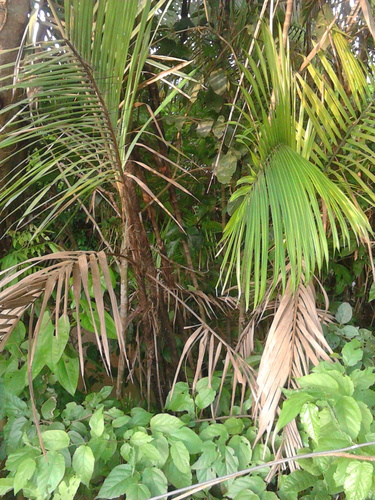
(c) Gustavo Sandres, some rights reserved (CC BY-NC), uploaded by Gustavo Sandres
iNaturalist· cc-by
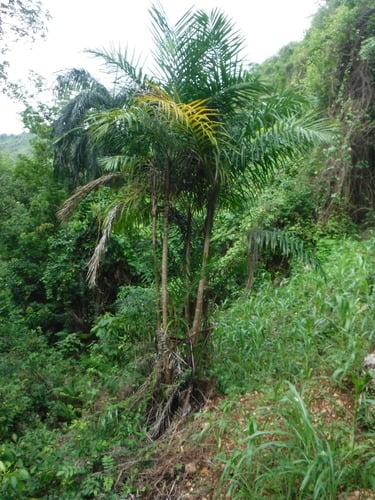
(c) Bruno de Medeiros, some rights reserved (CC BY)
iNaturalist· cc-by
(c) B. Phalan, some rights reserved (CC BY)
Summary
Source: WikipediaSyagrus coronata, commonly known as the ouricury palm, aricuri palm, or licuri palm, is a species of palm tree that is native to eastern Brazil, ranging from the southern part of the state of Pernambuco, into the state of Bahia, south to the Jequitinhonha River in the state of Minas Gerais. The tree can live for 30–150 years, though most only live for 8–10 years on average. It plays an important role in the diets of tropical seasonally dry forest animals.
Description
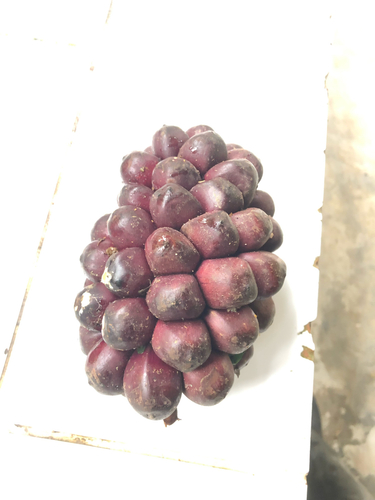
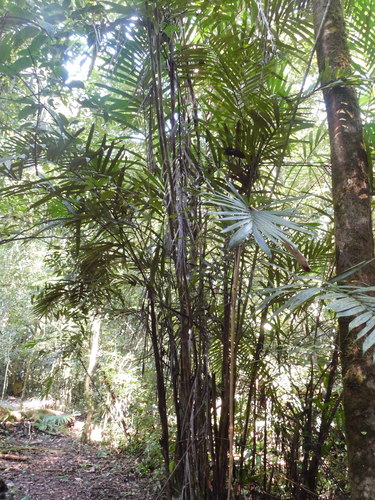
A slender palm. It grows 10-13 m tall. The trunk is 30 cm across. The old leaf bases remain on the trunk. The leaves are 3.3 m long. The leaves arch over. The leaves are like a cluster of feathers. They are bluish-green. The leaflets are in groups of 3-4. The leaflets are 30 cm long. They leaf bases remain hanging on the palm, forming a spiral pattern. A bundle of fruit hang down from the palm. The fruit are about 1.5 cm across and 2.6 cm long. They are orange and fleshy. The fruit is edible. The nut kernel is also edible and is rich in oil.
Edible Uses
The fruit is eaten raw by local peoples; it has a fibrous texture and slightly sweet flavour, measuring approximately 26mm long by 20mm wide. The apical bud, known as a palm heart, is cooked and eaten as a vegetable, though harvesting it kills the tree as it cannot produce side shoots. The seed is sometimes eaten. A non-drying oil extracted from the seed is used to make margarine. The pith of the stem is used to make bread.
Traditional Uses
The pulp of the fruit is eaten. The palm heart is edible. The nut kernel is edible. The nuts yield an edible oil. The starch is made into sago. It is used in bread.
Medicinal Uses
The oil from the seeds is useful for treating wounds caused by stingrays.
Distribution
It grows in subtropical and warm temperate places. It needs fertile and moist soils. It is damaged by frost. It will grow on calcareous soils. Plants do best in sunny positions. It suits plant hardiness zones 9-11. In Brisbane Botanical gardens.
Where It Grows
Asia, Australia, Brazil*, Chile, India, Peru, South America,
Cultivation
Plants are grown from seed. Seeds germinate rapidly in moist soils at 21°-25°C. They can take a year to germinate. They should be kept moist. Seed need to be planted fresh. Seedlings can be transplanted out after 3 years. Seed will store for 90 days in humid conditions.
Propagation
Sow seed as soon as it is ripe in a deeply shaded position in a nursery seedbed. Germination can be very slow, sometimes taking up to 12 months. Pot seedlings into individual containers once they reach 8–12cm tall. They grow slowly and may take a year or more before they are ready to plant out.
Other Uses
The plant is regarded as an indicator of fertile soils in the wild. A wax known as 'licuri wax' is obtained by scraping the leaves and used for making torches. Oil from the seed is also used for making soap. The dried leaves are used to make dusters, hats and brooms. The seeds are used in making rosaries. The wood is moderately heavy, hard and of low durability when exposed to the elements, limiting its use to local building construction. The plant plays an important role in the diets of tropical seasonally dry forest animals and is also grown as an ornamental.
Production
Plants grow very slowly. It flowers in warm wet seasons.
Notes
There are about 30 Syagrus species.
Nutrition
| Part | Moisture | kJ | kcal | Protein | Vit A | Vit C | Iron | Zinc |
|---|---|---|---|---|---|---|---|---|
| Fruit | 77.4 | — | 109 | 3.2 | 4.4 | — | — | — |
| Nut | 28.6 | — | 573 | 11.5 | — | — | — | — |
Synonyms
Also Known As
Alicuri, Aricuri, Licueizeiro, Nicuri, Ouricuri palm, Ouricury palm, Queen palm, Uricuri
References (24)
- Agric. Colon. 10:466. 1916
- Ambasta S.P. (Ed.), 2000, The Useful Plants of India. CSIR India. p 610
- Balick, M.J. and Beck, H.T., (Ed.), 1990, Useful palms of the World. A Synoptic Bibliography. Colombia p 125, 305,
- Bircher, A. G. & Bircher, W. H., 2000, Encyclopedia of Fruit Trees and Edible Flowering Plants in Egypt and the Subtropics. AUC Press. p 40 (As Arecastrum romanzoffiarum)
- Bussmann, R. W., (Ed.), 2020, Biodiverse food plants in the semiarid region of Brazil have unknown potential: A systematic review. Plos ONE 15(5): e0230936
Show all 24 references Hide references
- Facciola, S., 1998, Cornucopia 2: a Source Book of Edible Plants. Kampong Publications, p 31
- Gouldstone, S., 1983, Growing your own Food-bearing Plants in Australia. Macmillan p 126 (As Arecastrum romanzoffiarum)
- Grandtner, M. M. & Chevrette, J., 2013, Dictionary of Trees, Volume 2: South America: Nomenclature, Taxonomy and Ecology. Academic Press p 642
- Haynes, J., & McLaughlin, J., 2000, Edible palms and Their Uses. University of Florida Fact sheet MCDE-00-50-1 p 13
- Hedrick, U.P., 1919, (Ed.), Sturtevant's edible plants of the world. p 207 (As Cocos coronata)
- Henderson, A., Galeano, G and Bernal, R., 1995, Field Guide to the Palms of the Americas. Princeton. p 144
- Hunter, D., et al, 2019, The potential of neglected and underutilized species for improving diets and nutrition. Planta (2019) 250:709-729
- Janick, J. & Paul, R. E. (Eds.), 2008, The Encyclopedia of Fruit & Nuts. CABI p 158
- Johnson, D.V., 1998, Tropical palms. Non-wood Forest products 10. FAO Rome. p 95
- Jones, D.L., 1994, Palms throughout the World. Smithtonian Institution, Washington. p 51, 55, 359
- Kermath, B. M., et al, 2014, Food Plants in the Americas: A survey of the domesticated, cultivated and wild plants used for Human food in North, Central and South America and the Caribbean. On line draft. p 842
- Llamas, K.A., 2003, Tropical Flowering Plants. Timber Press. p 118
- Lorenzi, H., 2002, Brazilian Trees. A Guide to the Identification and Cultivation of Brazilian Native Trees. Vol. 01 Nova Odessa, SP, Instituto Plantarum p 303
- Lorenzi, H., Bacher, L., Lacerda, M. & Sartori, S., 2006, Brazilian Fruits & Cultivated Exotics. Sao Paulo, Instituto Plantarum de Estuados da Flora Ltda. p 91
- Oliviera V. B., et al, 2012, Native foods from Brazilian biodiversity as a source of bioactive compounds. Food Research International 48 (2012) 170-179
- Riffle, R.L. & Craft, P., 2003, An Encyclopedia of Cultivated Palms. Timber Press. p 457
- Wickens, G.E., 1995, Edible Nuts. FAO Non-wood forest products. FAO, Rome. p171
- Wiersema, J. H. & Leon, B., 2013, World Economic Plants. A Standard Reference CRC Press. 2nd Ed. p 668
- World Checklist of Useful Plant Species 2020. Royal Botanic Gardens, Kew