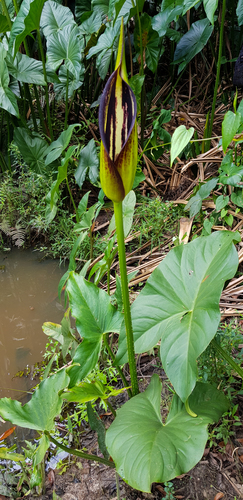
Amorphophallus lyratus
(Roxb.) Kunth.
Telinga potato
No photos yet for Amorphophallus lyratus
Sign in to contribute a photoDescription
Amorphophallus lyratus (Roxb.) Kunth is a tuberous herbaceous perennial in the arum family (Araceae), commonly known as the taro family. Native to the tropical regions of southeastern India, particularly around Chennai, it grows as a geophyte in seasonally dry habitats. The plant emerges from a solitary, rounded underground tuber (corm), which serves as its storage organ and is sometimes referred to locally as "Telinga potato" due to its edible nature. From this tuber, it typically produces a single large, deeply divided compound leaf on a tall petiole, giving it a striking palm-like or umbrella-like appearance. The inflorescence, which usually appears before the leaf, consists of a spathe surrounding a central spadix—a classic Amorphophallus structure that often emits an unpleasant odor to attract pollinating flies and beetles. Smaller and less imposing than its famous relative Amorphophallus titanum (Titan arum), this species still possesses the exotic, architectural beauty prized by aroid enthusiasts. It is seasonally dormant, with its leaf and inflorescence emerging at different times depending on environmental conditions.
Edible Uses
The plant is commonly known as Telinga potato (or Telinga potato) because of its edible underground tuber (corm). The round, solitary tuber serves as the main food source. Like many members of the Araceae (arum) family, it contains calcium oxalate crystals, which can cause irritation if consumed raw. Therefore, it must be properly prepared by boiling in several changes of water to remove the acrid compounds and make it safe and palatable. Once prepared, the tuber can be eaten as a starchy vegetable, similar to other edible aroids like elephant foot yam. It is considered a “famine food” or subsistence crop in some rural and tribal areas, providing carbohydrates during times of scarcity.
Traditional Uses
In southeastern India, particularly in regions around Chennai and other parts of Tamil Nadu, the tuber of Amorphophallus lyratus has long been utilized by local communities as both a food source and a medicinal plant. Known locally as Telinga potato, the corm is primarily valued as a subsistence or famine food. After thorough processing to remove its natural acridity and calcium oxalate content, it serves as a starchy vegetable in rural and tribal diets. In folk medicine, the tuber is traditionally employed for its digestive properties, often used to relieve stomach discomfort, aid digestion, and act as a mild carminative. Like many other species in the Amorphophallus genus, it is sometimes applied in local ethnobotanical practices for its potential anti-inflammatory and tonic effects, though species-specific documentation remains limited compared to more widely used relatives such as Amorphophallus paeoniifolius. Its use is mostly practical and localized rather than part of formalized Ayurvedic preparations.
Known Hazards
Contains oxalates; roots must be boiled multiple times in fresh water before consumption.
Distribution
A tropical plant. It grows near Chennai.
Where It Grows
Asia, India,
Notes
There are about 170-200 Amorphophallus species.
Synonyms
References (2)
- Hedrick, U.P., 1919, (Ed.), Sturtevant's edible plants of the world. p 51
- SHORTT (As Arum lyratum)