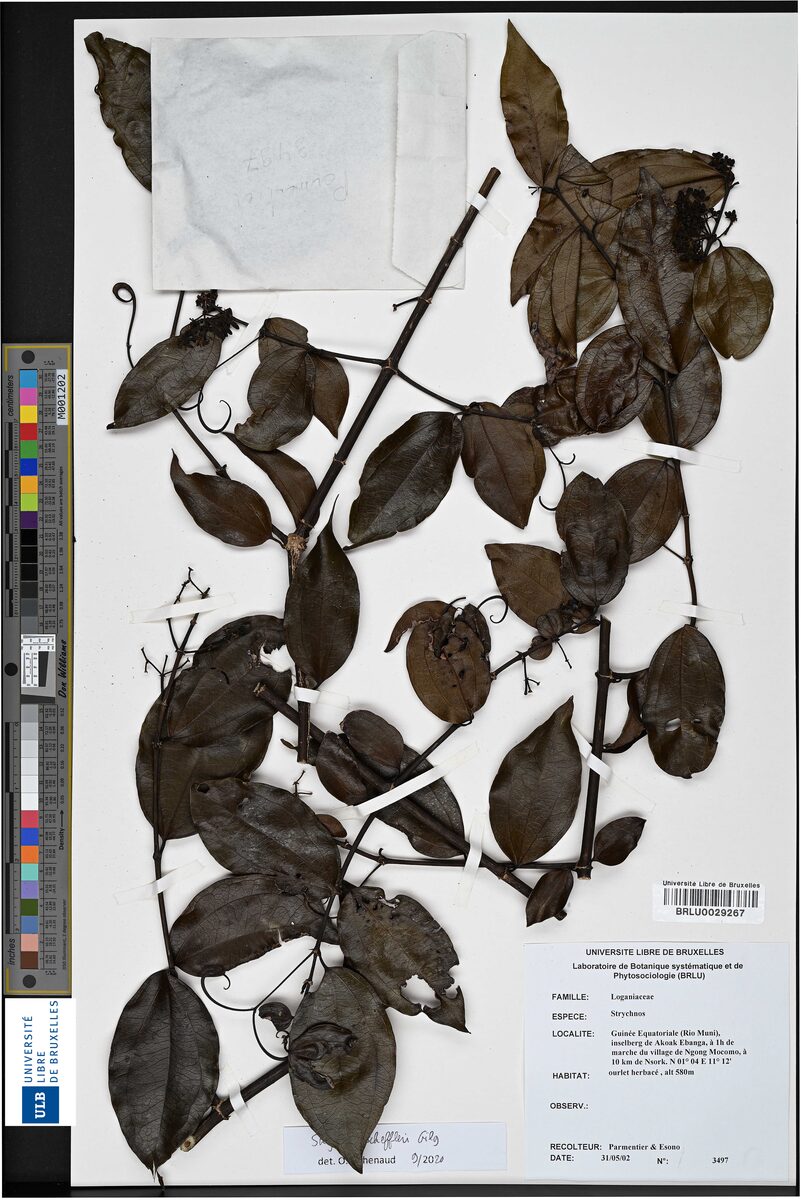
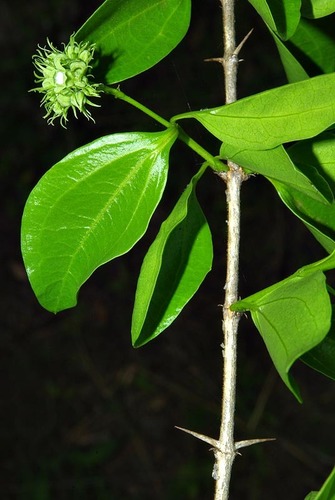
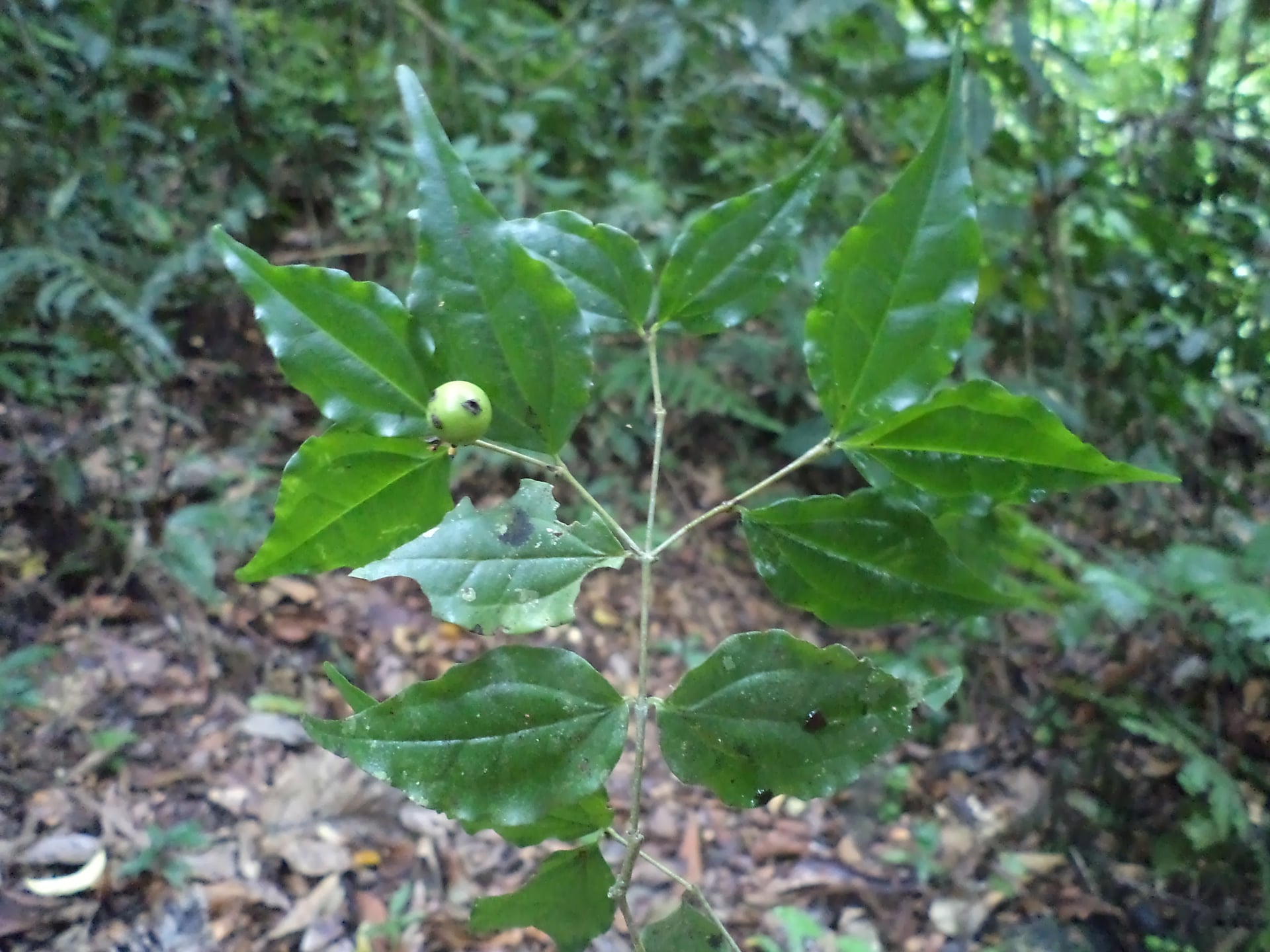
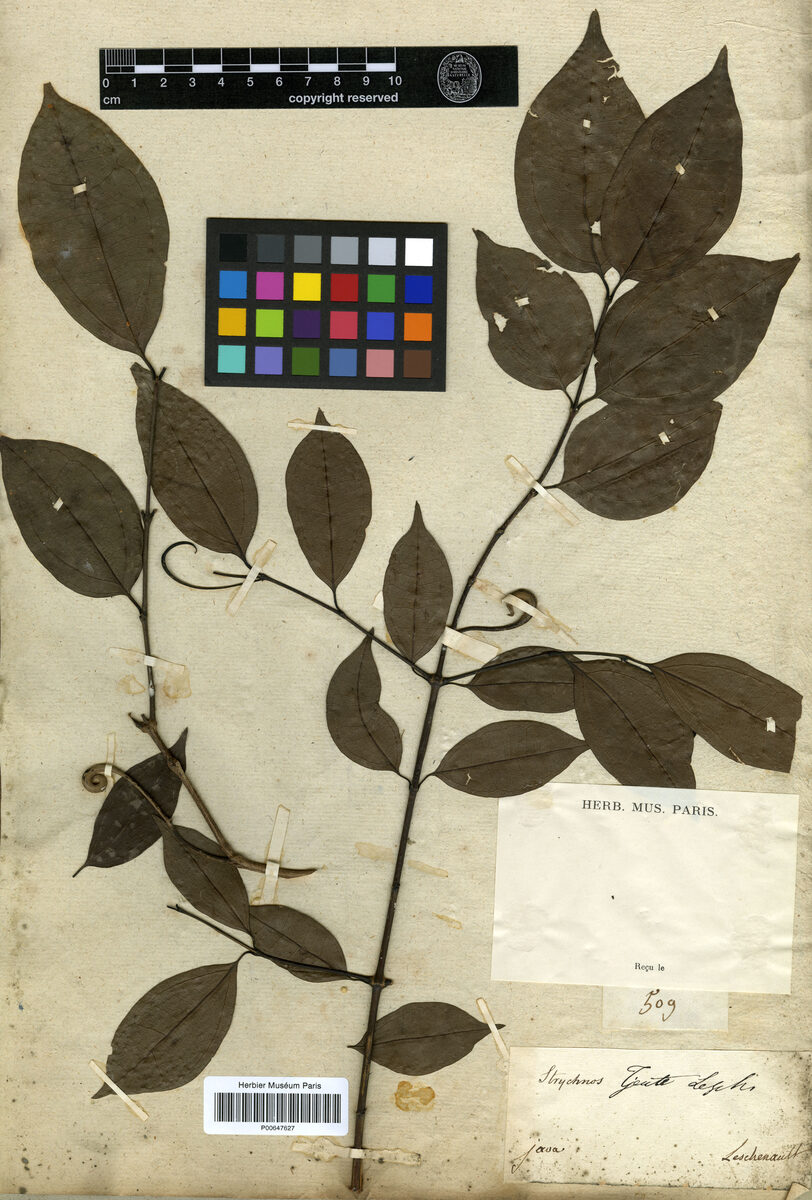
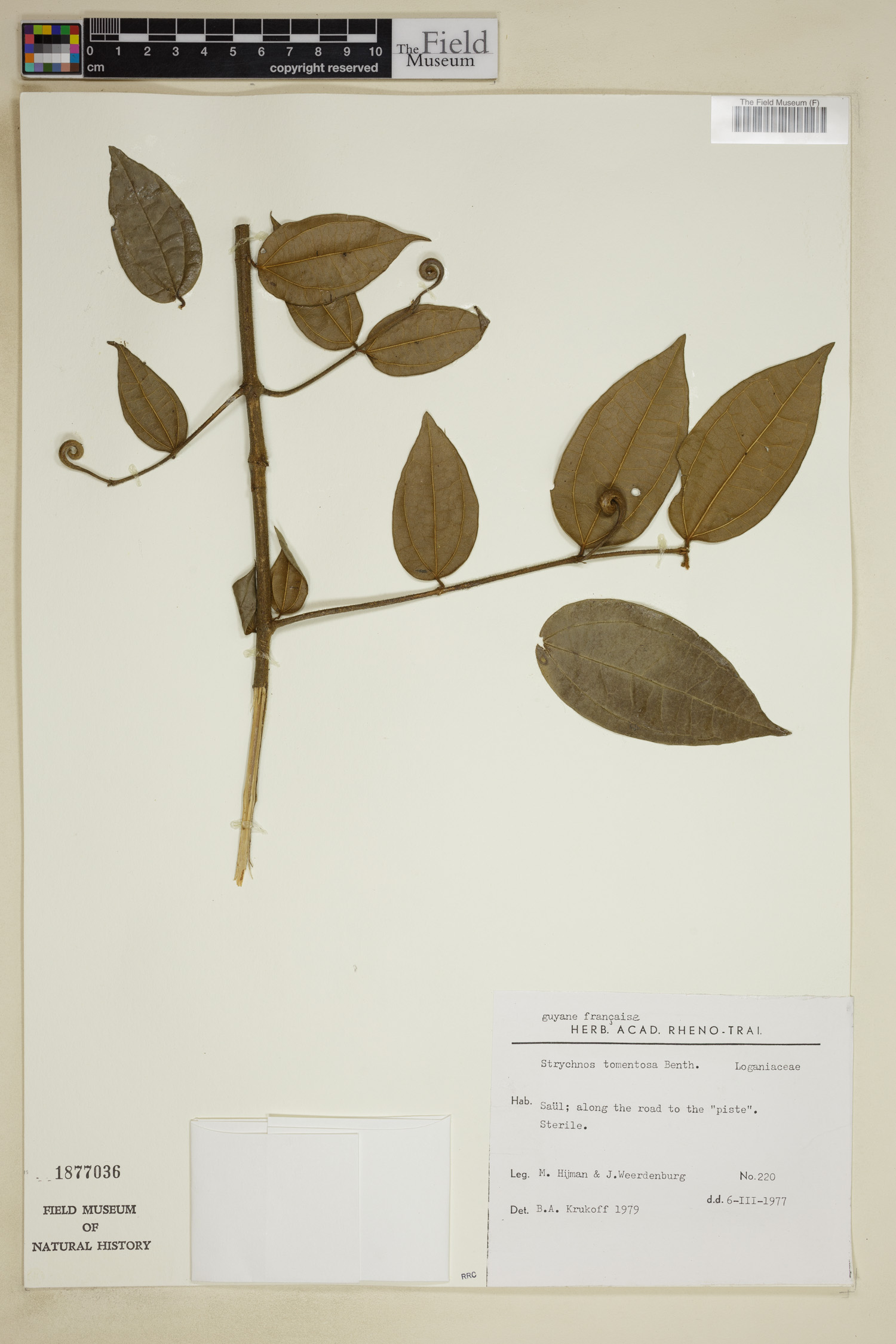
Strychnos nux-vomica
L.
Nux Vomica, Strychnine, Poison nut tree, Snake wood
iNaturalist· cc-by
(c) Siddarth Machado, some rights reserved (CC BY)
iNaturalist· cc-by-nc
(c) lanlin_lollipop, some rights reserved (CC BY-NC)
iNaturalist· cc-by-nc
(c) lanlin_lollipop, some rights reserved (CC BY-NC)
Summary
Source: WikipediaStrychnos nux-vomica, the strychnine tree, also known as nux vomica, poison fruit, semen strychnos, and quaker buttons, is a deciduous tree native to India and to southeast Asia. It is a medium-sized tree in the family Loganiaceae that grows in open habitats. Its leaves are ovate and 5–9 centimetres (2–3.5 in) in size. It is known for being the natural source of the extremely poisonous compound strychnine.
Description
A tree. It grows to 25 m tall. The small branches are slightly hairy. The leaf stalks is 0.5-1.5 cm long. The leaf blade is broadly oval and 5-18 cm long by 4-12.5 cm wide. It is papery. There are 3-5 veins from the base. The fruit is an orange berry. It is 2-4 cm across. There are 1-4 seeds.
Edible Uses
Fruit - raw. A white, bitter, sticky flesh. Much relished by children. The fruit is the size of a small orange. The seed is very poisonous.
Traditional Uses
CAUTION: The alkaloid Strychnine occurs in this plant and is very poisonous. The seeds are poisonous. The alkaloid strychnine is used in the distillation of country spirits. The fruit pulp is eaten.
Medicinal Uses
Parts are used in medicine and contain alkaloids.
Known Hazards
The seeds within the round, green to orange fruit of the tree are a major source of the highly poisonous, intensely bitter alkaloids strychnine and brucine. The seeds contain approximately 1.5% strychnine, and the dried blossoms contain 1.0%. However, the bark of the tree also contains brucine and other poisonous compounds. The strychnine-containing seeds have been used in arrow poison. The use of strychnine is highly regulated in many countries, and it is mostly used in baits to kill feral mammals. Most accidental poisoning is caused by breathing in the powder or by absorption through the skin.
Distribution
A tropical plant. It grows in deciduous forests and along riverbanks and shores. It grows up to 1,200 m above sea level. In Yunnan.
Where It Grows
Africa, Asia, Australia, Cambodia, China, Ghana, India, Indochina, Indonesia, Laos, Malaysia, Myanmar, SE Asia, Sri Lanka, Taiwan, Thailand, Vietnam, West Africa,
Cultivation
Plants can be grown from seeds.
Propagation
Seed - takes 70 - 120 days to germinate. The seeds are sown in nursery seedbeds and seedlings are transplanted to the field.
Other Uses
The seeds are sometimes used as beads to make necklaces. The seeds are used for dying cloth pale brown. The wood is hard and termite proof. It is used for agricultural implements and tool handles, cart wheels and fancy cabinet work.
Other Information
It is cultivated.
Notes
Parts are used in medicine. It contains alkaloids.
Also Known As
Goda kaduru, Kabaung, Kagra, Kar, Ma qian zi, Pnheav, Pohon bidara putih, Pohon kacang racun, Sleng, Theathankottai, Yetti
References (17)
- Abbiw, D.K., 1990, Useful Plants of Ghana. West African uses of wild and cultivated plants. Intermediate Technology Publications and the Royal Botanic Gardens, Kew. p 48
- Anderson, E. F., 1993, Plants and people of the Golden Triangle. Dioscorides Press. p 222
- Arinathan, V., et al, 2007, Wild edibles used by Palliyars of the western Ghats, Tamil Nadu. Indian Journal of Traditional Knowledge. 6(1) pp 163-168
- Bodkin, F., 1991, Encyclopedia Botanica. Cornstalk publishing, p 955
- Bremness, L., 1994, Herbs. Collins Eyewitness Handbooks. Harper Collins. p 131
Show all 17 references Hide references
- Burkill, H. M., 1985, The useful plants of west tropical Africa, Vol. 3. Kew.
- Cengel, D. J. & Dany, C., (Eds), 2016, Integrating Forest Biodiversity Resource Management and Sustainable Community Livelihood Development in the Preah Vihear Protected Forest. International Tropical Timber Organization p 120
- Cobley, L.S. (rev. Steele, W.M.) 2nd Ed., 1976, An Introduction to the Botany of Tropical Crops. Longmans. p 227
- Hedrick, U.P., 1919, (Ed.), Sturtevant's edible plants of the world. p 636
- Li Ping-tao, Leewenburg, A., Loganiaceae. Flora of China. p 325
- Mot So Rau Dai an Duoc O Vietnam. Wild edible Vegetables. Ha Noi 1994, p 254
- Sahni, K.C., 2000, The Book of Indian Trees. Bombay Natural History Society. Oxford. p 132
- Sp. pl. 1:189. 1753
- Sukarya, D. G., (Ed.) 2013, 3,500 Plant Species of the Botanic Gardens of Indonesia. LIPI p 529
- Vickery, M.L. and Vickery, B., 1979, Plant Products of Tropical Africa, Macmillan. p 92
- World Checklist of Useful Plant Species 2020. Royal Botanic Gardens, Kew
- Zeven, A. C. & de West, J. M. J., 1982, Dictionary of cultivated plants and their regions of diversity. Wageningen. p 79