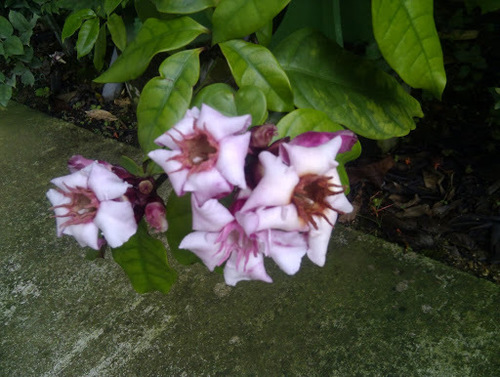
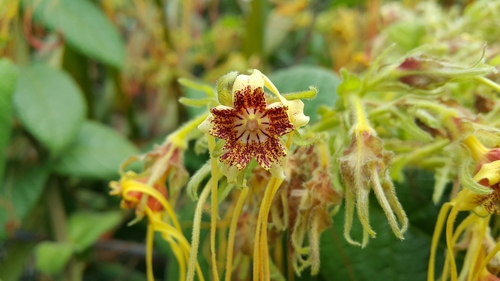
Strophanthus divaricatus
(Lour.) Hook. et Arn.
Goat-horns strophanthus
iNaturalist· cc-by-nc-sa
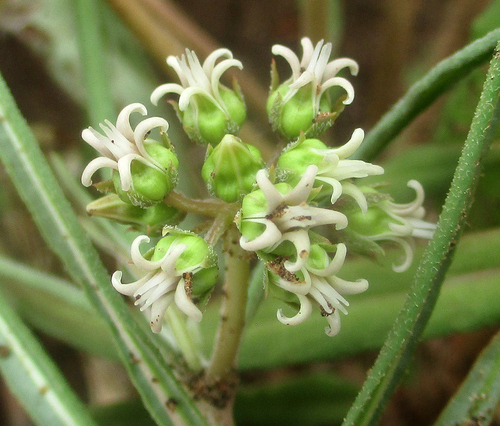
(c) Kai Yan, Joseph Wong, some rights reserved (CC BY-NC-SA)
iNaturalist· cc-by-nc
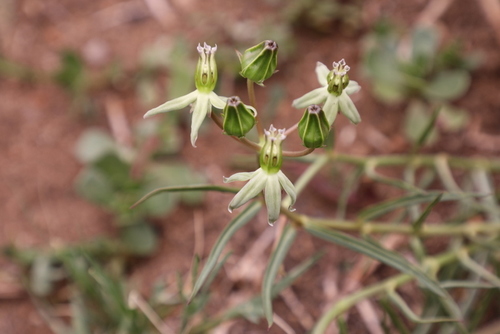
(c) Colin Chiu, some rights reserved (CC BY-NC)
Summary
Source: WikipediaStrophanthus divaricatus is a species of flowering plant in the family Apocynaceae. It is a liana or sarmentose shrub growing up to 4.5 m (15 ft) tall, with a trunk diameter of up to 4 cm (1.6 in). The specific epithet divaricatus means 'spreading at a wide angle'. The plant has been used medicinally: as a heart stimulant and in the treatment of snakebites. It is native to southern China and northern Vietnam.
Description
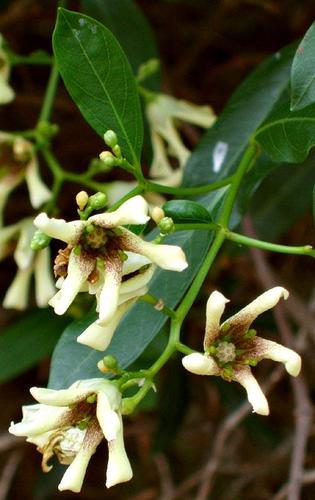
A woody climber or shrub. When it is pruned it produces stolons. It grows 4.5 m tall. The trunk can be 4 cm across. The leaves are 3-10 cm long by 205 cm wide. There are 3-15 flowers in a group. They have a yellow tube. The fruit are follicles 9-15 cm long by 2-4 cm wide. They are hard and woody.
Traditional Uses
CAUTION: Plants in this group are often poisonous. The poison is strophanthin. It affects the heart.
This uses section is brief — help expand it
Medicinal Uses
Parts of the plant are used as a heart stimulant and to treat snake bites.
Known Hazards
Plants in this group are often poisonous, containing strophanthin which affects the heart.
Distribution
A tropical plant. It grows in forest thickets in southern China between 100-1,000 m above sea level. In Yunnan
Where It Grows
Asia, China, Indochina, Indonesia, Laos, Myanmar, SE Asia, Vietnam,
Cultivation
Plants can be grown from seeds or cuttings,
Other Uses
The seeds are used as an insecticide.
Notes
There are 38 Strophanthus species. Parts of the plant are used as a heart stimulant and to treat snake bites.
Also Known As
Stropantus tanduk kambing
References (5)
- Bot. Beechey Voy. 199. 1837
- Burkill, I.H., 1966, A Dictionary of the Economic Products of the Malay Peninsula. Ministry of Agriculture and Cooperatives, Kuala Lumpur, Malaysia. Vol 2 (I-Z) p 2128
- Llamas, K.A., 2003, Tropical Flowering Plants. Timber Press. p 70
- Mot So Rau Dai an Duoc O Vietnam. Wild edible Vegetables. Ha Noi 1994, p 280
- Sukarya, D. G., (Ed.) 2013, 3,500 Plant Species of the Botanic Gardens of Indonesia. LIPI p 976