Sterculia rogersii
N. E. Br.
Common star-chestnut
iNaturalist· cc-by-nc
(c) Mashudu, some rights reserved (CC BY-NC), uploaded by Mashudu
iNaturalist· cc-by-nc
(c) Mashudu, some rights reserved (CC BY-NC), uploaded by Mashudu
iNaturalist· cc-by-nc
(c) Troos van der Merwe, some rights reserved (CC BY-NC), uploaded by Troos van der Merwe
Description
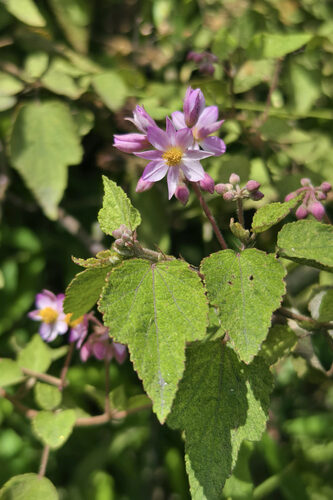
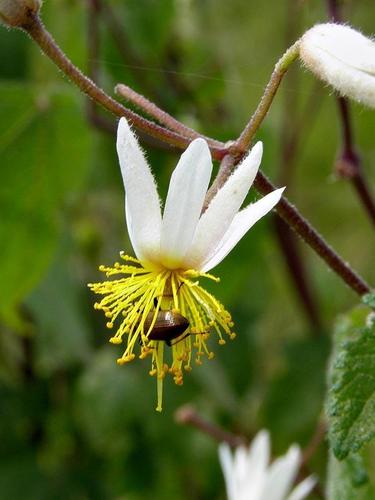
A dumpy tree. The trunk is swollen. It is often 3 m high but can be 8 m high. It usually branches near the base. The trunk is stout and shiny. The main branches are robust and grey. The leaves are alternate. They are on long wand like branches clustered at the ends. They are 2.5-6 cm long and often with 3-5 lobes. The lobes have a sharp point. They leaves are dark green above and greyish-green below. The flowers are separately male and female on the same tree. They are yellow-green streaked with red and 1.5 cm across. The fruit consists of 1-5 stalkless lobes or separate parts.
Edible Uses
The heartwood and seeds are eaten, particularly the heartwood in times of food shortage.
Traditional Uses
The heartwood is eaten in times of food shortage.
This uses section is brief — help expand it
Distribution
A tropical plant. It occurs in drier places. It is in hot, low-altitude areas. It is often in rocky places. It can grow in arid places.
Where It Grows
Africa, Botswana, East Africa, Eswatini, Mozambique, South Africa, Southern Africa, Swaziland, Zimbabwe,
Cultivation
Plants can be grown from seeds.
Notes
Also put in the family Sterculiaceae.
Also Known As
Chilussuane, Lilumbo, Luci, Sibhansi, Sibhosa, Squat sterculia, Ulumba, Ulumbu tree, Xissolobya
References (11)
- Long, C., 2005, Swaziland's Flora - siSwati names and Uses http://www.sntc.org.sz/flora/
- Palgrave, K.C., 1996, Trees of Southern Africa. Struik Publishers. p 598
- Palmer, E and Pitman, N., 1972, Trees of Southern Africa. Vol. 2. A.A. Balkema, Cape Town p 1487
- Peters, C. R., O'Brien, E. M., and Drummond, R.B., 1992, Edible Wild plants of Sub-saharan Africa. Kew. p 188
- Royal Botanic Gardens, Kew (1999). Survey of Economic Plants for Arid and Semi-Arid Lands (SEPASAL) database. Published on the Internet; http://www.rbgkew.org.uk/ceb/sepasal/internet [Accessed 11th June 2011]
Show all 11 references Hide references
- Ruiters-Welcome, A. K., 2019, Food plants of southern Africa. Ph.D. thesis. Univ. of Johannesburg p 77
- Schmidt, E., Lotter, M., & McCleland, W., 2007, Trees and shrubs of Mpumalanga and Kruger National Park. Jacana Media p 414
- Swaziland's Flora Database http://www.sntc.org.sz/flora
- van Wyk, B, van Wyk, P, and van Wyk B., 2000, Photographic guide to Trees of Southern Africa. Briza. p 293
- Welcome, A. K. & Van Wyk, B.-E., 2019, An inventory and analysis of the food plants of southern Africa. South African Journal of Botany 122 (2019) 136–179
- World Checklist of Useful Plant Species 2020. Royal Botanic Gardens, Kew