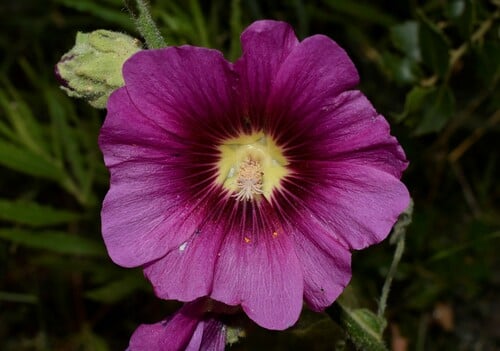
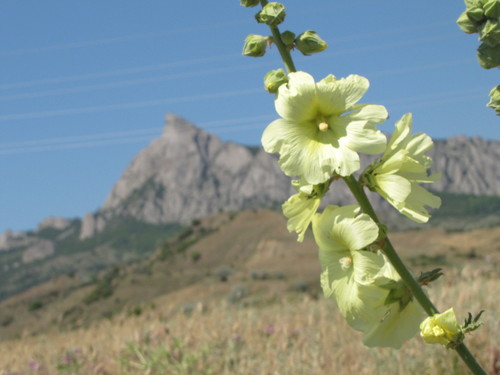
Hibiscus digitatus
Cav.
gbif· cc-by-nc
Bart Wursten
gbif· cc-by-nc
Joechang
gbif· cc-by-nc
Joechang
Description
A tropical shrub in the Malvaceae family with edible leaves.
This description is brief — help expand it
Edible Uses
In Bihar and Jharkhand roselle is also known as "kudrum" in local language. The bright red petal of the fruit is used for chutney which is sweet and sour in taste. In Saputara region (near Maharashtra/Gujarat MP border), roselle is called khate fule also called as 'ambade fule' by local tribal language. The khate fule leaves are mixed with green chillies, salt, some garlic to prepare a chutney and bhaji which is served with jowar (sorghum) or bajra (millet) made bakho (a flat bread). This is eaten by tribals as breakfast to start their day. A dry dish or sukhi bajji is prepared with khate fule leaves. In Andhra cuisine, roselle is called gongura and is extensively used. The leaves are steamed with lentils and cooked with dal. Another unique dish is prepared by mixing fried leaves with spices and made into a gongura pacchadi, the most famous dish of Andhra and Telangana often described as king of all Andhra foods. In Manipuri, it is called Sougri and it is used as a vegetable. It is generally cooked without oil by boiling with some other herbs and dried fish and is a favorite of the Manipuri people. Almost every household has this plant in their homes. In Burmese cuisine, called chin baung ywet (lit. 'sour leaf'), the roselle is widely used and considered affordable. It is perhaps the most widely eaten and popular vegetable in Myanmar. The leaves are fried with garlic, dried or fresh prawns and green chili or cooked with fish. A light soup made from roselle leaves and dried prawn stock is also a popular dish. Among the Paites tribe of the Manipur Hibiscus sabdariffa and Hibiscus cannabinus locally known as anthuk are cooked along with chicken, fish, crab or pork or any meat, and cooked as a soup as one of their traditional cuisines. In the Garo Hills of Meghalaya, it is known as galda and is consumed boiled with pork, chicken or fish. After monsoon, the leaves are dried and crushed into powder, then stored for cooking during winter in a rice powder stew, known as galda gisi pura. In the Khasi Hills of Meghalaya, the plant is locally known as jajew, and the leaves are used in local cuisine, cooked with both dried and fresh fish. The Bodos and other indigenous Assamese communities of north east India cook its leaves with fish, shrimp or pork along with boiling it as vegetables which is much relished. Sometimes they add native lye called karwi or khar to bring down its tartness and add flavour. In the Philippines, the leaves and flowers are used to add sourness to the chicken dish tinola (chicken stew). In Vietnam, the young leaves, stems and fruits are used for cooking soups with fish or eel. In Mali, the dried and ground leaves, also called djissima, are commonly used in Songhaï cuisine, in the regions of Timbuktu, Gao and their surroundings. It is the main ingredient in at least two dishes, one called djissima-gounday, where rice is slowly cooked in a broth containing the leaves and lamb, and the other dish is called djissima-mafé, where the leaves are cooked in a tomato sauce, also including lamb. Note that djissima-gounday is also considered an affordable dish. In Namibia, it is called mutete, and it is consumed by people from the Kavango region in northeastern Namibia. In the central African nations of Congo-Kinshasa, Congo-Brazzaville and Gabon the leaves are referred to as oseille or ngaï-ngaï, and are used puréed, or in a sauce, often with fish and/or aubergines.
Medicinal Uses
A 2021 meta-analysis conducted by the Cochrane hypertension group concluded that currently the evidence is insufficient to establish if roselle, when compared to placebo, is effective in managing or lowering blood pressure in people with hypertension. An older meta-survey (2015) in the Journal of Hypertension suggests a typical reduction in blood pressure of around 7.5/3.5 units (systolic/diastolic). Both cite the need for additional well designed studies. In a controlled laboratory experiment, extracted Calyx from Hibiscus sabdariffa were shown to reduce both systolic and diastolic blood pressures in Wistar Rats over a 4 week trial period.
Distribution
A tropical plant.
Where It Grows
Brazil, Guiana, South America,
Synonyms
References (1)
- Hedrick, U.P., 1919, (Ed.), Sturtevant's edible plants of the world. p 343