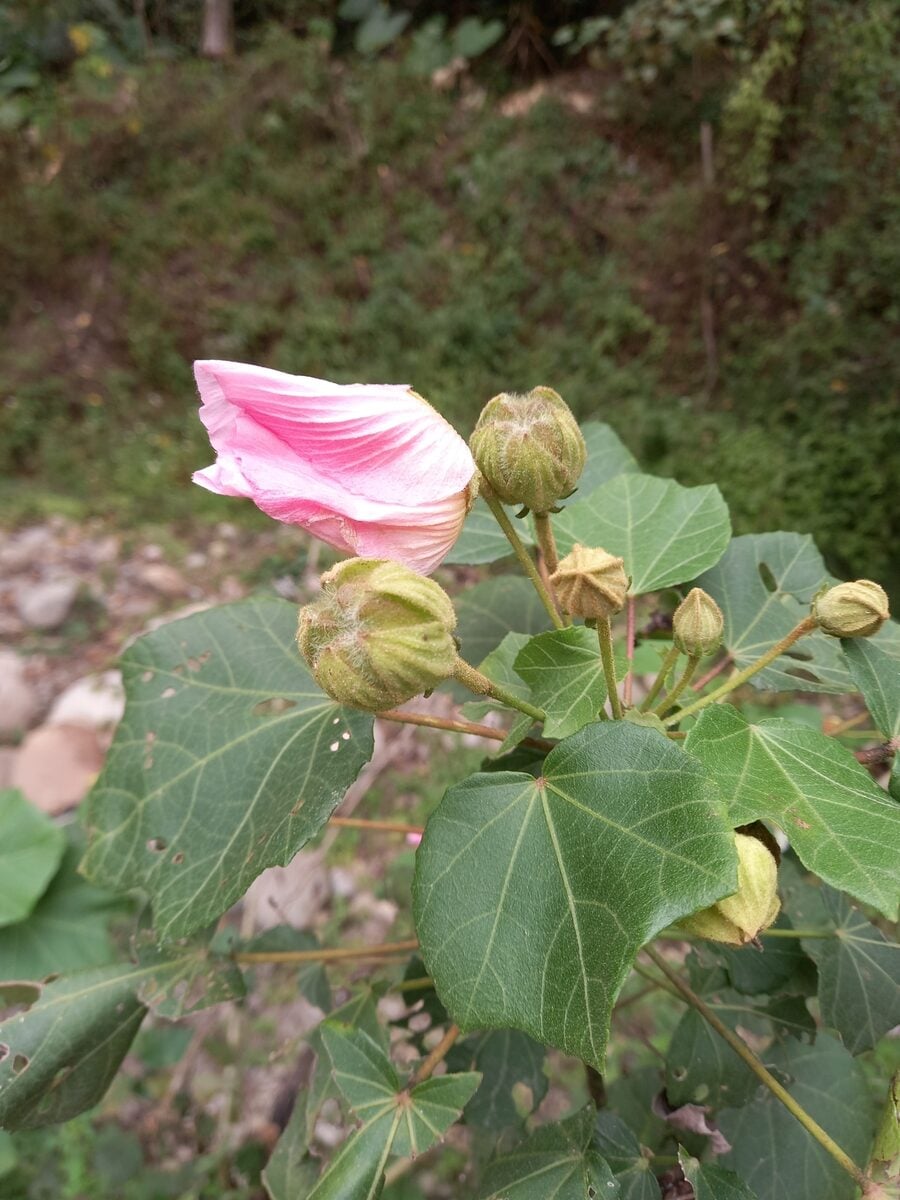
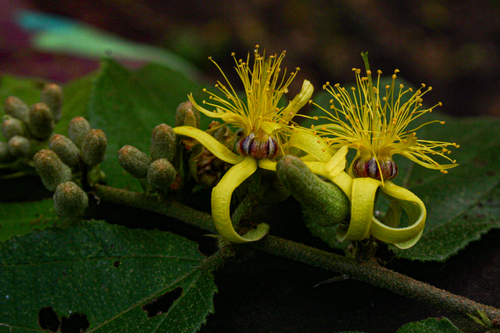
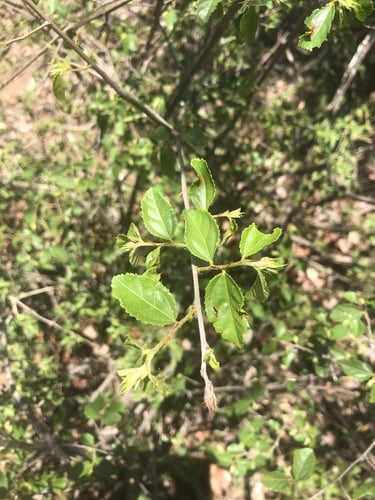
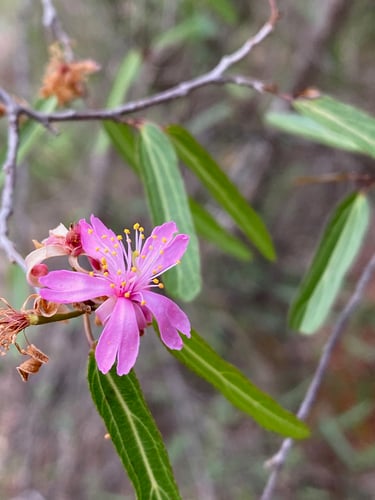
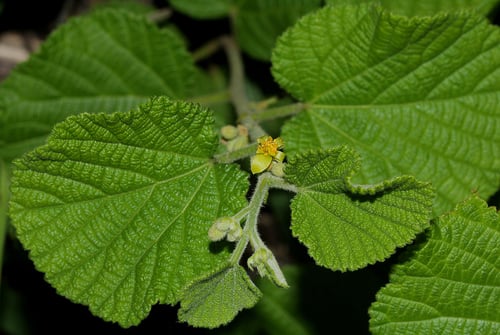
Sterculia guttata
Roxb.
iNaturalist· cc-by-nc-sa
(c) satish nikam, some rights reserved (CC BY-NC-SA), uploaded by satish nikam
iNaturalist· cc0
no rights reserved, uploaded by S.MORE
iNaturalist· cc0
no rights reserved, uploaded by S.MORE
Summary
Source: WikipediaSterculia guttata, the spotted sterculia, is a species of plant in the family Malvaceae. It is native to India, Bangladesh, the Andaman and Nicobar Islands, Myanmar, Thailand, and Laos. Extracts from its seeds have been tested for use as an insecticide against mosquito larvae.
Description
A large deciduous tree. It grows 20 m tall. The trunk is straight. It can keep its leaves throughout the year. The crown is oval. The leaves are simple and without lobes. The leaves are narrowly oval and the leaf stalks are 7 cm long. The flowers are in upright clusters. The flowers are white. The fruit pods or follicles are red and hairy on the outside.
Edible Uses
Seeds - raw or roasted. Usually cooked, the seeds of species in this genus are generally rich in oil and have a flavour described by some as like peanuts. An important crop in times of food shortage.
Traditional Uses
The young seeds are eaten. They are roasted.
This uses section is brief — help expand it
Medicinal Uses
A juice obtained from the bark and the leaves is used in the treatment of fevers and diarrhoea.
Distribution
A tropical plant. It grows in tropical India. It grows in the Deccan. In Thailand it grows between 350-1,800 m above sea level.
Where It Grows
Asia, Himalayas, India, Indochina, Laos, Myanmar, Northeastern India, SE Asia, Sri Lanka, Thailand, Vietnam,
Cultivation
Plants are grown from seeds.
Propagation
A physical dormancy caused by the hard seed coat of the mature seeds of many species in this genus can be overcome by scarifying the seed. This is carried out by cutting away or abrading some of the seed coat to allow the ingress of water, though great care must be taken not to damage the embryo. The aril surrounding the seed should also be removed - this is easiest when it has been softened through soaking in water. The seeds germinate optimally at temperatures between 20 - 30°c. They can be sown in a nursery seedbed or in containers. A germination rate of about 95%, occurring within about 2 weeks can be expected if the seed has been properly treated.
Other Uses
The bark yields a valuable cordage. The bark of the younger parts of the tree abounds with very strong, white, flaxen fibre which is used to make a kind of coarse cloth. The bark of 10 year old trees is used for making coarse clothing and cordage. The tree is felled, its branches are lopped, the trunk is cut into pieces 180cm long, a longitudinal incision is made in each piece, and the bark is opened, taken off entire, chopped, washed, and sun dried. In this state, it is very pliable and tough, and is used for clothing without further preparation. The greyish-white wood is soft, light and porous. It is of no value. It can be used for indoor construction.
Other Information
They are used in times of food scarcity.
Notes
Also put in the family Sterculiaceae.
Also Known As
Goldava, Golder, Happusavaga jaynkatalu, Hirik, Kattu iluppai, Kavalam, Kithondi, Kuhar, Kukar, Kukrul, Mok chaek, Po daeng, Po faan, Po khanun, Shirikh, Tattem belom, Thondi, Vandri
References (22)
- Ambasta, S.P. (Ed.), 2000, The Useful Plants of India. CSIR India. p 600
- Arinathan, V., et al, 2007, Wild edibles used by Palliyars of the western Ghats, Tamil Nadu. Indian Journal of Traditional Knowledge. 6(1) pp 163-168
- Binu, S., 2010, Wild edible plants by the tribals in Pathanamthitta district, Kerala. Indian Journal of Traditional Knowledge. 9(2): 309-312
- Chandrashekara, U. M., 2009, Tree species yielding edible fruit in the coffee-based homegardens of Kerala, India: their diversity, uses and management. Food Sec. 1:361-370
- Gardner, S., et al, 2000, A Field Guide to Forest Trees of Northern Thailand, Kobfai Publishing Project. p 80
Show all 22 references Hide references
- Hedrick, U.P., 1919, (Ed.), Sturtevant's edible plants of the world. p 635
- Hort. bengal. 50. 1814
- Jadhav, R., et al, 2015, Forest Foods of Northern Western Ghats: Mode of Consumption, Nutrition and Availability. Asian Agri-History Vol. 19, No. 4: 293-317
- Jose, D. T. & Sasidharan, N., 2016, Checklist of wild edible plants of Aralam Wildlife sanctuary, Kerala, India. South Indian Journal Of Biological Sciences 2016; 2(1); 141‐144
- Menninger, E.A., 1977, Edible Nuts of the World. Horticultural Books. Florida p 43
- Murtem, G. & Chaudhrey, P., 2016, An ethnobotanical note on wild edible plants of Upper Eastern Himalaya, India. Brazilian Journal of Biological Sciences, 2016, v. 3, no. 5, p. 63-81.
- Patiri, B. & Borah, A., 2007, Wild Edible Plants of Assam. Geethaki Publishers. p 16
- Prakash, V., & Megrotra B.N., 1987, Ethnobotanical Studies on the Flora of Khandala, Maharashtra State. J. Econ. Tax. Bot. Vol. 9 No. 1 pp 205-208
- Pullaiah, T., et al, Ethnobotany of India, Volume 1: Eastern Ghats and Deccan.
- Ramachandran, V.S. and Nair, V.J., 1981, Ethnobotanical studies in Cannanore District, Kerala State (India). J Econ. Tax. Bot. Vol 2 pp 65-72
- Ramachandran, V. S., 2007, Wild edible plants of the Anamalais, Coimbatore district, western Ghats, Tamil Nadu. Indian Journal or Traditional Knowledge. 6(1) pp 173-176
- Singh, H.B., Arora R.K.,1978, Wild edible Plants of India. Indian Council of Agricultural Research, New Delhi. p 83
- Thai Forestry Bulletin 23:62-108, 1995
- WATT,
- Wickens, G.E., 1995, Edible Nuts. FAO Non-wood forest products. FAO, Rome. p156
- Wild edible plants of Himachal Pradesh
- Yesodharan, K. & Sujana, K. A., 2007, Wild edible plants traditionally used by the tribes in the Parambokulam Wildlife Sanctuary, Kerala, India. Natural Product Radiance 6(1) pp 74-80