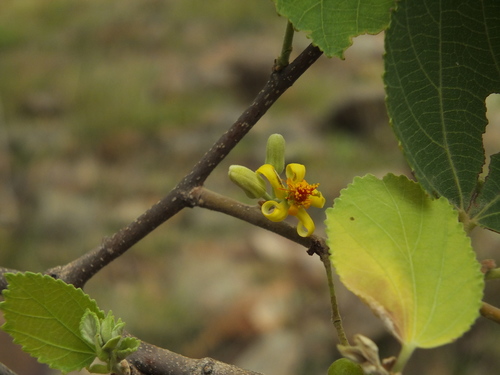
Sterculia appendiculata
K. Schum. ex Engl.
Tall sterculia
iNaturalist· cc-by-nc
(c) Graeme White, some rights reserved (CC BY-NC), uploaded by Graeme White
Description
A tall tree. It grows to 40 m tall. The trunk is straight. The first branches can be 15-20 m from the ground. The bark is pale yellow and smooth. The small branches have dense rusty hairs. The leaves are crowded towards the ends of branches. They are broadly oval. They are 14-30 cm long by 14-30 cm wide. The blade is usually divided into 3-7 lobes. The young leaves are densely woolly with yellow hairs. The leaf stalk is 6-11 cm long. The flowers are greenish or yellowish-brown. They are 2.8 cm across. They occur in sprays made up of a few flowers and located near the ends of branches. These are 12 cm long. The fruit have 2-3 carpels. Each of these is 9 cm long by 6 cm wide. They are covered with soft brown hairs. The seeds are up to 2 cm long and brown with a yellow seed coat (aril). They are surrounded by a dry powdery pulp.
Edible Uses
The leaves are cooked and eaten as a vegetable. The seeds are roasted and eaten whole, or roasted, pounded, and cooked with vegetables.
Traditional Uses
The leaves are cooked and eaten. The seeds are roasted and eaten. They are also roasted the pounded and cooked with vegetables.
This uses section is brief — help expand it
Medicinal Uses
A decoction of the bark and leaves is taken as a remedy for convulsions, paralysis and impotence. The leaves are used to treat cerebral malaria. A maceration of the petioles is drunk as a purgative. A decoction of the roots is used to treat diarrhoea, bilharzia and to prevent miscarriage in pregnant women.
Distribution
A tropical plant. It grows in forests along the coast and near rivers. In Malawi it grows in the rift valley below 600 m altitude.
Where It Grows
Africa, East Africa, Kenya, Malawi, Mozambique, Somalia, Southern Africa, Tanzania, Zimbabwe,
Cultivation
Plants can be grown from fresh seeds.
Propagation
Seed - best sown as soon as it is ripe. A physical dormancy caused by the hard seed coat of the mature seeds of many species in this genus can be overcome by scarifying the seed. This is carried out by cutting away or abrading some of the seed coat to allow the ingress of water, though great care must be taken not to damage the embryo. The aril surrounding the seed should also be removed - this is easiest when it has been softened through soaking in water. The seeds germinate optimally at temperatures between 20 - 30°c. They can be sown in a nursery seedbed or in containers. A germination rate of about 95%, occurring within about 2 weeks can be expected if the seed has been properly treated.
Other Uses
A yellow-brown dye is obtained from the tree (the part used is not specified). The heartwood is pale brown and indistinctly demarcated from the sapwood. The wood is soft, easy to work but not very durable. It is used for local construction, boxes and plywood. The wood is used for fuel. The plant is said to be a pioneer species.
Production
In Tanzania the seeds are collected from August to September. Seeds can be stored for several weeks.
Notes
Also put in the family Sterculiaceae. An unresolved name in The Plant List.
Also Known As
M'jali, Metil, Mfune, Mgude, Mjale, Mkunya, Mutilo, Njale, Tile
References (12)
- Grubben, G. J. H. and Denton, O. A. (eds), 2004, Plant Resources of Tropical Africa 2. Vegetables. PROTA, Wageningen, Netherlands. p 565
- Jardin, C., 1970, List of Foods Used In Africa, FAO Nutrition Information Document Series No 2.p 105
- Lovett, J. C. et al, Field Guide to the Moist Forest Trees of Tanzania. p 172
- Martin, F.W. & Ruberte, R.M., 1979, Edible Leaves of the Tropics. Antillian College Press, Mayaguez, Puerto Rico. p 221
- Mbuya, L.P., Msanga, H.P., Ruffo, C.K., Birnie, A & Tengnas, B., 1994, Useful Trees and Shrubs for Tanzania. Regional Soil Conservation Unit. Technical Handbook No 6. p 448
Show all 12 references Hide references
- Msuya, T. S., et al, 2010, Availability, Preference and Consumption of Indigenous Foods in the Eastern Arc Mountains, Tanzania, Ecology of Food and Nutrition, 49:3, 208-227
- Palgrave, K.C., 1996, Trees of Southern Africa. Struik Publishers. p 596
- Peters, C. R., O'Brien, E. M., and Drummond, R.B., 1992, Edible Wild plants of Sub-saharan Africa. Kew. p 188
- Ruffo, C. K., Birnie, A. & Tengnas, B., 2002, Edible Wild Plants of Tanzania. RELMA p 626
- White, F., Dowsett-Lemaire, F. and Chapman, J. D., 2001, Evergreen Forest Flora of Malawi. Kew. p 562
- Williamson, J., 2005, Useful Plants of Malawi. 3rd. Edition. Mdadzi Book Trust. p 234
- World Checklist of Useful Plant Species 2020. Royal Botanic Gardens, Kew