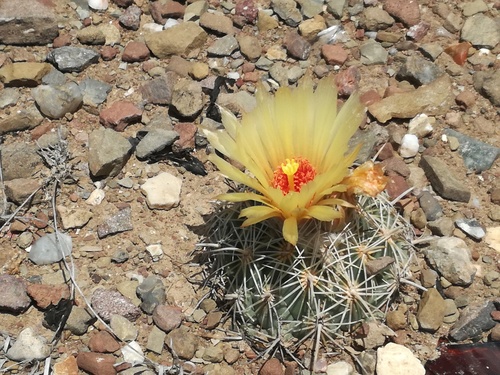
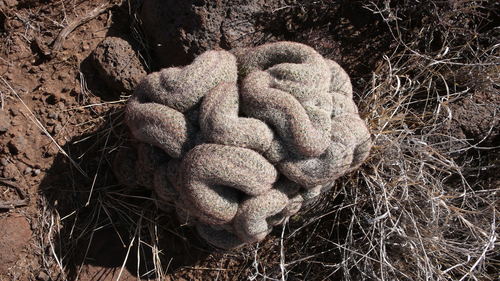
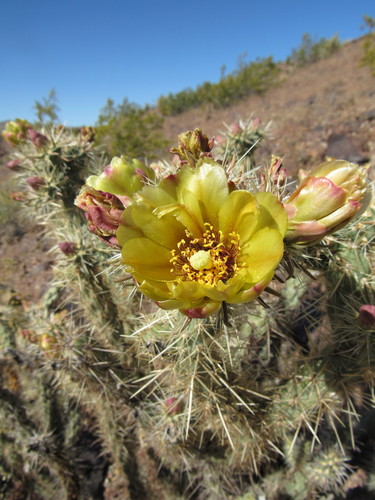
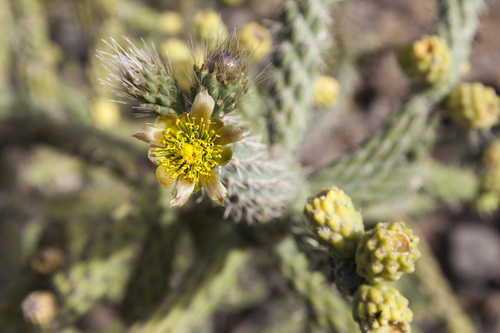
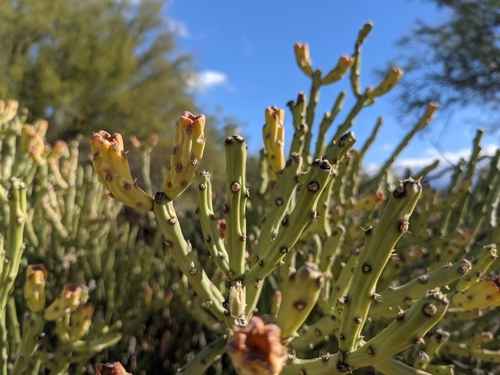
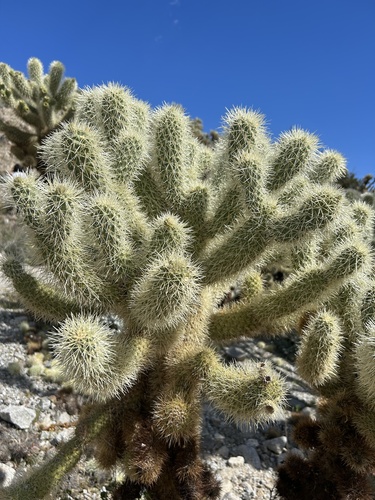
Stenocereus fricii
Sanchez-Mejorada
Pitaya
iNaturalist· cc-by-nc
(c) guillermo_ibarra_manriquez, some rights reserved (CC BY-NC), uploaded by guillermo_ibarra_manriquez
iNaturalist· cc-by-nc
(c) elsamariaguadalupeibarracarranza, some rights reserved (CC BY-NC)
iNaturalist· cc-by-nc
(c) elsamariaguadalupeibarracarranza, some rights reserved (CC BY-NC)
Summary
Source: WikipediaStenocereus fricii is a species of cactus in the genus Stenocereus, endemic to Mexico.
Description
A shrubby or tree like cactus. It has many branches. It grows 4-7 m high. The stems arise near the base. They are light green or greyish and 2-7 m long. They are 8-12 cm across. There are 4-6 ribs that are wide and wavy. There are 7-12 central spines and they are 2-5 cm long. There are 12-14 spines around it. The flowers are open during the day. They are funnel or bell shaped and 10-12 cm long. They are white with cream or red tints. The fruit are round and red or yellow. They are 5 cm across.
Edible Uses
Fruit - raw. Of good quality. The globose, red or yellow fruits are around 5cm in diameter. Seeds.
Distribution
It is a tropical plant. They need warmth.
Where It Grows
Central America, Mexico, North America,
Cultivation
The fruits are produced in the wet season.
Other Uses
The plant is grown as a living fence in order to demarcate boundaries and exclude grazing animals.
Notes
There are 23 Stenocereus species. They are tree like cacti from America.
Synonyms
Also Known As
Pitayo de aguas
References (7)
- Anderson, E.F., 2001, The Cactus Family, Timber Press. p 55, 645
- Cact. Suc. Mex. 18:89. 1973
- Pimienta-Barrios, E., and Nobel, P. S., 1994, Piyaya (Stenocereus spp., Cactaceae): An Ancient and Modern Fruit Crop of Mexico. Economic Botany, 48(1):76-83
- Segura, S. et al, 2018, The edible fruit species in Mexico. Genet Resour Crop Evol (2018) 65:1767–1793
- USDA, ARS, National Genetic Resources Program. Germplasm Resources Information Network - (GRIN). [Online Database] National Germplasm Resources Laboratory, Beltsville, Maryland. Available: www.ars-grin.gov/cgi-bin/npgs/html/econ.pl (10 April 2000)
Show all 7 references Hide references
- Wiersema, J. H. & Leon, B., 2013, World Economic Plants. A Standard Reference CRC Press. 2nd Ed. p 660
- World Checklist of Useful Plant Species 2020. Royal Botanic Gardens, Kew