Xanthosoma robustum
Schott
Ape
iNaturalist· cc-by
(c) Alan Rockefeller, some rights reserved (CC BY), uploaded by Alan Rockefeller
iNaturalist· cc-by-nc
(c) Bernabe Alejandro Uc Dzul, some rights reserved (CC BY-NC), uploaded by Bernabe Alejandro Uc Dzul
iNaturalist· cc-by-nc
(c) CARLOS VELAZCO, some rights reserved (CC BY-NC), uploaded by CARLOS VELAZCO
Summary
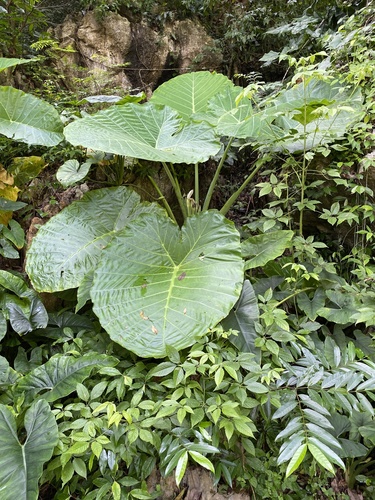
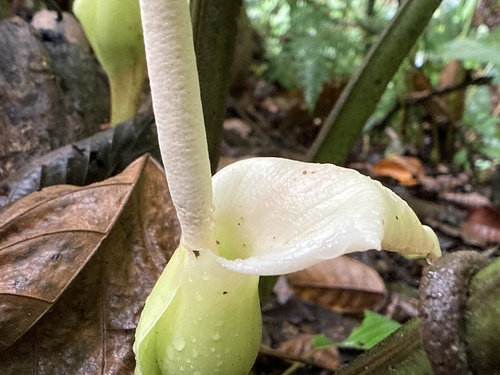
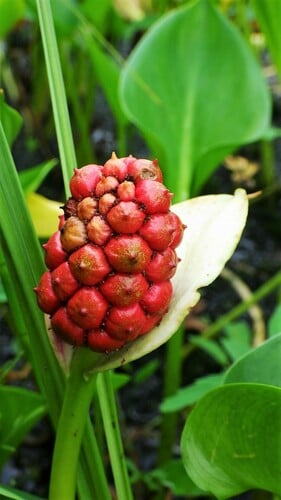
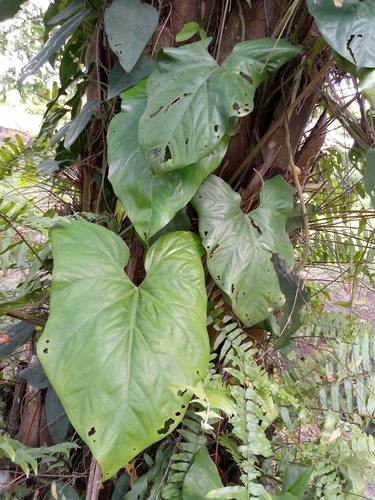
Source: WikipediaXanthosoma robustum, also known as Elephant Ear, is a robust herbaceous plant native to Central Mexico and Central America that can grow up to 4 meters tall. It's an important plant with uses in medicine, environmental applications, and as a food source. This species has large, waxy, green leaves that can grow over a meter long. The plant also produces distinct inflorescences with a white to yellowish-green spathe and a pale yellow to ochre spadix.
Description
A herb. It is in the taro family. The stem can be 1-4 m long and 10-20 cm thick. They often lie along the ground. The leaf stalks are 40-180 cm long. The leaf blades are oval to sword shaped and can be 2 m long.
Edible Uses
Young leaves are eaten in soup. Tubers and roots are also eaten.
Traditional Uses
It has been reported as used in Guatemala. The young leaves are eaten in soup. The roots are possibly poisonous.
This uses section is brief — help expand it
Known Hazards
The roots are possibly poisonous.
Distribution
A tropical plant. It grows in wet soil and usually boggy ground. It grows up to 900 m above sea level in Central America,
Where It Grows
Asia, Central America*, Costa Rica, Guatemala, Hawaii, Honduras, Indonesia, Mexico, North America, Pacific, SE Asia, USA,
Cultivation
It is grown from offshoots.
Notes
There are 57 Xanthosoma species.
Nutrition
| Part | Moisture | kJ | kcal | Protein | Vit A | Vit C | Iron | Zinc |
|---|---|---|---|---|---|---|---|---|
| Leaves - dry | 4.6 | — | — | 30.4 | — | — | — | — |
Synonyms
Also Known As
Kipul raksasa, Lokg, Mafafa blanca, Malvaron, Oreja de elefante, Paxnikak, Rejalgar, Quequeshque, Tup
References (11)
- de Polle, E., Plantas Silvestres Comestible de Guatemala. 1(1) Universidad de San Carlos de Guatemala.
- Diaz-Betancourt, M., et al, 1999, Weeds as a future source for human consumption. Rev. Biol. Trop. 47(3):329-338
- Kermath, B. M., et al, 2014, Food Plants in the Americas: A survey of the domesticated, cultivated and wild plants used for Human food in North, Central and South America and the Caribbean. On line draft. p 927
- Larios, et al., 2013, Plant management and biodiversity conservation in Náhuatl homegardens of the Tehuacán Valley, Mexico. Journal of Ethnobiology and Ethnomedicine 2013 9:74.
- Mapes, C. & Basurto, F., 2016, Biodiversity and Edible Plants of Mexico. Chapter 5 in R. Lira, et al. (eds.), Ethnobotany of Mexico, Ethnobiology, Springer. p 112, 116
Show all 11 references Hide references
- Oesterr. Bot. Wochenbl. 3:370. 1853
- Pena, F. B., et al, 1998, Los quelites de la Sierra Norte de Puebla, Mexico: Inventory Y Formas de Preparacion. Bol. Soc. Bot. Mexico 62:49-62
- Standley, P. & Steyermark, J., 1958, Flora of Guatemala. Fieldiana: Botany, Volume 24 part 1 p 362
- Staples, G.W. and Herbst, D.R., 2005, A tropical Garden Flora. Bishop Museum Press, Honolulu, Hawaii. p 613
- Sukarya, D. G., (Ed.) 2013, 3,500 Plant Species of the Botanic Gardens of Indonesia. LIPI p 1141
- Turreira-Garcia, N., et al, 2015, Wild edible plant knowledge, distribution and transmission: a case study of the Achi Mayans of Guatemala. Journal of Ethnobiology and Ethnomedicine. 11:52