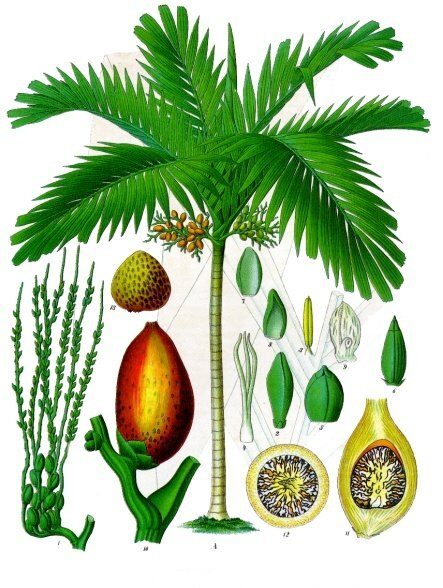
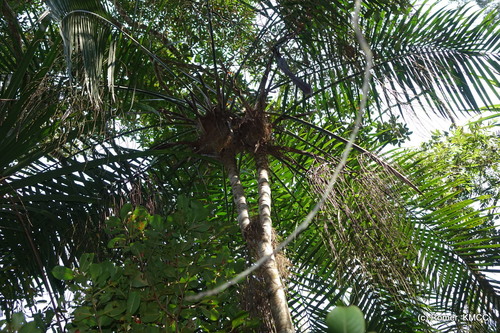
Chamaerops humilis
L.
European fan palm, Dwarf Date Palm
iNaturalist· cc-by-sa
(c) tato grasso, some rights reserved (CC BY-SA)
iNaturalist· cc-by-nc
(c) Andrew Cope Emlen, some rights reserved (CC BY-NC)
iNaturalist· cc-by-nc
(c) Andrew Cope Emlen, some rights reserved (CC BY-NC)
Summary
Source: WikipediaChamaerops humilis is a slow-growing evergreen tree reaching 1.5 m (5 ft) in height and spread. Hardy to UK zone 9. In leaf year-round, flowering April to June. The species is monoecious with both male and female flowers on the same plant. It adapts to light sandy and medium loamy soils with good drainage and tolerates poor soil. It grows in mildly acidic to mildly alkaline conditions, in semi-shade or full sun, and tolerates both dry and moist soil including drought.
Description
A fan palm. Plants can have one or many trunks. It can form suckers and produce clumps. They can be short or tall and with variegated leaves or plain. It is often 1 m tall but can be 6 m tall. The trunks usually have leaf base fibres covering them. The crown is made up of stiff spreading leaves. The leaf stalks are slender and flattened and have strong spines. The leaf blades are bluish-grey. The leaves are fan shaped like fingers on a hand. They are deeply divided. Flowering stalks arise among the leaf bases. Flowers are cream or yellow. Male and female flowers occur on separate plants. Both are necessary for fruit. The fruit are brown.
Edible Uses
Very young leaf buds are edible when cooked as a vegetable. Young shoots or suckers from the base of the plant are also used in the same way. The fruit can be dried and eaten, though no further details are available.
Traditional Uses
The young shoots or suckers from the bottom of the plants are eaten after cooking. The young stems and roots are eaten. The ripe fruit are eaten raw.
Medicinal Uses
None known.
Distribution
It suits temperate and subtropical regions. It is very cold hardy. It is not affected by heavy frosts. It can tolerate a variety of soils but needs good drainage. In the Mediterranean they can be in hills up to 1000 m altitude. It prefers a sunny position. It grows in coastal and near coastal situations. It is often on rocky headlands and low hills. In the Indian Himalayas it grows between 1,200-1,400 m above sea level. It needs a temperature above -12°C. It can grow in arid places. It suits hardiness zones 8-10. Melbourne Botanical Gardens. In Hobart Botanical gardens.
Where It Grows
Africa, Algeria, Asia, Australia, Britain, Canada, Dominican Republic, Europe, France, Gibraltar, Greece, Himalayas, India, Indochina, Indonesia, Israel, Italy, Libya, Mediterranean*, Middle East, Monaco, Morocco, Nepal, North Africa, North America, Northeastern India, Portugal, SE Asia, Sicily, Slovenia, Spain, Tasmania, Thailand, Tunisia, West Indies,
Cultivation
Easily grown in a rich strong loam enriched with leafmold and sand. Plants grow in poor dry soils in the wild. Requires very good drainage with abundant moisture in the summer and a sunny position. Another report says that plants grow well in dry conditions and are drought tolerant. Tolerates low light levels and can be grown in the home. Requires a position sheltered from the wind and cold. This species tolerates occasional short-lived lows down to about -10°c. It will not tolerate recurring bouts of freezing over several days, nor does it survive freezing of the root system. Plants are hardy in the milder areas of Britain, succeeding from S. Hampshire south and westwards. Plants growing outdoors at Kew fruited in October 1989. Palms usually have deep penetrating root systems and generally establish best when planted out at a young stage. However, older plants are substantially more cold tolerant than juvenile plants. In areas at the limit of their cold tolerance, therefore, it is prudent to grow the plants in containers for some years, giving them winter protection, and only planting them into their permanent positions when sheer size dictates. Palms can also be transplanted even when very large. Although the thick fleshy roots are easily damaged and/or desiccated, new roots are generally freely produced. It is important to stake the plant very firmly to prevent rock, and also to give it plenty of water until re-established - removing many of the leaves can also help. Another report says that this species dislikes root disturbance. Some botanists recognise a sub-species C. humilis arborescens (Pers.)Steud. (a taller growing form) and a cultivar 'Nana' which is smaller than the type and suckers. It is likely that these are no more than phenotypes and that this variety of habit can be induced in cultivation, plants in stressful situations such as near the coast duplicating the 'Nana' form whilst plants in optimum conditions are more like sub-species arborescens. Plants in the wild are usually found in poor soils and seldom exceed 1.5 metres tall. When grown in better soils in gardens, however, they can grow up to 5 metres tall.
Propagation
Seed is best sown as soon as it is ripe; older stored seed can be slow and difficult to germinate. Scarification or pre-soaking stored seed for 1–2 days can improve results. Sown in a warm greenhouse at 25°C, seed generally germinates in 3–4 months, though it can take longer. The seed produces a long root before any shoot appears above ground, and the seedling can be potted up at this stage. Grow plants on in the greenhouse for at least a couple of years before planting out into permanent positions in summer. Plants can also be propagated by removing suckers in spring.
Other Uses
A strong fibre extracted from the leaves is used for making cordage and brushes. Whole leaves can be used in weaving. Plants have been used to form hedges in Mediterranean regions.
Production
It takes 5 years to establish.
Other Information
It is cultivated.
Notes
There is only one Chamaerops species.
Synonyms
Also Known As
Bon khejur, Cafaglioni, Chaghashi, Djoumar, Doum, Dwarf fan palm, Dwarf palm, Eddoum, European Fan Palm, Evropska palma, Ghashi, Giummarra, Hair palm, Khajoor, Khajur, Khejur, Lusu, Margallo, Mediterranean fan palm, Mediterranean palm, Palem kipas eropa, Peng doi, Sanna echalu, Scupazzu, Thakal, Tizdemt
References (51)
- Ambasta, S.P. (Ed.), 2000, The Useful Plants of India. CSIR India. p 118
- Aryal, K. P., et al, 2018, Diversity and use of wild and non-cultivated edible plants in the Western Himalaya. Journal of Ethnobiology and Ethnomedicine (2018) 14:10 (As Phoenix humilis)
- Balick, M.J. and Beck, H.T., (Ed.), 1990, Useful palms of the World. A Synoptic Bibliography. Colombia p 121, 487, 628,
- Blamey, M and Grey-Wilson, C., 2005, Wild flowers of the Mediterranean. A & C Black London. p 502
- Blomberry, A. & Rodd, T., 1982, Palms. An informative practical guide. Angus & Robertson. p 82
Show all 51 references Hide references
- Bodkin, F., 1991, Encyclopedia Botanica. Cornstalk publishing, p 246
- BOUQUET,
- Brickell, C. (Ed.), 1999, The Royal Horticultural Society A-Z Encyclopedia of Garden Plants. Convent Garden Books. p 255
- Chakraborty, S. & Chaturbedi, H. P., 2014, Some Wild Edible Fruits of Tripura- A Survey. Indian Journal of Applied research. (4) 9
- Cundall, P., (ed.), 2004, Gardening Australia: flora: the gardener's bible. ABC Books. p 367
- Dangol, D. R., 2002, Economic uses of forest plant resources in western Chitwan, Nepal. Banko Janakari, 12(2): 56-64 (As Phoenix humilis)
- Dangol, D. R. et al, 2017, Wild Edible Plants in Nepal. Proceedings of 2nd National Workshop on CUAOGR, 2017.
- Etherington, K., & Imwold, D., (Eds), 2001, Botanica's Trees & Shrubs. The illustrated A-Z of over 8500 trees and shrubs. Random House, Australia. p 207
- Gautam, R. S., et al, 2020, Wild Edible Fruits of Nepal. Int. J. Appl. Sci. Biotechnol. Vol 8(3): 289-304
- Gautam, R. S., et al, 2022, Ethnobotanical Review of Wild Edible Plants of Nepal. Journal of Natural History Museum Volume 32, 2021-22 p 105
- Geraci, A., et al, 2018, The wild taxa utilized as vegetables in Sicily (Italy): a traditional component of the Mediterranean diet. Journal of Ethnobiology and Ethnomedicine (2018) 14:14
- Ghanimi, R., et al, 2022, Ethnobotanical study on wild edible plants traditionally used by Messiwa people, Morocco. Journal of Ethnobiology and Ethnomedicine. 18:16
- Gibbons, M., 2003, A pocket guide to Palms. Chartwell Books. p
- Gibbons, M., 1993, Palms. Compact study Guide and Identifier. Sandstone. p 28
- Harris, E & J., 1983, Field Guide to the Trees and Shrubs of Britain. Reader's Digest. p 182
- Haynes, J., & McLaughlin, J., 2000, Edible palms and Their Uses. University of Florida Fact sheet MCDE-00-50-1 p 4
- Hedrick, U.P., 1919, (Ed.), Sturtevant's edible plants of the world. p 183
- Hibbert, M., 2002, The Aussie Plant Finder 2002, Florilegium. p 65
- Jardin, C., 1970, List of Foods Used In Africa, FAO Nutrition Information Document Series No 2.p 66
- Jones, D.L., 1994, Palms throughout the World. Smithtonian Institution, Washington. p 58, 182
- Jones, D.L., 2000, Palms of Australia 3rd edition. Reed/New Holland. p 142
- Joshi, N. & Siwakoti, M., 2012, Wild Vegetables Used by Local Community of Makawanpur District and Their Contribution to Food Security and Income Generation. Nepal Journal of Science and Technology Vol. 13, No. 1 (2012) 59-66 (As Phoenix humilis)
- Kermath, B. M., et al, 2014, Food Plants in the Americas: A survey of the domesticated, cultivated and wild plants used for Human food in North, Central and South America and the Caribbean. On line draft. p 213
- Lord, E.E., & Willis, J.H., 1999, Shrubs and Trees for Australian gardens. Lothian. p 94
- Majumdar, K and Datta, N., 2009, Traditional wild edible fruits for the forest dwellers of Tripura, India. Pleione 3(2) 167-178 (As Phoenix humilis)
- Martin, F.W. & Ruberte, R.M., 1979, Edible Leaves of the Tropics. Antillian College Press, Mayaguez, Puerto Rico. p 210
- Nassif, F., & Tanji, A., 2013, Gathered food plants in Morocco: The long forgotten species in Ethnobotanical Research. Life Science Leaflets 3:17-54
- Pasta, S., et al, 2020, An Updated Checklist of the Sicilian Native Edible Plants: Preserving the Traditional Ecological Knowledge of Century-Old Agro-Pastoral Landscapes. Frontiers in Plant Science. Volume 11|Article 388
- Pfoze, N. L., et al, 2012, Survey and assessment of floral diversity on wild edible plants from Senapati district of Manipur, Northeast India. Journal of Biodiversity and Environmental Sciences. 1(6):50-52 (As Phoenix humilis)
- Plants for a Future database, The Field, Penpol, Lostwithiel, Cornwall, PL22 0NG, UK. http://www.scs.leeds.ac.uk/pfaf/
- Prashanth Kumar, G.M. and Shiddamallayya, N., 2015, Ethnobotanical Study of Less Known Wild Edible Plants of Hakki Pikki Tribes of Angadihalli, Hassan District, Karnataka. Journal or Medicinal Plants Studies 3(5):80-85 (As Phoenix humilis)
- Radha, B., et al, 2013, Wild Edible Plant Resources of the Lohba Range of Kedarnath Forest Division (KFD), Garhwal Himalaya, India. Int. Res J. Biological Sci. Vol. 2 (11), 65-73 (As Phoenix humilis)
- Recher, P, 2001, Fruit Spirit Botanical Gardens Plant Index. www.nrg.com.au/~recher/ seedlist.html p 7
- Rivera, D. et al, 2006, Gathered Mediterranean Food Plants - Ethnobotanical Investigations and Historical Development, in Heinrich M, Müller WE, Galli C (eds): Local Mediterranean Food Plants and Nutraceuticals. Forum Nutr. Basel, Karger, 2006, vol 59, pp 18–74
- Riffle, R.L. & Craft, P., 2003, An Encyclopedia of Cultivated Palms. Timber Press. p 302
- Royal Botanic Gardens, Kew (1999). Survey of Economic Plants for Arid and Semi-Arid Lands (SEPASAL) database. Published on the Internet; http://www.rbgkew.org.uk/ceb/sepasal/internet [Accessed 5th May 2011]
- Sfikas, G., 1984, Trees and shrubs of Greece. Efstathiadis Group. Athens. p 192
- Shrestha, S., 2021, Wild Edible Plants of Dhankuta, Eastern Nepal. Rupantaran : A Multidisciplinary Journal Vol. V : pp 100-109, September, 2021 p 103
- Sp. pl. 2:1187. 1753 (type species)
- Sukarya, D. G., (Ed.) 2013, 3,500 Plant Species of the Botanic Gardens of Indonesia. LIPI p 769
- Tardio, J., et al, 2006, Ethnobotanical review of wild edible plants in Spain. Botanical J. Linnean Soc. 152, 27-71
- Tbatou, M, et al, 2016, Wild Edible Plants traditionally used in the countryside of El Jadida, Coastal Area in the Center of Morocco. Life Sciences Leaflets 75:28-48
- Thitiprasert, W., et al, 2007, Country report on the State of Plant Genetic Resources for Food and Agriculture in Thailand (1997-2004). FAO p 95 (As Phoenix humilis)
- Upreti, K., et al, 2010, Diversity and Distribution of Wild Edible Fruit Plants of Uttarakhand. Bioversity Potentials of the Himalaya. p 180 (As Phoenix humilis Royle)
- World Checklist of Useful Plant Species 2020. Royal Botanic Gardens, Kew
- Zeven, A. C. & de West, J. M. J., 1982, Dictionary of cultivated plants and their regions of diversity. Wageningen. p 117