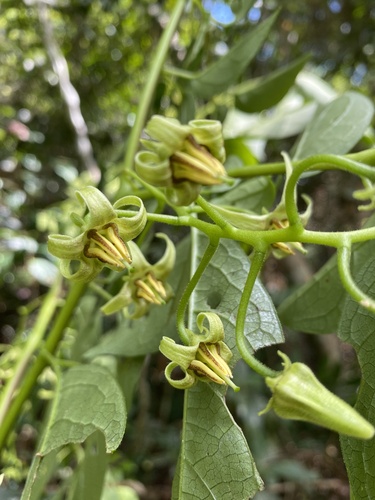
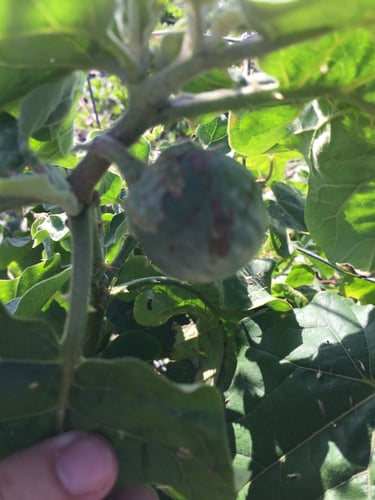
Solanum sisymbriifolium
Lam.
Sticky nightshade
iNaturalist· cc0
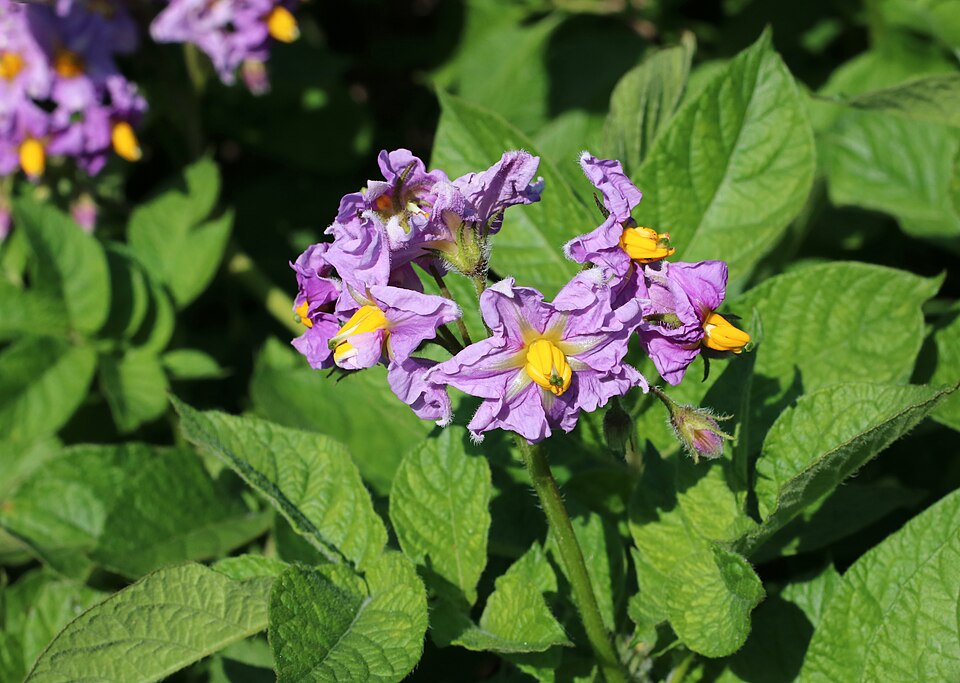
no rights reserved, uploaded by 葉子
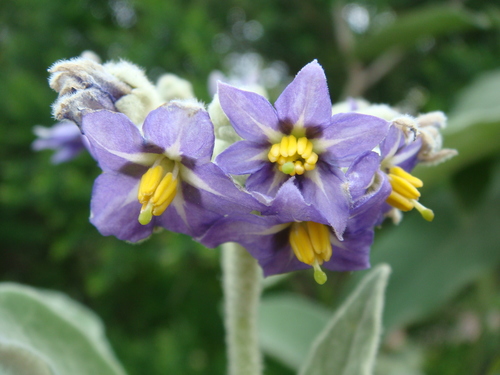
iNaturalist· cc-by-nc
(c) Lourdes Mariel Quarin, some rights reserved (CC BY-NC), uploaded by Lourdes Mariel Quarin
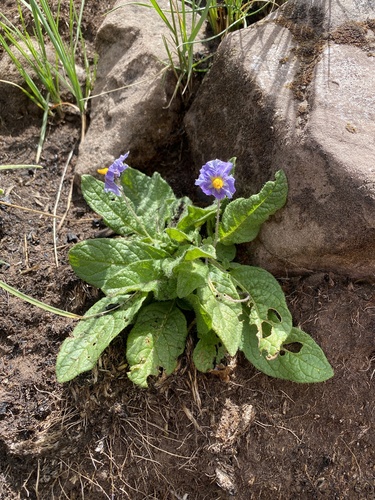
iNaturalist· cc0
no rights reserved, uploaded by 葉子
Summary
Source: WikipediaSolanum sisymbriifolium is commonly known as vila-vila, sticky nightshade, red buffalo-bur, the fire-and-ice plant, litchi tomato, or Morelle de Balbis. The small edible fruits are red on the outside and yellow inside. It grows inside a spiny, green husk. The fruit is ripe when it is easily removed from the stem. The flavor resembles sour cherries and a little bit like a tomato. This plant has been used as a trap crop to protect potatoes from potato cyst nematode. The stems and leaves contain solasodine which makes the plant very resistant to many pests and diseases, with the exception of potato beetles and tomato hornworms. It can also be used as a hedge plant to keep animals out of a garden, because it is covered with prickles (erroneously called thorns).
Description
A herb or small shrub. It grows 1-1.3 m high. The stems are 1-1.5 cm across. It has spines 1-1.3 mm long. The leaves are simple alternate. They are 20 cm long by 12 cm wide. The leaves have lobes. There are teeth along the edges. There are spines on the veins. The flowers are at the ends of branches. They occur singly. The fruit is round and 2 cm across. It is in a spiny case. This opens to reveal the red fruit.
Edible Uses
Fruit. The bright-red fruit is a spherical or depressed-spherical berry 12 - 16mm in diameter. The fruiting calyx is accrescent and wraps tightly around the developing fruit, opening out as the fruit ripens. There are 2 - 20 fruits per infructescence.
Traditional Uses
The fruit are sweet and eaten raw. They are probably best to be cooked. It is used for marmalades and jellies. CAUTION: There are some reports of poisoning children. The seeds are poisonous.
Medicinal Uses
None known
Known Hazards
Although no specific mention of toxicity has been seen for this species, it belongs to a genus where many if not all the members have poisonous leaves and sometimes also the unripe fruits.
Distribution
A tropical plant. In Bolivia it grows up to 2500 m altitude. In Ecuador it grows between 2,000-3,000 m above sea level. In Argentina it grows from sea level to 1,700 m above sea level.
Where It Grows
Africa, Andes, Argentina, Asia, Australia, Bolivia, Brazil*, Chile, China, Colombia, Ecuador*, Eswatini, India, Korea, Paraguay, Slovenia, South Africa, Southern Africa, South America*, Swaziland, Uruguay,
Cultivation
Succeeds in most soils. Plants are not very hardy outdoors in Britain, though they can be grown as spring-sown annuals. In milder almost frost-free climates they are perennial.
Propagation
Sow seed in early spring in a warm greenhouse. Prick seedlings out into individual pots when large enough to handle and plant out after the last expected frosts.
Other Uses
None known
Other Information
It is a cultivated plant. The fruit are enjoyed by children.
Notes
There are about 1400 Solanum species.
Synonyms
Also Known As
Espina colorada, Guinda pampa, Guindilla, Joa-das-taperas, Jua, Juciri, Jweelye, Mboi rembiu, Nuati pyta, Pocotillo, Puca-puca, Putui, Putuy, Quillo quillo, Revienta Caballo, Tomatillo, Toti'a, Toti'apintawa, Trnati paradižnik, Tutia, Viscid nightshade, Yag yemmek
References (30)
- Altschul, S.V.R., 1973, Drugs and Foods from Little-known Plants. Notes in Harvard University Herbaria. Harvard Univ. Press. Massachusetts. no. 4042
- Ambasta, S.P. (Ed.), 2000, The Useful Plants of India. CSIR India. p 582
- Arenas, P. and Scarpa, G. F., 2006, Edible wild plants of the Chorote Indians, Gran Chaco, Argentina. Botanical Journal of the Linnean Society. Vol. 153 (1): pp 73-85
- Brack, P., et al, 2020, Frutas nativas do Rio Grande do Sul, Brasil: riqueza e potencial alimentício. Native fruits of Rio Grande do Sul, Brazil: richness and potential as food. Rodriguésia 71: e03102018
- http://www.botanic-gardens-ljubljana.com/en/plants
Show all 30 references Hide references
- Hussey, B.M.J., Keighery, G.J., Cousens, R.D., Dodd, J., Lloyd, S.G., 1997, Western Weeds. A guide to the weeds of Western Australia. Plant Protection Society of Western Australia. p 223
- Kermath, B. M., et al, 2014, Food Plants in the Americas: A survey of the domesticated, cultivated and wild plants used for Human food in North, Central and South America and the Caribbean. On line draft. p 825
- Kinupp, V. F., 2007, Plantas alimenticias nao-convencionais da regiao metropolitana de Porto Alegre, RS, Brazil p 103
- Kinupp, V. F. & Bergman, I., 2008, Protein and minerals of native species, potential vegetables and fruits. Cienc.Tecnol. Aliment. Vol. 28 No. 4 Campinas Oct/Dec.
- Kujawska, M. & Luczaj, L., 2015, Wild Edible Plants Used by the Polish Community in Misiones, Argentina. Human Ecology 43:855-869
- Leon-Lobos, P., et al, 2022, Patterns of Traditional and Modern Uses of Wild Edible Native Plants of Chile: Challenges and Future Perspectives. Plants (Basel) v 11 (6) Table S1
- Lopez-Diago, D. & Garcia, N., 2021, Wild edible fruits of Colombia. Biota ColomBiana 22 (2) p 52
- Malezas Comestibles del Cono Sur, INTA, 2009, Buernos Aires
- Montani, M. C. & Scarpa, G. F., 2016, Recursos vegetales y prácticas alimentarias entre indígenas tapiete del noreste de la provincia de Salta, Argentina. Darwiniana, nueva serie vol.4 no.1 San Isidro jul. 2016
- NYBG Herbarium "edible"
- Paczkowska, G . & Chapman, A.R., 2000, The Western Australian Flora. A Descriptive Calatogue. Western Australian Herbarium. p 538
- Palmieri, V. S., et al, 2018, Aproximaciones etnobotánicas de las especies y prácticas de frutos nativos comestibles de la Actualidad. Aportes para la interpretación del pasado prehispánico de cerro colorado (Córdoba, Argentina). Bol. Soc. Argent. Bot. 53 (1): 115-133
- Plants for a Future database, The Field, Penpol, Lostwithiel, Cornwall, PL22 0NG, UK. http://www.scs.leeds.ac.uk/pfaf/
- Polini, G., et al, Useful and edible plants of Paraguay Region of Chaco. p 130
- Quintana, C. M., 2010, Wild Plants in the Dry Valleys Around Quito Ecuador. An Illustrated Guide. Publicationes del Harbario, QCA p 191
- Roa, J. A. G. & Boada, D. S. G., 2018, Fundación para el Fortalecimiento de la Fruticultura y Plantas Alimenticias no Convencionales en Colombia.
- Samuels, J., 2015, Biodiversity of Food Species of the Solanaceae Family: A Preliminary Taxonomic Inventory of Subfamily Solanoideae. Resources 2015, 4. 277-322
- Sasi, R. & Rajendran, A., 2012, Diversity of Wild Fruits in Nilgiri Hills of the Southern Western Ghats - Ethnobotanical Aspects. IJABPT, 3(1) p 82-87
- Scarpa, G. F., 2009, Wild food plants used by the indigenous peoples of South American Gran Chaco: A general synopsis and intercultural comparison. Journal of Applied Botany and Food Quality 83:90-101
- Swaziland's Flora Database http://www.sntc.org.sz/flora
- Tabl. encycl. 2(vol. 3):25. 1794
- Torre, de la, L., et al, 2008, Enciclopedia de las Plantas Útiles del Ecuador. Herbario QCA. Pontificia Universidad Católica del Ecuador. p 596
- Van den Eynden, V., et al, 2003, Wild Foods from South Ecuador. Economic Botany 57(4): 576-603
- Vasquez, Roberto Ch. & Coimbra, German S., 1996, Frutas Silvestres Comestibles de Santa Cruz. p 234
- www.colecionandofrutas.org