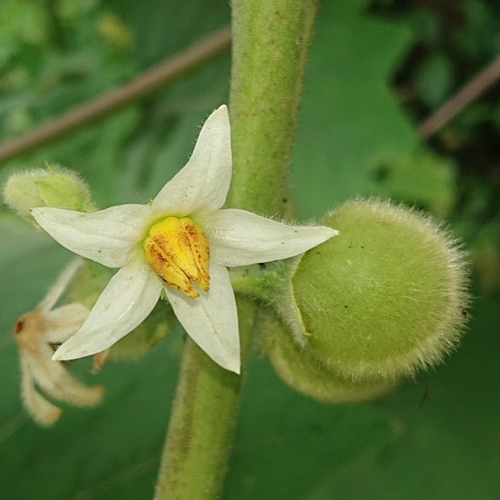
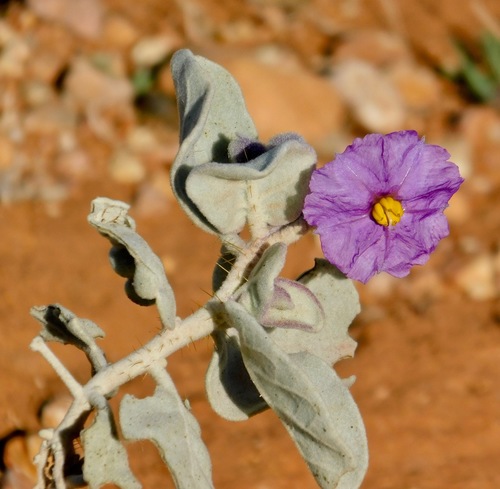
Physalis philadelphica
Lam.
Tomatillo, Ground cherry
iNaturalist· cc-by
(c) carnifex, some rights reserved (CC BY), uploaded by carnifex
iNaturalist· cc-by-nc
(c) Donna's Utopia, some rights reserved (CC BY-NC), uploaded by Donna's Utopia
iNaturalist· cc-by-nc
(c) Misha Zitser, some rights reserved (CC BY-NC), uploaded by Misha Zitser
Summary
Source: WikipediaAn annual groundcherry growing to 0.6 m (2 ft). Hardy to UK zone 7, not frost tender. Flowers from July to September with seeds ripening August to October. Hermaphroditic and insect-pollinated. Tolerates light sandy, medium loamy, and heavy clay soils with preference for well-drained conditions. Grows in mildly acidic to basic pH soils. Adapts to semi-shade or full sun and prefers moist soil.
Description
This herb is an annual plant in temperate regions and a perennial plant in the tropics. It is a soft wooded creeping plant. It can be 1 m high. The branches are purple, spreading and covered with fine hairs. The leaves are heart shaped and nearly opposite. They are 6-15 cm long. They are slightly velvety. The flowers are bell shaped and hang down. They occur in the axils of leaves. They are yellow with purple spots. The fruit buds occur after 12-13 stem internodes have formed. The fruit is covered with a straw coloured husk. The fruit is a berry with smooth waxy skin. It is orange-yellow. The juicy pulp contains small yellow seeds.
Edible Uses
The fruit can be eaten raw or cooked, and works particularly well used like a tomato in soups and stews. Each fruit is naturally enclosed in its own papery calyx, protecting it from pests and the elements — this calyx is toxic and must not be eaten. Fruits picked before they are fully ripe and left inside their calyx can be stored for up to a year.
Traditional Uses
The fruit are used in sauces. The fruit is also used fresh or cooked. They can be stewed or fried.
This uses section is brief — help expand it
Medicinal Uses
Juice from the berries has been used as an eyewash.
Known Hazards
The unripe fruits and foliage of Physalis species contain solanine and other solanidine alkaloids and are toxic if ingested in large quantities. The ripe fruiys are usually edible, and several species are cultivated for these fruits.
Distribution
A tropical plant. In the Andes it occurs at 800-3,200 m altitude. The plants are frost tender. They need a sunny frost free position. They need to be protected from strong winds. They need well drained soil. They can grow on poor sandy soil. It can grow in arid places. It suits hardiness zones 7-11.
Where It Grows
Africa, Asia, Australia, Central America*, China, Colombia, East Africa, El Salvador, Europe, Guatemala, Haiti, Hawaii, Lesser Antilles, Mediterranean, Mexico*, New Zealand, North America, Pacific, Panama, Portugal, South Africa, Southern Africa, South America, Spain, Ukraine, USA, West Indies*, Zambia, Zimbabwe,
Cultivation
Plants are grown from seed. There are about 250 seeds per gram. Small seeds like this are often best sown mixed with some fine soil to achieve even planting. Plants can be grown from one year old stem cuttings. Such plants flower earlier but are less vigorous than seedlings. Plants are self pollinating. Pollination can be improved by lightly shaking plants or giving them a spraying with water. Plants need constant watering to get a good crop. Little fertiliser is needed. Fertiliser can promote vegetative growth at the expense of fruiting.
Propagation
Sow seed in March or April in a greenhouse, barely covering it. Germination is usually quick and reliable; diurnal temperature fluctuations help. Prick seedlings into individual pots of fairly rich soil once large enough to handle, then plant out after the last expected frost, with cloche protection if needed until established.
Other Uses
Beyond its culinary role, this plant serves a range of ecological and traditional functions. Its flowers attract native pollinators including specialist bees such as Melitoma and Peponapis, making it valuable in pollinator-friendly gardens and biodiversity plantings. It has potential as a trap crop in integrated pest management, drawing pests away from more vulnerable solanaceous crops like tomatoes and eggplants. The plant produces a good volume of biomass suitable for use as mulch or compost, supporting soil health and fertility. In Mexican traditional medicine, it has been used for anti-inflammatory and antimicrobial purposes, including herbal teas and topical treatments for skin conditions; its ethnobotanical use is well-documented in some regions, though scientific studies remain limited. The papery husks have occasional cultural applications, including use in natural dyes and educational displays.
Production
Fruit are harvested when they fall to the ground.
Other Information
It is commonly used in Mexican cooking. It is cultivated.
Notes
There are about 75-100 Physalis species.
Synonyms
Also Known As
Husk-tomato, Jamberry, Miltomate, Tomate de milpa, Tomate verde
References (32)
- Arellanes, Y., et al, 2013, Influence of traditional markets on plant management in the Tehuacan Valley. Journal of Ethnobiology and Ethnomedicine 9:38
- Beckstrom-Sternberg, Stephen M., and James A. Duke. "The Foodplant Database." http://probe.nalusda.gov:8300/cgi-bin/browse/foodplantdb.(ACEDB version 4.0 - data version July 1994)
- Casas, A., et al, 1996, Plant Management Among the Nahua and the Mixtec in the Balsas River Basin, Mexico: An Ethnobotanical Approach to the Study of Plant Domestication. Human Ecology, Vol. 24, No. 4 pp. 455-478
- Cruz, I. M., et al, 2015, Edible fruits and seeds in the State of Mexico. Revista Mexicana de Ciencias Agricolas. Vol. 6. Num. 2 pp 331-346
- Cuevas-Arias, C. T., et al., 2008, Solanaceae diversity in the state of Jalisco, Mexico. Revista Mexicana de Biodiversidad 79: 67- 79
Show all 32 references Hide references
- Cundall, P., (ed.), 2004, Gardening Australia: flora: the gardener's bible. ABC Books. p 1037
- Encycl. 2:101. 1786
- Estrada-Castillon, E., et al, 2014, Ethnobotany in Rayones, Nuevo Leon, Mexico. Journal of Ethnobiology and Ethnomedicine, 10:62
- Facciola, S., 1998, Cornucopia 2: a Source Book of Edible Plants. Kampong Publications, p 235
- Hedrick, U.P., 1919, (Ed.), Sturtevant's edible plants of the world. p 492
- Hermandez Bermejo, J.E., and Leon, J. (Eds.), 1994, Neglected Crops. 1492 from a different perspective. FAO Plant Production and Protection Series No 26. FAO, Rome. p18, 117
- Hussey, B.M.J., Keighery, G.J., Cousens, R.D., Dodd, J., Lloyd, S.G., 1997, Western Weeds. A guide to the weeds of Western Australia. Plant Protection Society of Western Australia. p 220
- Illustrated Flora of Central Texas p 1023
- Kermath, B. M., et al, 2014, Food Plants in the Americas: A survey of the domesticated, cultivated and wild plants used for Human food in North, Central and South America and the Caribbean. On line draft. p 651
- Lazarides, M. & Hince, B., 1993, Handbook of Economic Plants of Australia, CSIRO. p 189
- Low, T., 1991, Wild Herbs of Australia and New Zealand. Angus & Robertson. p 100
- Mapes, C. & Basurto, F., 2016, Biodiversity and Edible Plants of Mexico. Chapter 5 in R. Lira, et al. (eds.), Ethnobotany of Mexico, Ethnobiology, Springer. p 107
- Moerman, D. F., 2010, Native American Ethnobotany. Timber Press. p 396
- Paczkowska, G . & Chapman, A.R., 2000, The Western Australian Flora. A Descriptive Calatogue. Western Australian Herbarium. p 537
- Piedra-Malagón, E. M., et al, 2022, Edible native plants of the Gulf of Mexico Province. Biodiversity Data Journal 10: e80565 p 31
- Plants for a Future database, The Field, Penpol, Lostwithiel, Cornwall, PL22 0NG, UK. http://www.scs.leeds.ac.uk/pfaf/
- Plants of Haiti Smithsonian Institute http://botany.si.edu/antilles/West Indies
- Rangel-Landa, S., et al, 2017, Sociocultural and ecological factors influencing management of edible and non-edible plants: the case of Ixcatlan, Mexico. Journal of Ethnobiology and Ethnomedicine. 13:59
- Reis, S. V. and Lipp, F. L., 1982, New Plant Sources for Drugs and Foods from the New York Botanical Garden herbarium. Harvard. p 270
- Royal Botanic Gardens, Kew (1999). Survey of Economic Plants for Arid and Semi-Arid Lands (SEPASAL) database. Published on the Internet; http://www.rbgkew.org.uk/ceb/sepasal/internet [Accessed 11th June 2011]
- Samuels, J., 2015, Biodiversity of Food Species of the Solonaceae Family: A Preliminary Taxonomic Inventory of Subfamily Solanoideae. Resources 2015, 4. 277-322
- Segura, S., et al, 2018, The edible fruit species in Mexico. Genet Resour Crop Evol (2018) 65:1767–1793
- Stanley, T. D. & Ross, E. M., 1986, Flora of south-eastern Queensland Volume 2. Queensland Government p 428
- USDA, ARS, National Genetic Resources Program. Germplasm Resources Information Network - (GRIN). [Online Database] National Germplasm Resources Laboratory, Beltsville, Maryland. Available: www.ars-grin.gov/cgi-bin/npgs/html/econ.pl (10 April 2000)
- van Wyk, B., 2005, Food Plants of the World. An illustrated guide. Timber press. p 290 (As Physalis ixocarpa)
- Wiersema, J. H. & Leon, B., 2013, World Economic Plants. A Standard Reference CRC Press. 2nd Ed. p 524
- World Checklist of Useful Plant Species 2020. Royal Botanic Gardens, Kew