Solanum petrophilum
F. Muell.
Rock Nightshade
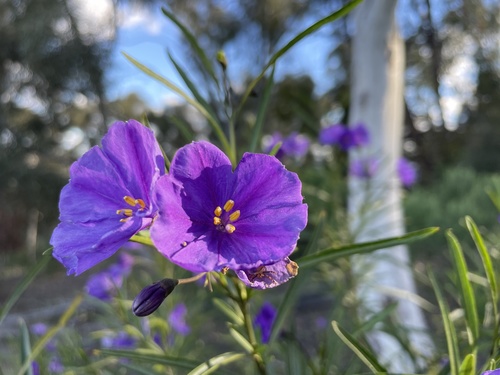
iNaturalist· cc-by
(c) Thomas Mesaglio, some rights reserved (CC BY), uploaded by Thomas Mesaglio
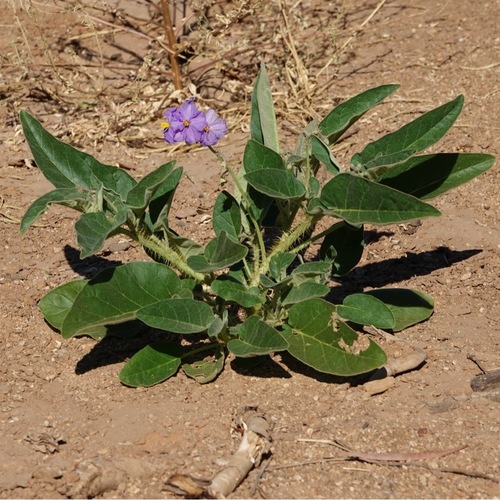
iNaturalist· cc-by-nc
(c) Steve Dew, some rights reserved (CC BY-NC)
Summary
Source: WikipediaSolanum petrophilum, commonly known as rock nightshade or prickly nightshade, is an Australian native perennial herbaceous plant that belongs to the family Solanaceae. Solanaceae has a worldwide distribution and also contains important food species such as the tomato (Solanum lycopersicum), peppers (Capsicum annuum), and potatoes (Solanum tuberosum). Solanum is a large genus in the Solanaceae family with over 100 different species in the family occurring in Australia, and a large majority of them also being native. Particularly many species occur in arid and semi-arid areas, though many also have wide distributions excluding alpine, saline and aquatic habitats.
Description
A shrub. It can be erect or spreading. It grows 20-50 cm high. The flowers are purple.
This description is brief — help expand it
Edible Uses
The fruit are eaten.
Known Hazards
The berries of S. petrophilum have long been thought to be toxic to livestock, though no clear evidence has proven this. It is likely due to the presence of toxic steroidal glycoalkaloids in the berries which can be harmful if ingested. They are a natural defence in many Solanum species against snails and insects and have the potential to suppress the germination of other competing plants. Some other Australian native Solanum species such as S. centrale are important food sources in arid Australia, though can still be toxic when unripe, but S. petrophilum is still treated with caution and avoided as a food source. Conversely, in studies of the Yellow-footed Rock Wallabies (Petrogale xanthopus), S. petrophilum was found to be a major contributor to its diet, particularly in summer and autumn when there is more fruit present and a lower proportion of other herbs.
Distribution
It grows on sandy and clayey soils and rocky hills. It grows in arid places.
Where It Grows
Australia*,
Notes
There are about 1400 Solanum species.
Also Known As
Ngaliyirki
References (5)
- Bodkin, F., 1991, Encyclopedia Botanica. Cornstalk publishing, p 935
- Lazarides, M. & Hince, B., 1993, Handbook of Economic Plants of Australia, CSIRO. p 223
- Linnaea 25:433. 1853
- Paczkowska, G . & Chapman, A.R., 2000, The Western Australian Flora. A Descriptive Calatogue. Western Australian Herbarium. p 538
- Samuels, J., 2015, Biodiversity of Food Species of the Solanaceae Family: A Preliminary Taxonomic Inventory of Subfamily Solanoideae. Resources 2015, 4. 277-322