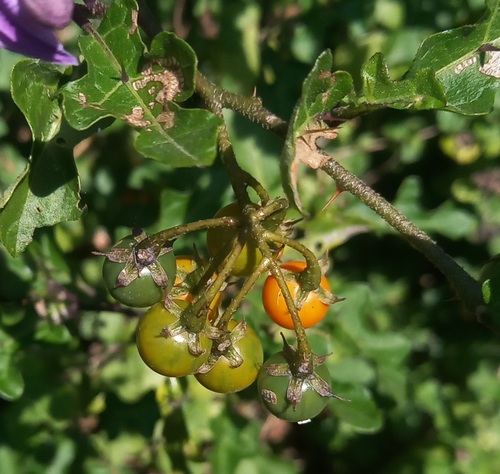
Solanum mamilliferum
Juz. & Bukasov
wikimedia· cc0
Wikimedia Commons - George Chernilevsky
wikimedia· cc-by-sa
Wikimedia Commons
Description
A tropical potato variety in the Solanaceae family.
This description is brief — help expand it
Edible Uses
Potato dishes vary around the world. Peruvian cuisine naturally contains the potato as a primary ingredient in many dishes, as around 3,000 varieties of the tuber are grown there. Chuño is a freeze-dried potato product traditionally made by Quechua and Aymara communities of Peru and Bolivia. In the UK, potatoes form part of the traditional dish fish and chips. Roast potatoes are commonly served as part of a Sunday roast dinner and mashed potatoes form a major component of several other traditional dishes, such as shepherd's pie, bubble and squeak, and bangers and mash. New potatoes may be cooked with mint and are often served with butter. In Germany, Northern Europe (Finland, Latvia and especially Scandinavian countries), Eastern Europe (Russia, Belarus and Ukraine) and Poland, newly harvested, early ripening varieties are considered a special delicacy. Boiled whole and served un-peeled with dill, these "new potatoes" are traditionally consumed with Baltic herring. Puddings made from grated potatoes (kugel, kugelis, and potato babka) are popular items of Ashkenazi, Lithuanian, and Belarusian cuisine. Cepelinai, the national dish of Lithuania, are dumplings made from boiled grated potatoes, usually stuffed with minced meat. In Italy, in the Friuli region, potatoes serve to make a type of pasta called gnocchi. Potato is used in northern China where rice is not easily grown, a popular dish being 青椒土豆丝 (qīng jiāo tǔ dòu sī), made with green pepper, vinegar and thin slices of potato. In the winter, roadside sellers in northern China sell roasted potatoes.
Known Hazards
Raw potatoes contain toxic glycoalkaloids, of which the most prevalent are solanine and chaconine. Solanine is found in other plants in the same family, Solanaceae, which includes such plants as deadly nightshade (Atropa belladonna), henbane (Hyoscyamus niger) and tobacco (Nicotiana spp.), as well as food plants like tomato. These compounds, which protect the potato plant from its predators, are especially concentrated in the aerial parts of the plant. The tubers are low in these toxins, unless they are exposed to light, which makes them go green. Exposure to light, physical damage, and age increase glycoalkaloid content within the tuber. Different potato varieties contain different levels of glycoalkaloids. The 'Lenape' variety, released in 1967, was withdrawn in 1970 as it contained high levels of glycoalkaloids. Since then, breeders of new varieties test for this, sometimes discarding an otherwise promising cultivar. Breeders try to keep glycoalkaloid levels below 200 mg/kg (0.0032 oz/lb). However, when these commercial varieties turn green, their solanine concentrations can go well above this limit, with higher levels in the potato's skin.
Distribution
A tropical plant.
Where It Grows
Colombia, Peru, South America,
Notes
There are about 1400 Solanum species.
References (2)
- Plants for a Future database, The Field, Penpol, Lostwithiel, Cornwall, PL22 0NG, UK. http://www.scs.leeds.ac.uk/pfaf/
- Trudy vsecouz. sezda genetike 3:609. 1929