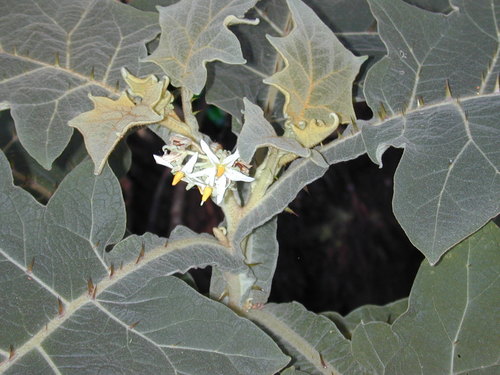
Solanum fendleri
A. Gray
Fendler's Horse-nettle, Fendler potato
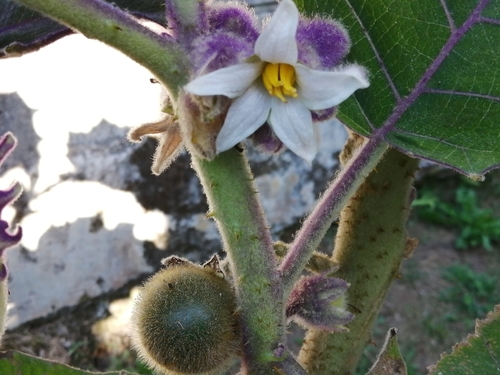
iNaturalist· cc-by-nc
(c) Jose Luis Leon de la Luz, some rights reserved (CC BY-NC)
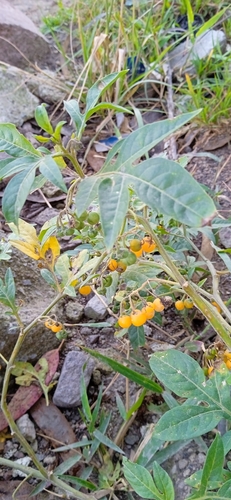
iNaturalist· cc-by-nc
(c) Jose Luis Leon de la Luz, some rights reserved (CC BY-NC)
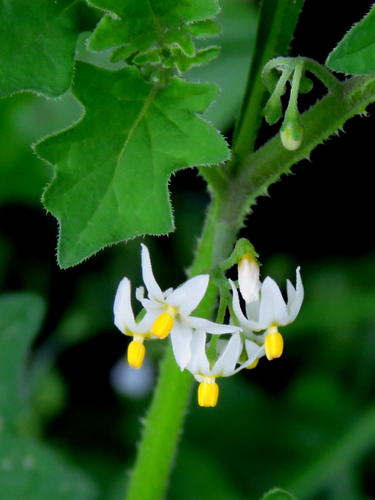
iNaturalist· cc-by-nc
(c) Eusebio Roldán Félix, some rights reserved (CC BY-NC)
Summary
Source: WikipediaA hermaphroditic perennial pollinated by insects. Grows in light sandy, medium loamy, and heavy clay soils with good drainage, thriving across mildly acidic to mildly alkaline pH ranges. Requires full sun and prefers moist conditions.
Description
A hermaphroditic perennial pollinated by insects. Grows in light sandy, medium loamy, and heavy clay soils with good drainage, thriving across mildly acidic to mildly alkaline pH ranges. Requires full sun and prefers moist conditions.
Edible Uses
The tubers can be eaten raw or cooked. They are rich in starch and can be dried and ground into a powder for use in bread-making. Described as pleasant eating with a flavour somewhat like sweet chestnut, the tubers are fairly small, averaging around 15mm in diameter. When eaten raw, they are typically mixed with white clay — a bite of clay taken after each mouthful to counteract the astringent effect of the raw potato in the mouth.
Traditional Uses
The small tubers are eaten raw, boiled, baked or roasted. They are boiled with clay.
This uses section is brief — help expand it
Medicinal Uses
Stomachic. Raw tubers have been used to treat gastric distress caused by hyperacidity.
Known Hazards
Raw potatoes contain toxic glycoalkaloids, of which the most prevalent are solanine and chaconine. Solanine is found in other plants in the same family, Solanaceae, which includes such plants as deadly nightshade (Atropa belladonna), henbane (Hyoscyamus niger) and tobacco (Nicotiana spp.), as well as food plants like tomato. These compounds, which protect the potato plant from its predators, are especially concentrated in the aerial parts of the plant. The tubers are low in these toxins, unless they are exposed to light, which makes them go green. Exposure to light, physical damage, and age increase glycoalkaloid content within the tuber. Different potato varieties contain different levels of glycoalkaloids. The 'Lenape' variety, released in 1967, was withdrawn in 1970 as it contained high levels of glycoalkaloids. Since then, breeders of new varieties test for this, sometimes discarding an otherwise promising cultivar. Breeders try to keep glycoalkaloid levels below 200 mg/kg (0.0032 oz/lb). However, when these commercial varieties turn green, their solanine concentrations can go well above this limit, with higher levels in the potato's skin.
Distribution
It is a warm temperate plant.
Where It Grows
Mexico, North America, USA,
Cultivation
We have very little information on this species and do not know if it will succeed in Britain. This plant is a N. American species of potatoes and it can probably be grown in much the same way as potatoes are grown. The following notes are based on the general needs of the genus. Succeeds in most soils. Dislikes wet or heavy clay soils. Prefers a slightly acid soil, the tubers are subject to scab on limy soils or those deficient in humus. Yields best on a fertile soil rich in organic matter.
Propagation
Sow seed in early spring in a warm greenhouse. Prick seedlings into a fairly rich compost as soon as they are large enough to handle and grow on quickly. Plant out after the last expected frosts. Alternatively, propagate by division: harvest tubers in autumn once frost has cut back the top-growth, store in a cool frost-free place over winter, and replant in April.
Other Uses
None known Special Uses
Other Information
It is a famine food.
Notes
There are about 1400 Solanum species.
Also Known As
Wild potato
References (9)
- Amer. J. Sci. Arts ser. 2, 22:285. 1856
- Beckstrom-Sternberg, Stephen M., and James A. Duke. "The Foodplant Database." http://probe.nalusda.gov:8300/cgi-bin/browse/foodplantdb.(ACEDB version 4.0 - data version July 1994)
- Facciola, S., 1998, Cornucopia 2: a Source Book of Edible Plants. Kampong Publications, p 236
- Hedrick, U.P., 1919, (Ed.), Sturtevant's edible plants of the world. p 614
- https://www.fireflyforest.com/flowers/category/edible-plants/ Edible Plants – Southeastern Arizona Wildflowers and Plants
Show all 9 references Hide references
- Kermath, B. M., et al, 2014, Food Plants in the Americas: A survey of the domesticated, cultivated and wild plants used for Human food in North, Central and South America and the Caribbean. On line draft. p 817
- Lim, T. K., 2015, Edible Medicinal and Non Medicinal Plants. Volume 9, Modified Stems, Roots, Bulbs. Springer p 78
- Moerman, D. F., 2010, Native American Ethnobotany. Timber Press. p 535
- Plants for a Future database, The Field, Penpol, Lostwithiel, Cornwall, PL22 0NG, UK. http://www.scs.leeds.ac.uk/pfaf/