Solanum aviculare
Forster.f.
Kangaroo apple, Poroporo
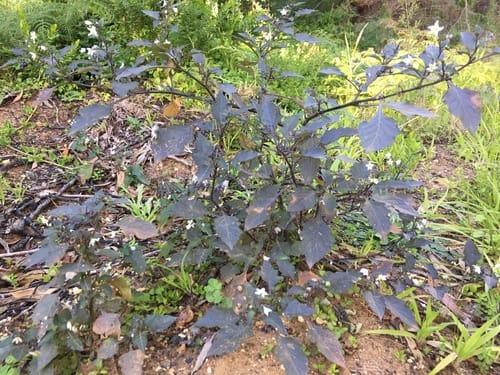
iNaturalist· cc0
no rights reserved, uploaded by Peter de Lange
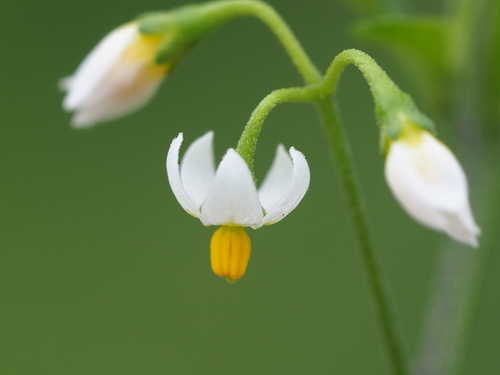
iNaturalist· cc-by-nc
(c) Pat Neve, some rights reserved (CC BY-NC), uploaded by Pat Neve
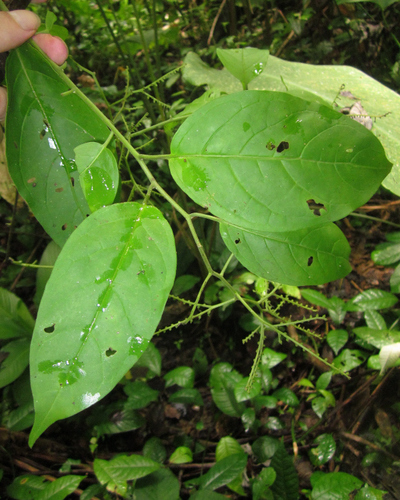
iNaturalist· cc-by-nc
(c) Jack Warden, some rights reserved (CC BY-NC), uploaded by Jack Warden
Summary
Source: WikipediaSolanum aviculare, commonly known as kangaroo apple or New Zealand nightshade, is a species of flowering plant in the family Solanaceae and native to New Zealand and the east coast of Australia.
Description
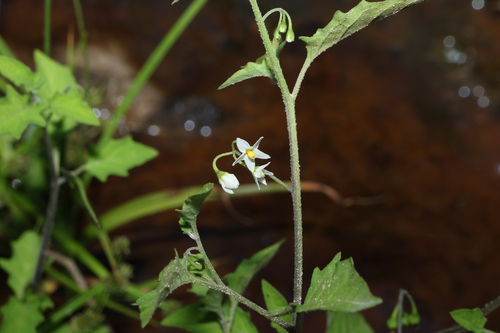
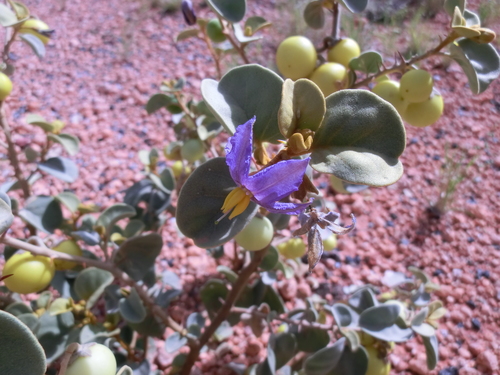
A shrub which keeps growing from year to year. It grows to 2-4 m tall and spreads to 5 m across. The stem is erect with spreading branches. The stems are purplish-green and angular. The leaves are dark green and 10-30 cm long and 1-12 cm wide. Normally the leaves are deeply divided into long tapering triangular segments. The leaf stalks are 3 cm long. The flowers are blue or purple and 3.5 cm across. They are 5 sided or star shaped with sharply pointed lobes. They develop in bunches in the axils of leaves and towards the ends of branches. The bunches can be 5-13 cm across. The fruit are egg shaped berries. They are orange, red or yellow and 2.5 cm long. There are several seeds inside the soft pulp.
Edible Uses
The fruit can be eaten raw or cooked, but must be thoroughly ripe as unripe fruit is poisonous. It can be used as a sweet fruit or as a vegetable. The fruit is best harvested once it has fallen from the plant, at which point it will have lost its unpleasant acidity. It tastes much worse than it looks — sickly sweet and often bitter — and quality varies from plant to plant and even year to year on the same plant. The fruit is up to 2cm long and contains a large number of flat seeds.
Traditional Uses
The fully ripe fruit is eaten raw or baked until the skin breaks open. They can be boiled, baked or stewed with sugar. They can be made into jam. Caution: The chemicals could make this plant risky, especially with unripe fruit and for pregnant women.
Medicinal Uses
The plant is a source of steroids much used in the pharmaceutical industry. The unripe berries are the richest source.
Known Hazards
The fruit when unripe was traditionally boiled by Indigenous communities in Australia to allow for its use as an oral contraceptive for women. The leaves and unripe fruits of S. aviculare contain the toxic alkaloid solasodine. S. aviculare is cultivated in Russia and Hungary for the solasidine which is extracted and used as a base material for the production of steroid contraceptives. Indigenous communities in Australia also used the fruit as a poultice on swollen joints. The plant contains a steroid which is important to the production of cortisone. The plant is also used as a rootstock for grafting eggplant.
Distribution
A warm and cool temperate plant. It is drought and frost resistant. It will grow on most soils. It is more common near the edges of rainforests. It suits hardiness zones 9-11.
Where It Grows
Asia, Australia, Britain, Europe, India, New Caledonia, New Zealand*, Norfolk Island, Pacific, Papua New Guinea, PNG, Solomon Islands, Russia, Tasmania, Vanuatu,
Cultivation
Succeeds in most fertile soils in a sunny position. Tolerates temperatures down to at least -7°c in Australian gardens but is not very hardy in Britain. It sometimes succeeds as a shrub outdoors in the mildest areas of the country but is more usually cut to the ground by winter cold. It can, however, be grown at the foot of a warm sunny wall and be treated as a herbaceous perennial. As long as the roots are given a good mulch in autumn they should survive quite cold winters. Alternatively, it is possible to grow the plant as an annual. If the seed is sown in early spring in a warm greenhouse and planted out after the last frosts it can fruit in its first year though yields will be lower than from plants grown as perennials. A very ornamental plant, it has been cultivated for its edible fruit by the New Zealand Maoris. It is a fast-growing but short-lived plant. There is much confusion between this species and S. laciniatum. Some botanists unite the two under S. aviculare whilst others say that S. laciniatum is a tetraploid form of this species. S. laciniatum is treated as a distinct species here.
Propagation
Seed - sow spring in a warm greenhouse. Germinates in 2–3 weeks at 20°C. Prick out seedlings into individual pots when large enough to handle. If growing as annuals, plant out after the last expected frosts with some protection such as a cloche until established. If growing as a perennial, especially at the limits of cold-hardiness, it is better to keep plants in the greenhouse for the first winter in fairly large pots (12cm or larger) to accommodate strong root growth. Top growth may die back over winter but roots should survive if greenhouse temperatures do not fall below about -5°C. Plant out in early summer the following year; plants will be somewhat hardier in their second winter. Cuttings of half-ripe wood, July/August in a frame. Very easy — cuttings root within a couple of weeks. Pot up in fairly large pots and overwinter in the greenhouse before planting out in early summer.
Other Uses
In warmer climates than Britain this plant is often used as a hedge.
Production
The fully mature fruit are collected after they drop from the plant. They have then lost their unpleasant acid taste.
Notes
Steroid drugs are collected from this plant. It is extensively cultivated in Russia. There are about 1400 Solanum species. Possibly not in Tasmania?.
Also Known As
Mayakitch, Mookitch
References (41)
- Ambasta, S.P. (Ed.), 2000, The Useful Plants of India. CSIR India. p 579
- Arora, R. K., 2014, Diversity in Underutilized Plant Species - An Asia-Pacific Perspective. Bioversity International. p 51
- Bindon, P., 1996, Useful Bush Plants. Western Australian Museum. p 229
- Blomberry, A.M., 1979, Australian Native Plants. Angus and Robertson p 316
- Bodkin, F., 1991, Encyclopedia Botanica. Cornstalk publishing, p 933
Show all 41 references Hide references
- Bremness, L., 1994, Herbs. Collins Eyewitness Handbooks. Harper Collins. p 129
- Brickell, C. (Ed.), 1999, The Royal Horticultural Society A-Z Encyclopedia of Garden Plants. Convent Garden Books. p 965
- Caton, J.M. & Hardwick, R. J., 2016, Field Guide to Useful Native Plants from Temperate Australia. Harbour Publishing House. p 276
- Cherikoff V. & Isaacs, J., The Bush Food Handbook. How to gather, grow, process and cook Australian Wild Foods. Ti Tree Press, Australia p 196
- Choudhury, B., 1979, Eggplant, in Simmonds, N.W., (ed), Crop Plant Evolution. Longmans. London. p 278
- Cooper, W. and Cooper, W., 2004, Fruits of the Australian Tropical Rainforest. Nokomis Editions, Victoria, Australia. p 519
- Cribb, A.B. & J.W., 1976, Wild Food in Australia, Fontana. p 59
- Cronin, L., 1989, The Concise Australian Flora. Reed. p 28
- Crowe, A., 1997, A Field Guide to the Native Edible Plants of New Zealand. Penguin. p 46
- Cundall, P., (ed.), 2004, Gardening Australia: flora: the gardener's bible. ABC Books. p 1346
- Curtis, W.M., 1993, The Student's Flora of Tasmania. Part 3 St David's Park Publishing, Tasmania, p 505
- Facciola, S., 1998, Cornucopia 2: a Source Book of Edible Plants. Kampong Publications, p 236
- Flora of Australia Volume 49, Oceanic Islands 1, Australian Government Publishing Service, Canberra. (1994) p 299
- French, B.R., 2010, Food Plants of Solomon Islands. A Compendium. Food Plants International Inc. p 387
- Hardwick, R.J., 2000, Nature's Larder. A Field Guide to the Native Food Plants of the NSW South Coast. Homosapien Books. p 23
- Hastings Advance Community College, 2017, Uses for Native Plants of the Mornington Peninsula. 86pp. p 69
- Hedrick, U.P., 1919, (Ed.), Sturtevant's edible plants of the world. p 613
- Henty, E.E., 1980, Harmful Plants in Papua New Guinea. Botany Bulletin No 12. Division Botany, Lae, Papua New Guinea. p 128
- Hibbert, M., 2002, The Aussie Plant Finder 2002, Florilegium. p 291
- Holliday, I., 1979, A Field Guide to Australian Native Shrubs. Rigby. p 188
- Hussey, B.M.J., Keighery, G.J., Cousens, R.D., Dodd, J., Lloyd, S.G., 1997, Western Weeds. A guide to the weeds of Western Australia. Plant Protection Society of Western Australia. p 223
- Kiple, K.F. & Ornelas, K.C., (eds), 2000, The Cambridge World History of Food. CUP p 1795
- Lamp, C & Collet F., 1989, Field Guide to Weeds in Australia. Inkata Press. p 274
- Lazarides, M. & Hince, B., 1993, Handbook of Economic Plants of Australia, CSIRO. p 221
- Lord, E.E., & Willis, J.H., 1999, Shrubs and Trees for Australian gardens. Lothian. p 192
- Low, T., 1991, Wild Food Plants of Australia. Australian Nature FieldGuide, Angus & Robertson. p 68
- Matthews, J., 1987, New Zealand Native Plants for your Garden. Pacific Publishers, p 109
- Paczkowska, G . & Chapman, A.R., 2000, The Western Australian Flora. A Descriptive Calatogue. Western Australian Herbarium. p 537
- Pl. esc. 42. 1786 Aug-Sep (Fl. ins. austr. 18. 1786 Oct-Nov)
- Plants for a Future database, The Field, Penpol, Lostwithiel, Cornwall, PL22 0NG, UK. http://www.scs.leeds.ac.uk/pfaf/
- Ratcliffe D & P., 1987, Australian Native Plants for Indoors. Little Hills press. p 131
- Ryan, M. (Ed.), 2003, Wild Plants of Greater Brisbane. Queensland Museum. p 294
- Salmon, J.T., 1989, The Native Trees of New Zealand. Heinmann Reid p 339
- Samuels, J., 2015, Biodiversity of Food Species of the Solonaceae Family: A Preliminary Taxonomic Inventory of Subfamily Solanoideae. Resources 2015, 4. 277-322
- Skinner, G. & Brown, C., 1981, Simply Living. A gatherer's guide to New Zealand's fields, forests and shores. Reed. p 50
- Williams, J.B., Harden, G.J., and McDonald, W.J.F., 1984, Trees and shrubs in rainforests of New South Wales and Southern Queensland. Univ. of New England, Armidale. p 64, 100