Cyphomandra hartwegii
(Miers) Sendtn. ex Walp.
Hartweg's Cyphomandra
iNaturalist· cc-by-nc
(c) Alisson Fierro-Minda, some rights reserved (CC BY-NC)
iNaturalist· cc-by-nc
(c) Alisson Fierro-Minda, some rights reserved (CC BY-NC)
iNaturalist· cc-by-nc
(c) Alisson Fierro-Minda, some rights reserved (CC BY-NC)
Summary
An evergreen frost-tender tree growing to 2 m tall with vigorous growth. Hardy to UK zone 9. Maintains foliage year-round with hermaphroditic flowers pollinated by insects and capable of self-fertilization. Needs full sun and well-drained soil in light sandy, medium loamy, or heavy clay compositions with pH from mildly acidic to mildly alkaline. Prefers consistently moist conditions.
Description
A shrub or small tree. It grows 2-12 m tall. The branches can be hairy. The fruit is a reddish berry. They are 3-5 cm long and 3-4 cm wide. The seeds are 4-7 mm long.
Edible Uses
The fruit can be eaten raw or cooked. It resembles a tomato in both flavour and size and is used as a tomato substitute in cooking.
Traditional Uses
The fruit are cooked like a tomato. It can be eaten raw but is stewed, candied in syrup, or sweetened and made into juice and preserves.
This uses section is brief — help expand it
Medicinal Uses
None known.
Distribution
A tropical plant. It grows in rain forest between sea level to 2,000 m altitude.
Where It Grows
Argentina, Bolivia, Brazil, Central America, Chile, Colombia, Costa Rica, Ecuador, French Guiana, Guianas, Guyana, Honduras, Mexico, Nicaragua, North America, Panama, Peru, South America, Suriname, Venezuela,
Cultivation
It can be grown from seed.
Propagation
Sow seed in spring in a greenhouse. Germination typically occurs within 4 weeks at 15°C or within 2 weeks at 25°C. Once large enough to handle, prick seedlings into individual pots and grow on in the greenhouse for at least their first winter. Plant out into permanent positions in late spring or early summer, after the last expected frosts. The plant can also be propagated from greenwood cuttings taken in a frame.
Other Uses
None known.
Production
It produces fruit in two years.
Other Information
Fruit are sold in local markets. It is a cultivated fruit plant.
Notes
There are about 30 Cyphomandra species.
Synonyms
Also Known As
Fruta de adua, Gallinazo panga, Pepinillo, Sandillo, Tomate de arbol
References (13)
- Bendezu, Y. F., 2018, Arboles nativos de lad Region Ucayali. Instituto Nacional de Innovacion Agraria. p 304
- Bohs, L., 1989, Ethnobotany of the Genus Cyphomandra (Solanaceae). Economic Botany 43(2) pp. 143-163
- Bohs, L., 1994, Cyphomandra (Solanaceae): Flora Neotropica, Vol. 63, pp. 102
- Facciola, S., 1998, Cornucopia 2: a Source Book of Edible Plants. Kampong Publications, p 233
- Gouldstone, S., 1983, Growing your own Food-bearing Plants in Australia. Macmillan p 94 (As Cyphomandra naranjilla)
Show all 13 references Hide references
- Hedrick, U.P., 1919, (Ed.), Sturtevant's edible plants of the world. p 263
- Plants for a Future database, The Field, Penpol, Lostwithiel, Cornwall, PL22 0NG, UK. http://www.scs.leeds.ac.uk/pfaf/
- Recher, P, 2001, Fruit Spirit Botanical Gardens Plant Index. www.nrg.com.au/~recher/ seedlist.html p 5 (?As Cyphomandra hartwegetii)
- Repert. bot. syst. 6:579. 1847
- Samuels, J., 2015, Biodiversity of Food Species of the Solonaceae Family: A Preliminary Taxonomic Inventory of Subfamily Solanoideae. Resources 2015, 4. 277-322 (As Solanum circinatum)
- Uphof,
- USDA, ARS, National Genetic Resources Program. Germplasm Resources Information Network - (GRIN). [Online Database] National Germplasm Resources Laboratory, Beltsville, Maryland. Available: www.ars-grin.gov/cgi-bin/npgs/html/econ.pl (10 April 2000)
- Vasquez, R. and Gentry, A. H., 1989, Use and Misuse of Forest-harvested Fruits in the Iquitos Area. Conservation Biology 3(4): 350f
More from Solanaceae
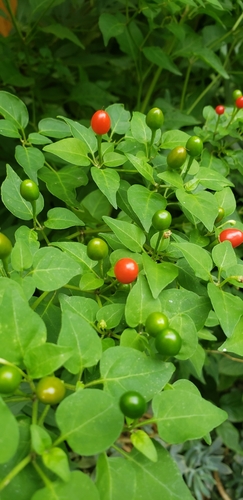
Capsicum annuum var. conoides
Cone peppers, Tabasco
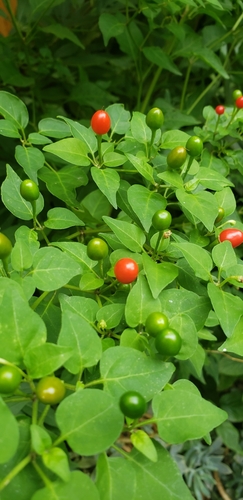
Capsicum annuum var. fasciculatum
Cluster pepper, Red cone pepper
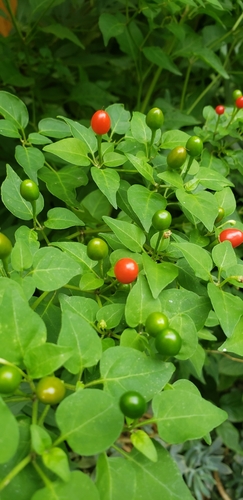
Capsicum annuum var. glabriusculium
Bird pepper
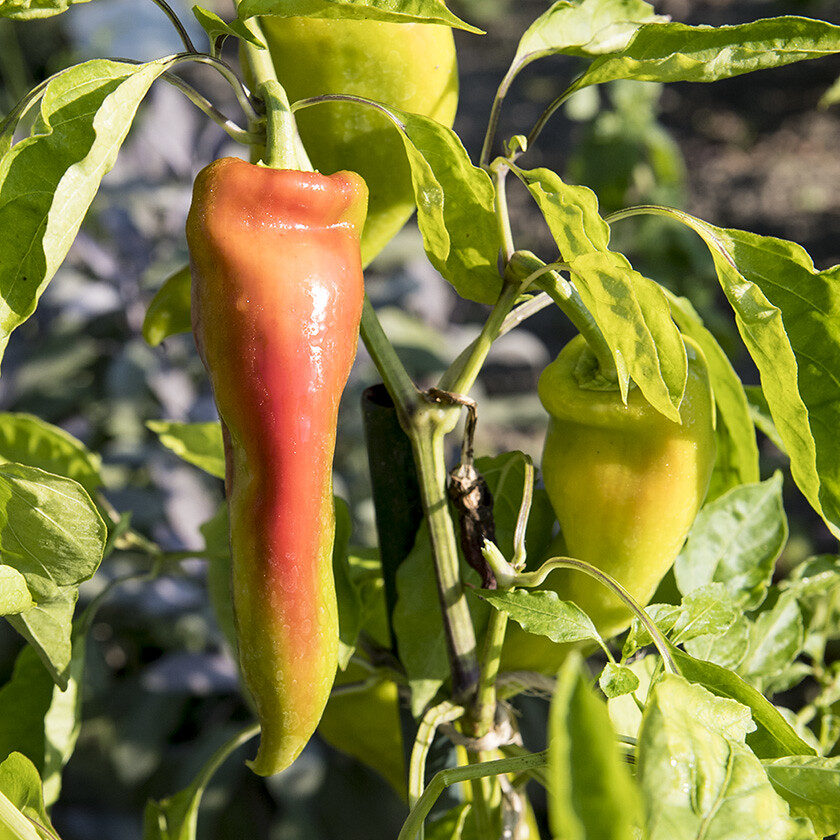
Capsicum annuum var. grossum
Bell pepper
Capsicum annuum var. longum
Long peppers, Afi largo
Capsicum annuum var. parvo-acuminatum
Long cayenne pepper