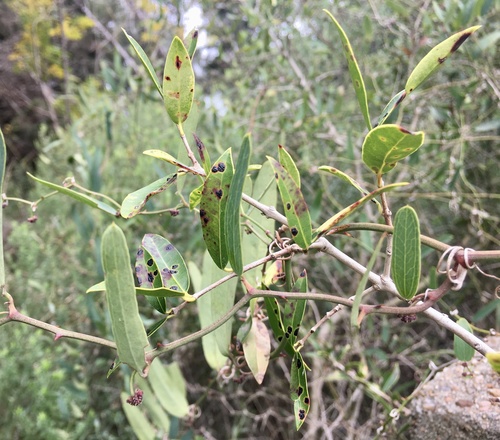
Smilax laurifolia
Linn.
Laurel greenbrier, Lanceleaf greenbrier
iNaturalist· cc-by-sa
(c) Chris Hoess, some rights reserved (CC BY-SA)
iNaturalist· cc-by-nc
(c) Allyson, some rights reserved (CC BY-NC)
iNaturalist· cc-by-nc
(c) Allyson, some rights reserved (CC BY-NC)
Summary
Source: WikipediaSmilax laurifolia is a species of flowering plant in the greenbrier family known by the common names laurel greenbrier, laurelleaf greenbrier, bamboo vine, and blaspheme vine. It is native to the southeastern United States, where it occurs along the Gulf Coastal Plain and Atlantic Plain from Texas to New Jersey, the range extending inland to Arkansas, Oklahoma, and Tennessee. It also occurs in Cuba and the Bahamas.
Description
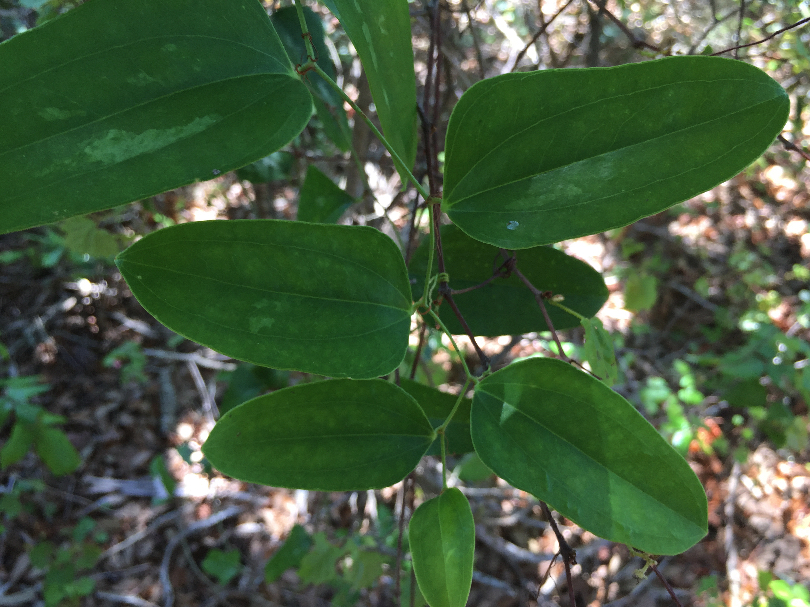
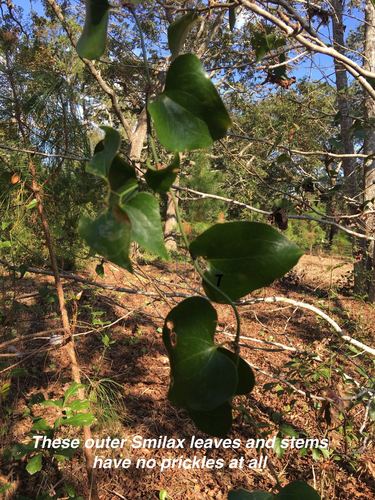
A slender woody vine. The stems have prickles. The leaves are green and leathery. They are oval to sword shaped and 6-10 cm long. They are wedge shaped at the base. The fruit are purple to black and have 1 seed.
Edible Uses
The root, which can grow up to 15cm thick, is starchy and good cooked. It can also be dried and ground into a powder to use as a flavouring in soups or for bread-making. Young shoots can be cooked and used as an asparagus substitute.
Traditional Uses
The young shoots are eaten as asparagus. A starch can be extracted from the roots. The tuberous roots are dried, ground into flour and used to make bread.
Medicinal Uses
The stem prickles have been rubbed on the skin as a counter-irritant to relieve localised pain, muscle cramps, and twitching. A tea made from the leaves and stems has been used for rheumatism and stomach complaints. Wilted leaves are applied as a poultice to boils. A tea from the roots is used to assist expulsion of the afterbirth. Reports that the roots contain the hormone testosterone have not been confirmed, though they may contain steroid precursors. The root bark is astringent and mildly tonic, and an infusion of it has been used as a wash for burns, sores, and pox.
Distribution
It is a tropical plant. It grows in wet woods and on the edges of swamps.
Where It Grows
Bahamas, Central America, Dominican Republic, Haiti, Mexico, North America, USA, West Indies,
Cultivation
Succeeds in most soils in sun or semi-shade. This species is not very hardy in Britain. It succeeds outdoors in S.W. England, but even there it is best when grown against a wall. The fruit takes two growing seasons to ripen. The stems have viscious thorns. Dioecious. Male and female plants must be grown if seed is required.
Propagation
Sow seed in March in a warm greenhouse, though this guidance likely applies to tropical members of the genus. Seeds from cooler-climate plants appear to need cold stratification, with some species taking two or more years to germinate. For temperate species, sow in a cold frame as soon as seed is received, or ideally as soon as it is ripe. Once seedlings germinate, prick out into individual pots when large enough to handle and grow on under glass for at least the first year — normally two years in pots — before planting into permanent positions in early summer. Divide in early spring as new growth begins; larger divisions can go directly into permanent positions, while smaller ones are best potted up and grown on in a lightly shaded cold frame until established, then planted out in summer. Cuttings of half-ripe shoots can be taken in July and rooted in a frame.
Other Uses
None known.
Notes
There are about 300 Smilax species.
Synonyms
References (8)
- Beckstrom-Sternberg, Stephen M., and James A. Duke. "The Foodplant Database." http://probe.nalusda.gov:8300/cgi-bin/browse/foodplantdb.(ACEDB version 4.0 - data version July 1994)
- Hedrick, U.P., 1919, (Ed.), Sturtevant's edible plants of the world. p 611
- Kermath, B. M., et al, 2014, Food Plants in the Americas: A survey of the domesticated, cultivated and wild plants used for Human food in North, Central and South America and the Caribbean. On line draft. p 810 (Also as Smilax lanceolata with different synonym)
- Kermath, B. M., et al, 2014, Food Plants in the Americas: A survey of the domesticated, cultivated and wild plants used for Human food in North, Central and South America and the Caribbean. On line draft. p 810 (As Smilax lanceolata)
- Moerman, D. F., 2010, Native American Ethnobotany. Timber Press. p 533
Show all 8 references Hide references
- Pena, F. B., et al, 1998, Los quelites de la Sierra Norte de Puebla, Mexico: Inventory Y Formas de Preparacion. Bol. Soc. Bot. Mexico 62:49-62 (As Smilax lanceolata)
- Plants for a Future database, The Field, Penpol, Lostwithiel, Cornwall, PL22 0NG, UK. http://www.scs.leeds.ac.uk/pfaf/ (Also as Smilax lanceolata)
- Sp. Pl. 2: 1031. 1753 (As Smilax lanceolata)