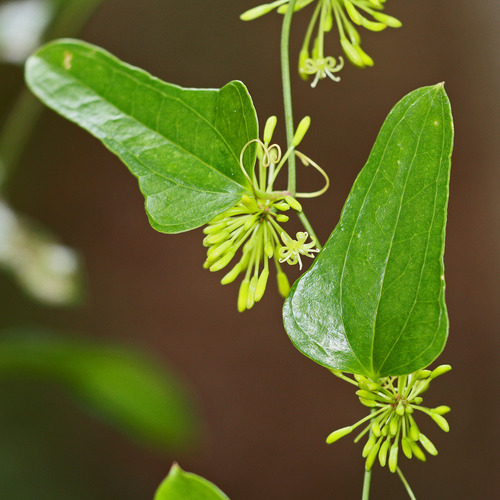
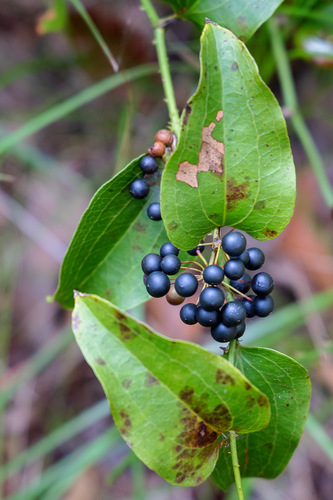
Smilax glabra
Roxb.
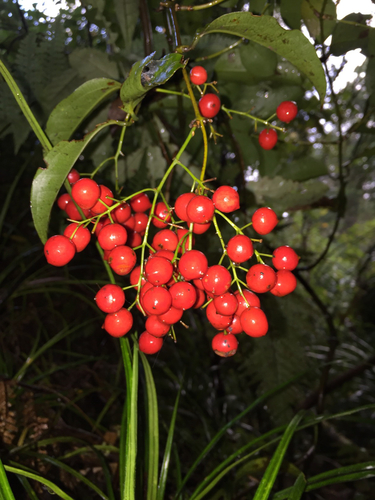
iNaturalist· cc-by-nc
(c) Hong, some rights reserved (CC BY-NC), uploaded by Hong
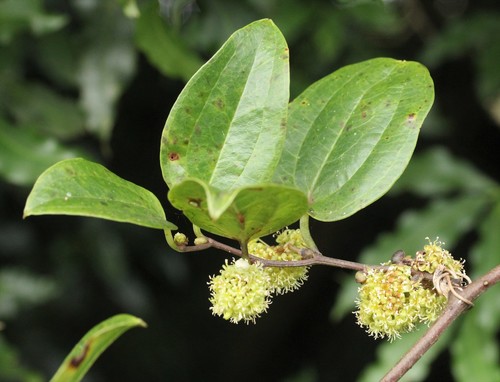
iNaturalist· cc-by-nc
(c) 眼前有景, some rights reserved (CC BY-NC)
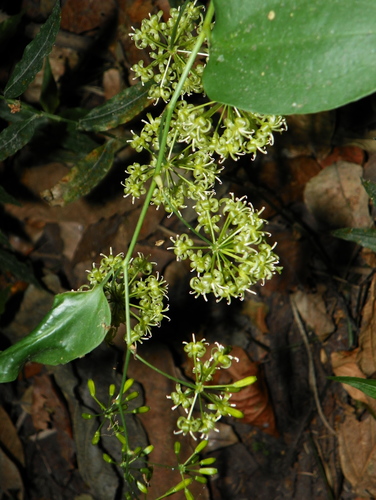
iNaturalist· cc-by-nc
(c) 眼前有景, some rights reserved (CC BY-NC)
Summary
Source: WikipediaSmilax glabra, sarsaparilla, is a plant species in the genus Smilax. It is native to China, the Himalayas, and Indochina. S. glabra is a traditional medicine in Chinese herbology, whence it is also known as tufuling (土茯苓) or chinaroot, china-root, and china root (a name it shares with the related S. china). Chinaroot is a key ingredient in the Chinese medical dessert guilinggao, which uses its ability to set certain kinds of jelly.
Description
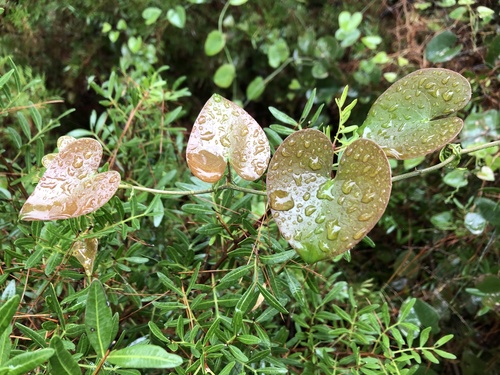
A climbing vine. It does not have prickles. The stem is branched. It is 1-4 m long and woody. The leaf stalk is 5-15 cm long and narrowly winged. There are tendrils. The leaf blade is oval or sword shaped and 6-15 cm long by 1-7 cm wide. The flowering stalk has 10-30 or more flowers. They are greenish white. The fruit is a round, blue-black berry. It is 6-10 mm across.
Edible Uses
The root is cooked and can be dried and ground into a powder; it contains nearly 70% starch. The fruit, up to 10mm in diameter, is also edible, though no further details are recorded.
Traditional Uses
The root is used as a substitute for coffee. The young shoots are fried. The fresh fruit are eaten.
This uses section is brief — help expand it
Medicinal Uses
The aerial tubers are used in the treatment of abscesses, boils, cystitis and diarrhoea. The rhizome is antiarthritic, antiscrophulatic, depurative, and stomachic, with applications for the skin. It has been used in the treatment of cancer, mercury poisoning, acute bacterial dysentery, rheumatoid arthritis and syphilis, and is said to be clinically 90% effective in the treatment of primary syphilis.
Distribution
A tropical plant. It grows on thinly forested slopes along valleys. In China it occurs between 300-1800 m altitude in many provinces. In Sichuan and Yunnan.
Where It Grows
Asia, Cambodia, China, India, Indochina, Laos, Myanmar, Northeastern India, SE Asia, Taiwan, Thailand, Tibet, Vietnam,
Cultivation
We have very little information on this species and do not know if it will be hardy in Britain, though judging by its native range it should succeed outdoors in many parts of the country. The following notes are based on the general needs of the genus. Succeeds in most soils in sun or semi-shade. Dioecious. Male and female plants must be grown if seed is required.
Propagation
Sow seed in March in a warm greenhouse — though this guidance likely applies to tropical members of the genus. Seeds from plants of cooler regions appear to need a period of cold stratification, and some species can take two or more years to germinate. For temperate species, sow in a cold frame as soon as seed is received, or ideally as soon as it is ripe. When seedlings germinate, prick out into individual pots and grow on in a greenhouse for at least the first year, though keeping them in pots for two years is preferable. Plant out into permanent positions in early summer. Divide in early spring as new growth begins; larger divisions can go straight into permanent positions, while smaller ones are best potted up and grown on in a lightly shaded cold frame until well established, then planted out in summer. Cuttings of half-ripe shoots can be taken in July in a frame.
Other Uses
None known Special Uses
Production
In NE Thailand fruit are available March to May.
Other Information
It is sold in local markets in China. It is cultivated.
Notes
There are about 300 Smilax species. The tuber like roots are used in medicine.
Nutrition
| Part | Moisture | kJ | kcal | Protein | Vit A | Vit C | Iron | Zinc |
|---|---|---|---|---|---|---|---|---|
| Leaves | 83.3 | 193 | 46 | 2.4 | — | 18 | — | — |
Synonyms
Also Known As
Barichob-chini, Harina-shuk-china, Hazena, Hmab pos tauj tsiab, Kai tluang, Katcho-gyi, Phelangtang, Ruikangtang, Tu fu, Tu fu ling
References (15)
- Altschul, S.V.R., 1973, Drugs and Foods from Little-known Plants. Notes in Harvard University Herbaria. Harvard Univ. Press. Massachusetts. no. 366
- Ambasta, S.P. (Ed.), 2000, The Useful Plants of India. CSIR India. p 577
- Cengel, D. J. & Dany. C., (Eds), 2016, Integrating Forest Biodiversity Resource Management and Sustainable Community Livelihood Development in the Preah Vihear Protected Forest. International Tropical Timber Organization p 110
- Chen Xinqi, Liang Songyun, Xu Jiemei, Tamura M.N., Liliaceae. Flora of China. p 36
- Fl. ind. ed. 1832, 3:792. 1832
Show all 15 references Hide references
- Kar, A., & Borthakur, S. K., 2007, Wild vegetables sold in local markets of Karbi Anglong, Assam. Indian Journal of Traditional Knowledge. 6(1) January 2007, pp 169-172
- Kar, A., et al, 2013, Wild Edible Plant Resources used by the Mizos of Mizoram, India. Kathmandu University Journal of Science, Engineering and Technology. Vol. 9, No. 1, July, 2013, 106-126
- Li, D. et al, 2017, Ethnobotanical survey of herbal tea plants from the traditional markets in Chaoshan, China. Journal of Ethnopharmacology. 205 (2017) 195-206
- Mot So Rau Dai an Duoc O Vietnam. Wild edible Vegetables. Ha Noi 1994, p 140
- Phangchopi, U., et al, 2015, Diversity of wild edible plants in Marat Longri Wildlife Sanctuary, Assam. Indian Journal of Natural Products and Resources Vol. 6(4), December 2015 pp. 305-313
- Plants for a Future database, The Field, Penpol, Lostwithiel, Cornwall, PL22 0NG, UK. http://www.scs.leeds.ac.uk/pfaf/
- Suksri, S., et al, 2005, Ethnobotany in Bung Khong Long Non-Hunting Area, Northeast Thailand. Kasetsart J., (Nat. Sci) 39: 519-533
- Teron, R. & Borthakur, S. K., 2016, Edible Medicines: An Exploration of Medicinal Plants in Dietary Practices of Karbi Tribal Population of Assam, Northeast India. In Mondal, N. & Sen, J.(Ed.) Nutrition and Health among tribal populations of India. p 155
- Whitney, C. W., et al, 2014, Conservation and Ethnobotanical Knowledge of a Hmong Community in Long Lan, Luang Prabang, Lao People’s Democratic Republic. Ethnobotany Research and Applications 12:643-658
- Zhang, Q., et al, 2009, Antioxidant activity of Rhizoma Smilacis Glabrae extracts and its key constituet- astilbin. Food Chemistry 115: 297-303