Smilax glyciphylla
Smith
Sweet tea, Sarsparilla vine
iNaturalist· cc-by-nc
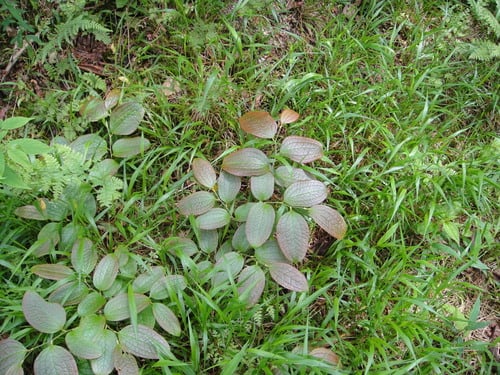
(c) Nathanael Green, some rights reserved (CC BY-NC)
iNaturalist· cc-by-nc
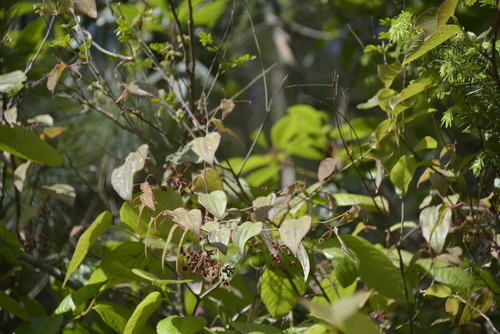
(c) polyscias099, some rights reserved (CC BY-NC)
iNaturalist· cc-by-nc
(c) polyscias099, some rights reserved (CC BY-NC)
Summary
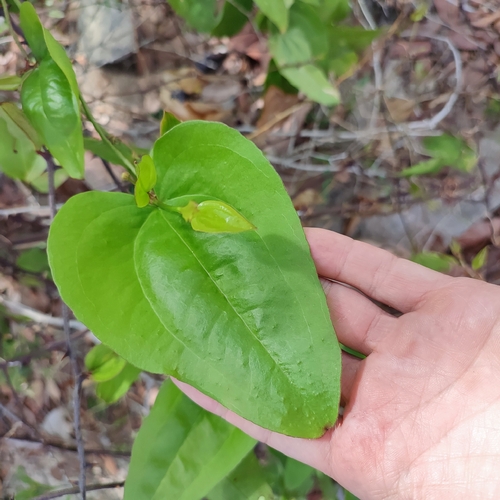
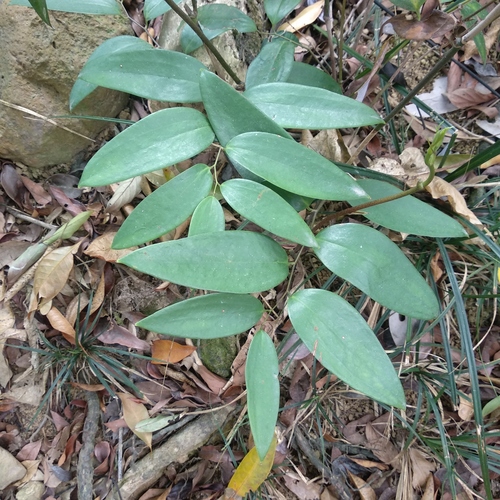
Source: WikipediaSmilax glyciphylla, the sweet sarsaparilla, is a dioecious climber native to eastern Australia. It is widespread in rainforest, sclerophyll forest and woodland; mainly in coastal regions. The leaves are distinctly three-veined with a glaucous under-surface, lanceolate, 4–10 cm long by 1.5–4 cm wide. Coiling tendrils are up to 8 cm long. The globose berries are 5–8 mm in diameter, black with a singular seed.
Description
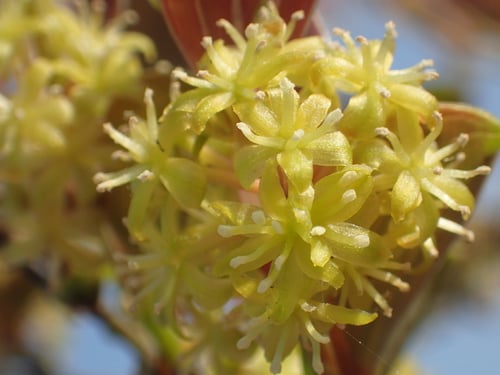
A slender, wiry climber. It does not have prickles. The leaves are sword shaped and thin textured. They are 8-10 cm long and 3-4 cm wide. They are dark green above and paler underneath. They have 3 prominent veins. The flowers are small and greenish-white. They occur in loose clusters in the axils of leaves. The fruit are black berries. They are 5-8 mm across. They have 3 seeds.
Edible Uses
The leaves are refreshing to chew and can also be used as a tea substitute. The plant has also been used as a sugar substitute, though the specific part used for this purpose is not recorded.
Traditional Uses
The ripe fruit are eaten raw.
This uses section is brief — help expand it
Medicinal Uses
Used as an alterative, antiscorbutic, diuretic, pectoral, and tonic.
Distribution
A tropical plant. They are found in moist gullies and rainforests. In tropical Queensland it grows from sea level to 1550 m altitude.
Where It Grows
Australia*,
Cultivation
We have very little information on this species and do not know if it will be hardy in Britain. It tolerates temperatures down to at least -7°c in Australian gardens but this cannot be translated directly to this country due to our cooler summers and longer, colder and wetter winters. The following notes are based on the general needs of the genus. Succeeds in most soils in sun or semi-shade. Dioecious. Male and female plants must be grown if seed is required.
Propagation
Sow seed in March in a warm greenhouse, though this guidance likely applies to tropical members of the genus. Seeds from plants in cooler areas appear to need cold stratification, and some species can take two or more years to germinate. For temperate species, sow in a cold frame as soon as seed is received, or as soon as it is ripe if possible. Once seedlings germinate, prick them out into individual pots when large enough to handle and grow on under glass for at least the first year — typically two years in pots before planting out into permanent positions in early summer. Divide in early spring as new growth begins; larger divisions can go straight into permanent positions, while smaller ones do best potted up and grown on in a lightly shaded cold frame until well established, then planted out in summer. Cuttings of half-ripe shoots can be taken in July and rooted in a frame.
Other Uses
None known.
Notes
There are about 300 Smilax species.
Synonyms
References (20)
- Beasley, J., 2011, Plants of Tropical North Queensland - the compact guide. Footloose publications. p 70
- Bodkin, F., 1991, Encyclopedia Botanica. Cornstalk publishing, p 932
- Caton, J.M. & Hardwick, R. J., 2016, Field Guide to Useful Native Plants from Temperate Australia. Harbour Publishing House. p 240
- Cherikoff V. & Isaacs, J., The Bush Food Handbook. How to gather, grow, process and cook Australian Wild Foods. Ti Tree Press, Australia p 171, 196
- Cooper, W. and Cooper, W., 2004, Fruits of the Australian Tropical Rainforest. Nokomis Editions, Victoria, Australia. p 517
Show all 20 references Hide references
- Cribb, A.B. & J.W., 1976, Wild Food in Australia, Fontana. p 177
- Hardwick, R.J., 2000, Nature's Larder. A Field Guide to the Native Food Plants of the NSW South Coast. Homosapien Books. p 17
- Haslam, S., 2004, Noosa's Native Plants. Noosa Integrated Catchment Assn. Inc. p 305
- Hedrick, U.P., 1919, (Ed.), Sturtevant's edible plants of the world. p 610
- Jackes, B.R., 2001, Plants of the Tropics. Rainforest to Heath. An Identification Guide. James Cook University. p 82
- Jones, D.L. & Gray, B., 1977, Australian Climbing Plants. Reed. p 144
- Lazarides, M. & Hince, B., 1993, Handbook of Economic Plants of Australia, CSIRO. p 221
- Lord, E.E., & Willis, J.H., 1999, Shrubs and Trees for Australian gardens. Lothian. p 325
- Low, T., 1992, Bush Tucker. Australia’s Wild Food Harvest. Angus & Robertson. p 22
- Melzer, R. & Plumb, J., 2011, Plants of Capricornia. Belgamba, Rockhampton. p 390
- Morley, B.D., & Toelken, H.R., (Eds), 1983, Flowering Plants in Australia. Rigby. p 341
- Plants for a Future database, The Field, Penpol, Lostwithiel, Cornwall, PL22 0NG, UK. http://www.scs.leeds.ac.uk/pfaf/
- Ryan, M. (Ed.), 2003, Wild Plants of Greater Brisbane. Queensland Museum. p 309
- Smith, K & I., 199, Grow your own bushfoods. New Holland. Australia. p 14
- Ulian, T., et al, 2020, Unlocking plant resources to support food security and promote sustainable agriculture. Plants, People, Planet. 2020;2:421–445.