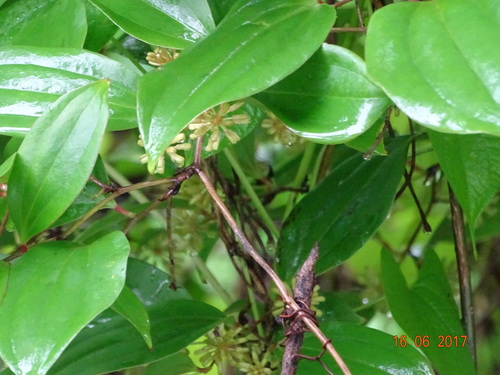
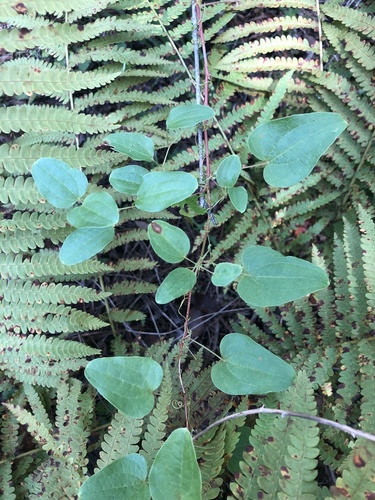
Smilax bona-nox
L.
Bullbrier, Greenbrier
iNaturalist· cc-by-nc
(c) Janet Wright, some rights reserved (CC BY-NC)
iNaturalist· cc-by-nc
(c) Janet Wright, some rights reserved (CC BY-NC)
iNaturalist· cc-by-nc
(c) Janet Wright, some rights reserved (CC BY-NC)
Summary
Source: WikipediaSmilax bona-nox, the saw greenbrier, is a species of plant in the family Smilacaceae. It is native to the Southern United States, and eastern Mexico.
Description
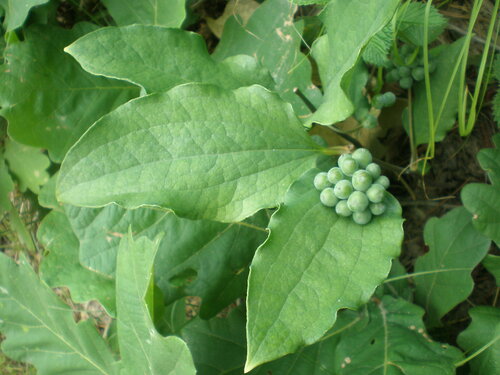
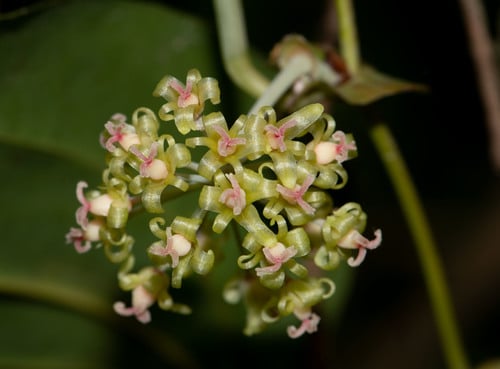
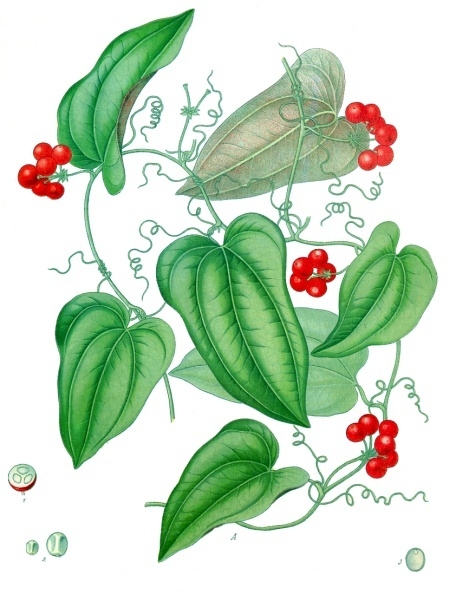
A slightly woody plant. It is a climbing vine that keeps growing from year to year. The stems are four sided. The branches have long green tendrils. The leaves are triangle shaped. They are alternate and fall off during the year. They are 5-10 cm long. There can be teeth along the edge. The vine can be separately male or female. These are in dense round clusters. They are greenish-white. The fruit are black and small. They are 5-10 mm across. The seeds are very small and brown.
Edible Uses
The root is cooked and can be dried and ground into a powder or made into a gelatine, as it contains a pectin-like substance. Young shoots can be eaten raw or cooked. The fruit is edible raw but has a rubbery texture requiring prolonged chewing. It is produced in umbels of up to 20 fruits, each about 5mm in diameter.
Traditional Uses
The fruit can be eaten raw or slightly cooked. The young shoots are cooked with other vegetables. The tuberous roots can be used in jellies and drinks. They can also be dried, thickened and used as flour.
Medicinal Uses
The root is diuretic and is used in the treatment of dropsy and urinary complaints. A tea made from the roots helps with the expelling of afterbirth. Reports that the roots contain the hormone testosterone have not been confirmed, though they may contain steroid precursors. The stem prickles have been rubbed on the skin as a counter-irritant to relieve localised pains, muscle cramps and twitching. A tea made from the leaves and stems has been used as a general tonic and for treating rheumatism and stomach problems. Wilted leaves are applied as a poultice to boils.
Distribution
It is a temperate plant.
Where It Grows
Britain, Europe, Mexico, North America, USA,
Cultivation
Succeeds in most soils in sun or semi-shade. Dioecious. Male and female plants must be grown if seed is required.
Propagation
Sow seed in March in a warm greenhouse — though this guidance likely applies to tropical members of the genus. Seeds from plants of cooler regions appear to need a period of cold stratification, and some species can take two or more years to germinate. For temperate species, sow in a cold frame as soon as seed is received, or ideally as soon as it is ripe. When seedlings germinate, prick out into individual pots and grow on in a greenhouse for at least the first year, though keeping them in pots for two years is preferable. Plant out into permanent positions in early summer. Divide in early spring as new growth begins; larger divisions can go straight into permanent positions, while smaller ones are best potted up and grown on in a lightly shaded cold frame until well established, then planted out in summer. Cuttings of half-ripe shoots can be taken in July in a frame.
Other Uses
None known Special Uses
Production
The new young shoots are harvested.
Notes
There are about 300 Smilax species.
Also Known As
Zarza, Zarzaparilla
References (9)
- Beckstrom-Sternberg, Stephen M., and James A. Duke. "The Foodplant Database." http://probe.nalusda.gov:8300/cgi-bin/browse/foodplantdb.(ACEDB version 4.0 - data version July 1994) (As Smilax bona)
- Elias, T.S. & Dykeman P.A., 1990, Edible Wild Plants. A North American Field guide. Sterling, New York p 66
- Esperanca, M. J., 1988. Surviving in the wild. A glance at the wild plants and their uses. Vol. 1. p 149
- Kermath, B. M., et al, 2014, Food Plants in the Americas: A survey of the domesticated, cultivated and wild plants used for Human food in North, Central and South America and the Caribbean. On line draft. p 810
- Martin, F.W. & Ruberte, R.M., 1979, Edible Leaves of the Tropics. Antillian College Press, Mayaguez, Puerto Rico. p 202
Show all 9 references Hide references
- Moerman, D. F., 2010, Native American Ethnobotany. Timber Press. p 533
- Piedra-Malagón, E. M., et al, 2022, Edible native plants of the Gulf of Mexico Province. Biodiversity Data Journal 10: e80565 p 30
- Plants for a Future database, The Field, Penpol, Lostwithiel, Cornwall, PL22 0NG, UK. http://www.scs.leeds.ac.uk/pfaf/
- Sp. Pl. 2: 1030. 1753