Smilax megacarpa
A DC
Da guo ba qia
iNaturalist· cc-by-nc
(c) airgel, some rights reserved (CC BY-NC), uploaded by airgel
iNaturalist· cc-by
(c) scallions, some rights reserved (CC BY), uploaded by scallions
iNaturalist· cc-by-nc-sa
(c) Smithsonian Institution, National Museum of Natural History, Department of Botany, some rights reserved (CC BY-NC-SA)
Description
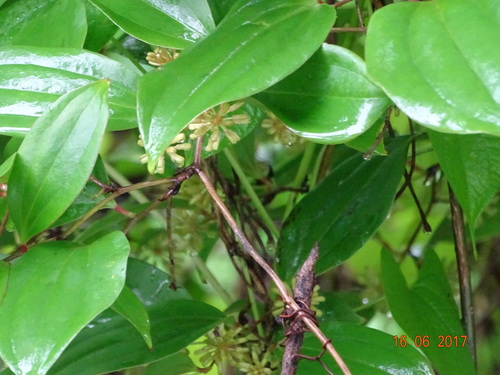
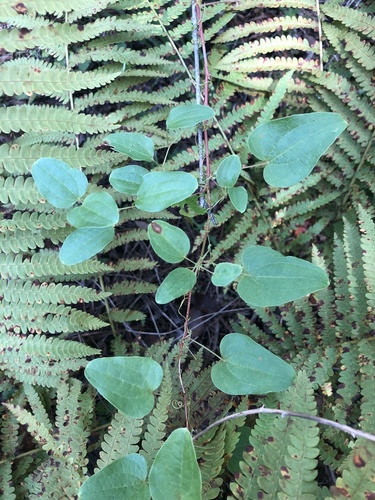
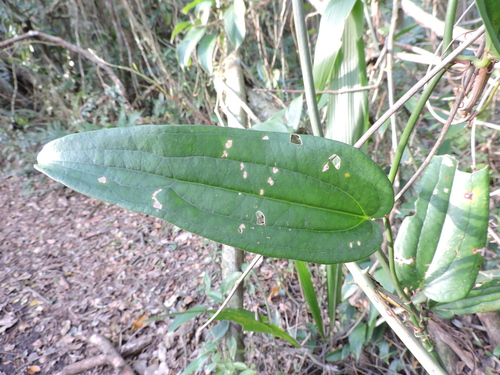
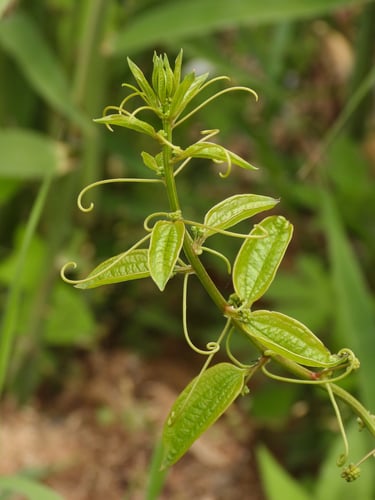
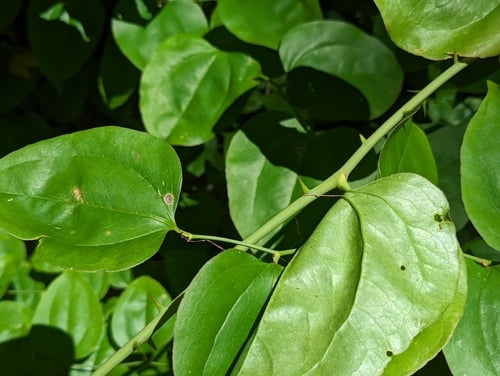
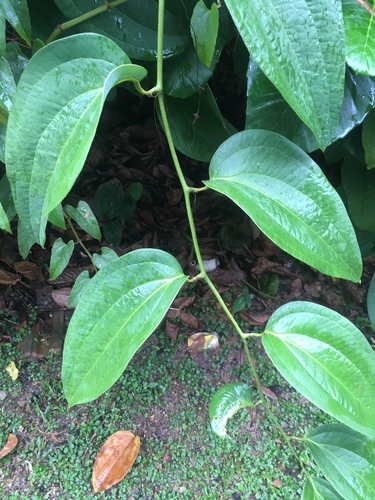
A climbing vine. It usually does not have prickles. The stem is branched. It is 10 m long and woody. The leaf stalk is 1.5-5 cm long and has narrow wings. Tendrils are usually present. The leaf blade is oval and 10-20 cm long by 3-12 cm wide. It is papery. There can be 1-3 flowerings stalks together. They are 3-6 cm long. There can be 6-20 flowers on each stalk. The flowers are greenish yellow. The fruit is a dark red berry. It is round and 1.5-2 cm across.
Edible Uses
The dark red berries are conserved and eaten. The rhizome and roots are also eaten.
Traditional Uses
The fruit are conserved and eaten. The rhizome is eaten.
This uses section is brief — help expand it
Medicinal Uses
The plant is used in local medicine in Laos, where it plays a role in medicines given after childbirth and against cough.
Distribution
A tropical plant. It grows in forest thickets and shaded slopes from near sea level to 1500 m in southern China. In Yunnan.
Where It Grows
Asia, Cambodia, China, India, Indochina, Indonesia, Laos, Malaysia, Myanmar, Pacific, Philippines, SE Asia, Thailand, Vietnam,
Notes
There are about 300 Smilax species.
Synonyms
Also Known As
Akar kelona, Porpreus, Vor rombers
References (8)
- Altschul, S.V.R., 1973, Drugs and Foods from Little-known Plants. Notes in Harvard University Herbaria. Harvard Univ. Press. Massachusetts. no. 374
- Ambasta, S.P. (Ed.), 2000, The Useful Plants of India. CSIR India. p 577
- Burkill, I.H., 1966, A Dictionary of the Economic Products of the Malay Peninsula. Ministry of Agriculture and Cooperatives, Kuala Lumpur, Malaysia. Vol 2 (I-Z) p 2075
- Chen Xinqi, Liang Songyun, Xu Jiemei, Tamura M.N., Liliaceae. Flora of China. p 40
- Lim, T. K., 2015, Edible Medicinal and Non Medicinal Plants. Volume 9, Modified Stems, Roots, Bulbs. Springer p 77
Show all 8 references Hide references
- PROSEA handbook Volume 9 Plants yielding non-seed carbohydrates. p 189
- Turreira Garcia, N., et al, 2017, Ethnobotanical knowledgeof the Kuy and Khmer people in Prey Lang, Cambodia. Cambodian Journal of Natural History 2017 (1): 76-101
- World Checklist of Useful Plant Species 2020. Royal Botanic Gardens, Kew