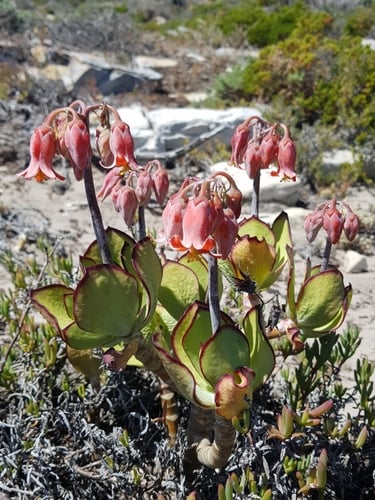
Sedum rupestre
L.
Crooked yellow stonecrop, Sengreene
iNaturalist· cc-by
(c) Igor Balashov, some rights reserved (CC BY)
iNaturalist· cc-by
(c) Igor Balashov, some rights reserved (CC BY)
iNaturalist· cc-by
(c) Igor Balashov, some rights reserved (CC BY)
Summary
Source: WikipediaEvergreen perennial reaching 10 cm tall by 30 cm wide. Flowers July to August with seed ripening August to September. Hermaphroditic, self-fertile, pollinated by bees, flies, and Lepidoptera. Hardy to UK zone 7, not frost tender. Grows in light sandy, medium loamy, and heavy clay soils with good drainage. Prefers neutral to mildly alkaline pH. Tolerates semi-shade or full sun. Adapts to both dry and moist conditions with excellent drought tolerance.
Description
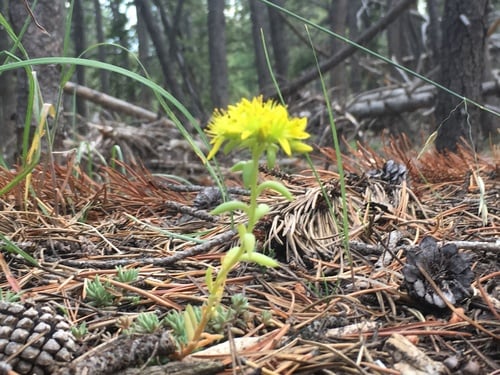
A small succulent plant. It grows 20-40 cm high and spreads 30-50 cm wide. It is spreading and forms a mound. It keeps growing from year to year. The stems are woody. The leaves are narrow and fleshy and crowded on the stems. They are light blue-green. The flowers are bright yellow and in heads.
Edible Uses
The leaves can be eaten raw or cooked. Their slightly astringent, sour taste makes them a useful addition to green tossed salads, and they can also be added to soups or served as a cooked vegetable. When used in salads, the leaves have a fine relish.
Traditional Uses
It is used mixed with salads. It is best cooked to remove alkaloids.
This uses section is brief — help expand it
Medicinal Uses
None known.
Known Hazards
Although not poisonous, if large quantities of this plant are eaten it can cause a stomach upset.
Distribution
It is a temperate plant. It suits hardiness zones 7-10.
Where It Grows
Australia, Britain, Europe, Germany, Hawaii, Ireland, Italy, Luxembourg, Mediterranean, Netherlands, Pacific, Tasmania, USA,
Cultivation
Succeeds in most soils but prefers a fertile well-drained soil. Requires a sunny position. The plant flowers best when grown in a sunny position, though it also succeeds in semi-shade. Established plants are very drought tolerant, they grow well in dry soils and can also be grown in a crevice on a wall. This species is hardy to about -15°c. A mat forming plant, it spreads rapidly and it is not suitable for the rockery. All members of this genus are said to have edible leaves, though those species, such as this one, that have yellow flowers can cause stomach upsets if they are eaten in quantity. Plants in this genus seem to be immune to the predations of rabbits. An evergreen.
Propagation
Surface sow seed in spring in well-drained soil in a sunny greenhouse position, keeping the soil consistently moist. Prick seedlings into individual pots when large enough to handle. Plant out during summer if sufficient growth has been made, otherwise overwinter in a cold frame or greenhouse and plant out the following early summer. Division is straightforward at almost any point during the growing season, though spring or early summer is preferred. Larger divisions can go directly into permanent positions; smaller ones are best potted up and grown on in a lightly shaded cold frame until well established, then planted out in summer.
Other Uses
A good ground cover plant for sunny positions, with an open growth habit that suits underplanting with larger bulbs such as some lilies. Space starter plants 20–30cm apart for rapid establishment as ground cover. The plant is used in green roof and green wall systems in Korea, where it is incorporated into building structures to provide wildlife habitat, insulate the building, and improve the surrounding environment. The cultivar 'Blue Spruce' has been specifically noted for such use.
Notes
There are about 400 Sedum species.
Synonyms
References (8)
- Baker, M. L. & de Salas, M. F., 2012, A Census of the Vascular Plants of Tasmania. (On line)
- Cundall, P., (ed.), 2004, Gardening Australia: flora: the gardener's bible. ABC Books. p 1330
- Hedrick, U.P., 1919, (Ed.), Sturtevant's edible plants of the world. p 602
- Irving, M., 2009, The Forager Handbook, A Guide to the Edible Plants of Britain. Ebury Press p 293
- Jackes, D. A., 2007, Edible Forest Gardens
Show all 8 references Hide references
- Plants for a Future database, The Field, Penpol, Lostwithiel, Cornwall, PL22 0NG, UK. http://www.scs.leeds.ac.uk/pfaf/
- Sp. pl. 2:431. 1753
- Staples, G.W. and Herbst, D.R., 2005, A tropical Garden Flora. Bishop Museum Press, Honolulu, Hawaii. p 261