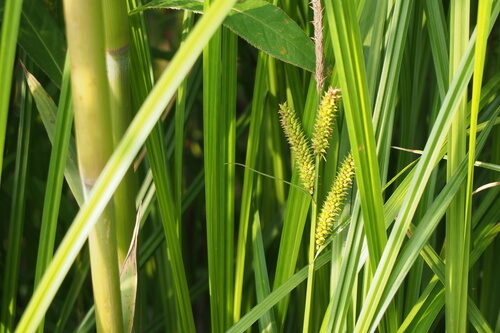
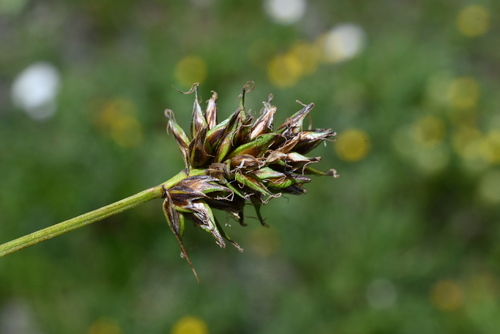
Schoenoplectus americanus
(Pers.) Volkart
American bulrush
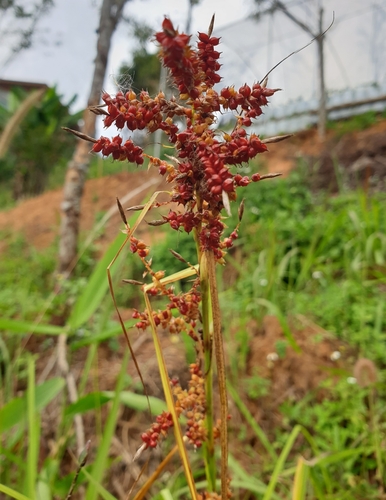
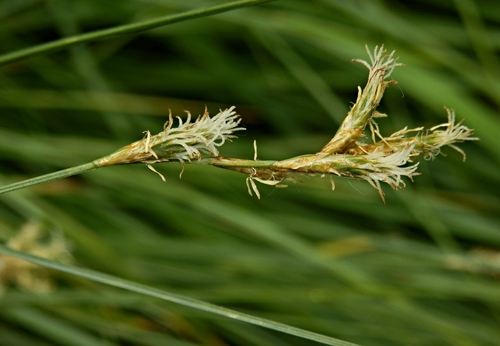
iNaturalist· cc-by-nc
(c) Prairie Guy, some rights reserved (CC BY-NC), uploaded by Prairie Guy
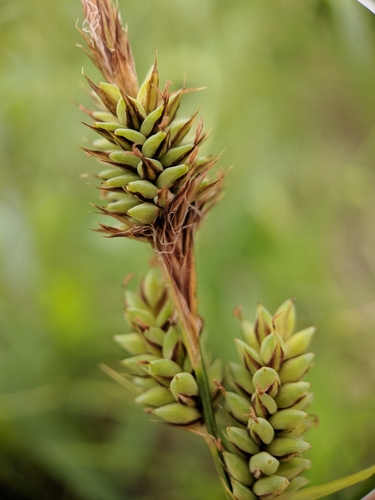
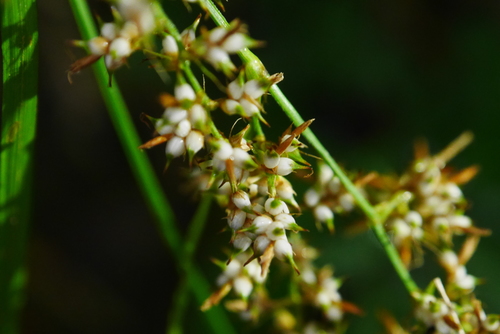
iNaturalist· cc-by-nc
(c) sk74, some rights reserved (CC BY-NC)
Summary
Source: WikipediaSchoenoplectus americanus (syn. Scirpus americanus) is an American species of flowering plant in the sedge family known by the common names chairmaker's bulrush and Olney's three-square bulrush.
Description
Evergreen perennial sedge reaching 1 m tall and 0.5 m wide at a medium growth rate. Hardy to UK zone 6. Wind-pollinated flowers attract wildlife. Thrives in light sandy and medium loamy soils, including nutrient-poor conditions. Tolerates neutral to very alkaline and saline soils. Requires full sun and prefers wet soil or standing water.
Edible Uses
Rhizomes, stem bases, shoots, and seeds are all edible, though all parts are small and low-yielding; seeds are the most practical component (edibility rating 2/5). Shoots and stems have a mild grassy flavour, rhizomes are tough and stringy, and seeds can be toasted for a wheat-like flavour. They are best used in soups or as a flour extender. Growth occurs in spring and summer, with seeds maturing in late summer; rhizomes can be harvested year-round. Compared to tule (Schoenoplectus acutus), this species played a limited role as a food source; it was more widely used for weaving and seed harvesting. Overall caloric value is low, with seeds the only component worth collecting in quantity.
Traditional Uses
The roots and tender shoots are used as food. The roots are eaten raw, boiled, baked or roasted. They are also pounded into flour.
This uses section is brief — help expand it
Medicinal Uses
None known
Distribution
It is a temperate plant. It grows in salt marshes and mud flats.
Where It Grows
Australia, Britain, Chile, Europe, North America, South America, St. Kitts and Nevis, USA,
Propagation
Propagate by rhizome division or seed. Plant rhizomes horizontally at 5–10cm depth. Seeds require cold-moist stratification and germinate best in shallow water or saturated media.
Other Uses
Excellent for soil stabilization. Seeds are eaten by ducks and rails, and dense mats provide shelter for amphibians.
Notes
There are about 60 Schoenoplectus species.
Synonyms
References (8)
- Lim, T. K., 2015, Edible Medicinal and Non Medicinal Plants. Volume 9, Modified Stems, Roots, Bulbs. Springer p 75
- Moerman, D. F., 2010, Native American Ethnobotany. Timber Press. p 522 (As Scirpus americanus)
- Plants for a Future database, The Field, Penpol, Lostwithiel, Cornwall, PL22 0NG, UK. http://www.scs.leeds.ac.uk/pfaf/ (As Scirpus americanus)
- Simpson, D. A. & Inglis, C. A., 2001, Cyperaceae of Economic, Ethnobotanical and Horticultural Importance: A checklist. Kew Bulletin Vol. 56, No. 2 (2001), p. 330 (As Scirpus americanus)
- Syn. pl. 1:68. 1805 (As Scirpus americanus)
Show all 8 references Hide references
- Toupal, R. S. & Hollenback, K., 2009, An Ethnobotany of Indiana Dunes National Lakeshore: Plant Uses of the Ojibwa People. Bureau of Applied Research in Anthropology. University of Arizona (As Scirpus americanus)
- Ugalde, P. C., et al, 2020, 13,000 years of sociocultural plant use in the Atacama Desert of northern Chile. Vegetation History and Archaeobotany. Springer
- World Checklist of Useful Plant Species 2020. Royal Botanic Gardens, Kew