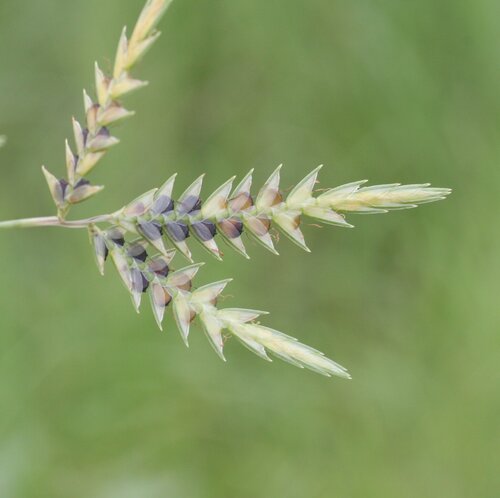
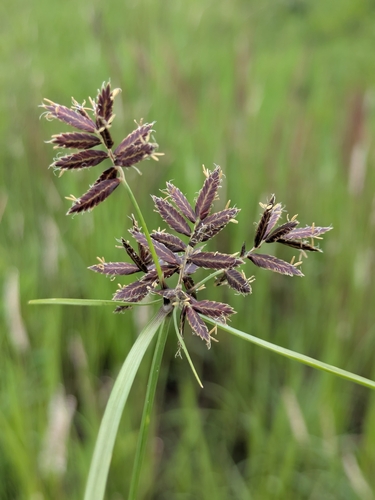
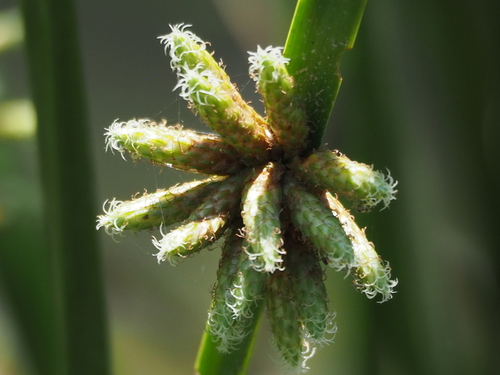
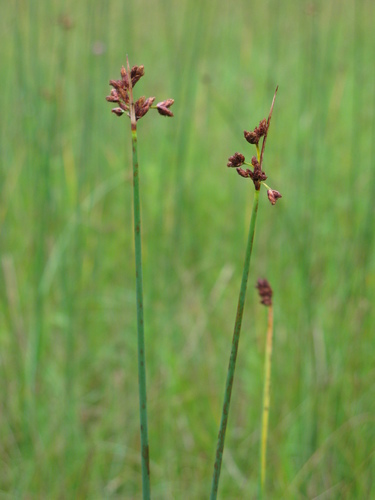
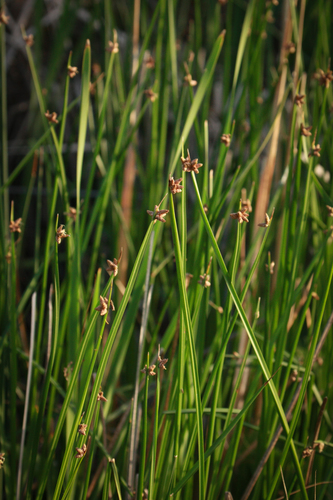
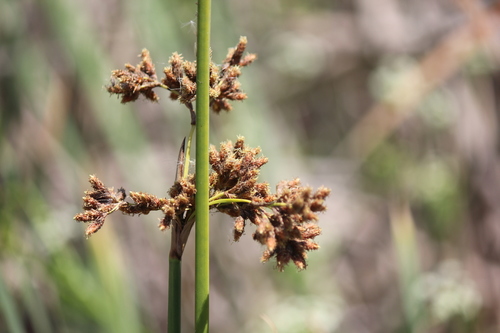
Scirpus affinis
Roth.
Summary
A perennial sedge reaching 60 cm tall with a hermaphroditic flower structure pollinated by wind. Adapts well to light sandy, medium loamy, and heavy clay soils across mildly acidic to basic pH ranges, including saline conditions. Grows in semi-shaded woodland or full sun and thrives in consistently moist or wet environments, including shallow water. Tolerates maritime exposure.
Description
A perennial sedge reaching 60 cm tall with a hermaphroditic flower structure pollinated by wind. Adapts well to light sandy, medium loamy, and heavy clay soils across mildly acidic to basic pH ranges, including saline conditions. Grows in semi-shaded woodland or full sun and thrives in consistently moist or wet environments, including shallow water. Tolerates maritime exposure.
Edible Uses
The root can be eaten raw or cooked and is rich in starch.
Medicinal Uses
None known
Distribution
It is a temperate plant.
Where It Grows
Asia, Europe,
Cultivation
We have very little information on this species and do not know if it will be hardy in Britain, though judging by its native range it should succeed outdoors in most parts of this country. This species is not in 'Flora Europaea' even though it is said to be native to Europe. However, S. maritimus affinis.(Roth.)T.Norlindii. is mentioned in 'Flora Europaea' and it is quite likely that these two names are one and the same species. The following notes are based on the general needs of the genus. Succeeds in any wet to moisture retentive ground, pond margins and shallow water in full sun or shade.
Propagation
Sow seed in a cold frame as soon as it is ripe in a pot standing in 3cm of water, barely covering the seed with soil. Germination is usually fairly quick. Prick out plants when large enough to handle and plant into permanent positions in early summer. Divide in spring — larger divisions can go directly into permanent positions, while smaller divisions are best potted up and grown on in a lightly shaded cold frame until well established, then planted out in summer.
Other Uses
The plant is used to make roofs and walls of temporary shelters, as insulation in walls, and for weaving items such as mats.
References (1)
- Plants for a Future database, The Field, Penpol, Lostwithiel, Cornwall, PL22 0NG, UK. http://www.scs.leeds.ac.uk/pfaf/