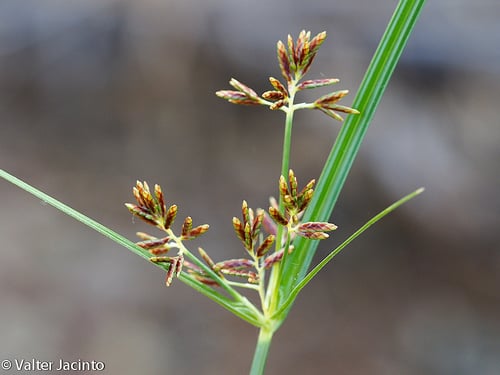
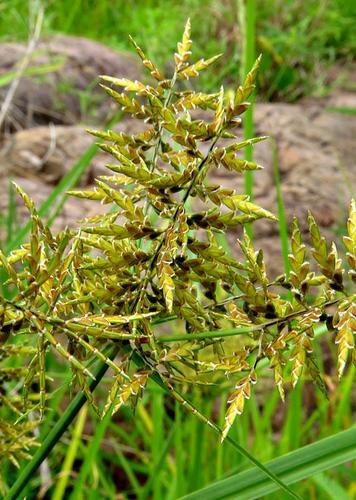
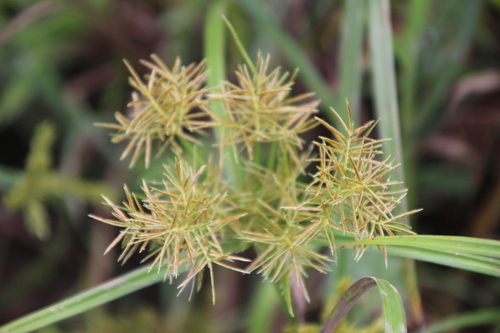
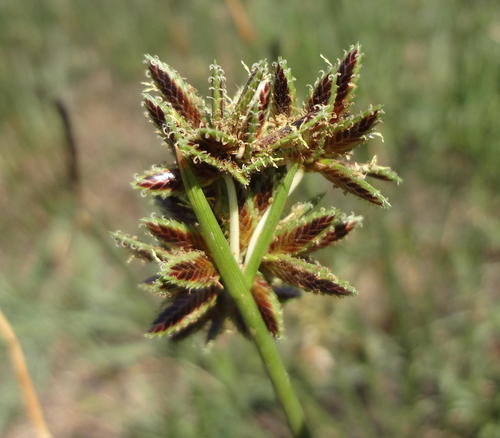
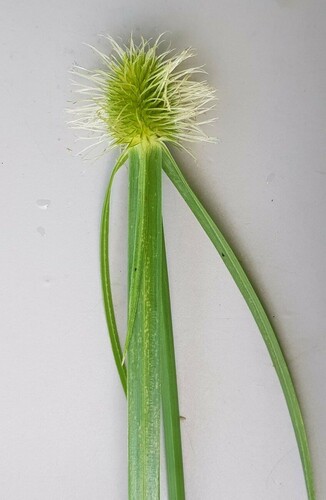
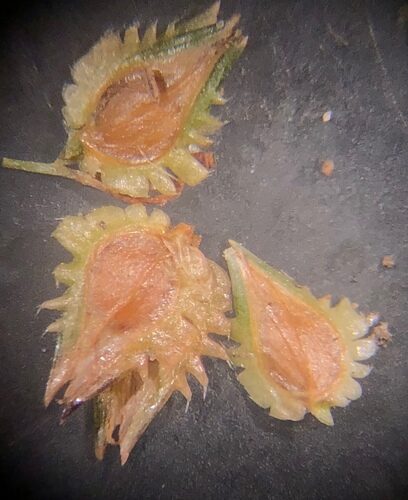
Cyperus textilis
Thunb.
iNaturalist· cc-by-nc
(c) Vathiswa ZIKISHE, some rights reserved (CC BY-NC), uploaded by Vathiswa ZIKISHE
iNaturalist· cc-by-sa
(c) Tony Rebelo, some rights reserved (CC BY-SA), uploaded by Tony Rebelo
iNaturalist· cc-by
(c) Averater, some rights reserved (CC BY)
Summary
Source: WikipediaCyperus textilis (flat sedge, basket grass, umbrella sedge, mat sedge) is a sedge in the family Cyperaceae. It is endemic to southern parts of South Africa where it grows near rivers and other water reservoirs. Cyperus textilis is used to make baskets, sleeping mats, rolled twine and other woven articles.
Description
An evergreen perennial sedge reaching 1.5 m tall and 1 m wide with fast growth. Tolerates light sandy, medium loamy, and heavy clay soils across a range of pH levels from mildly acidic to mildly alkaline. Thrives in full shade to open conditions and prefers consistently moist or wet soil, even growing directly in water. Can tolerate air pollution. Hardy to UK zone 10.
Edible Uses
None known.
Traditional Uses
The bottom end of the stem is eaten.
This uses section is brief — help expand it
Medicinal Uses
None known.
Distribution
It is a subtropical plant.
Where It Grows
Africa, South Africa, Southern Africa,
Cultivation
Grows in any good soil. Can grow in shallow water, waterlogged soil and moist soil. Can be grown in containers or water features. Good for heavy clay soils. A tender perennial, surviving with minimum is -7ºC / 30ºF (USDA zone 9). Frost kills the foliage but the plant will resprout in spring provided the roots were not frozen. Carbon Farming Solutions - Cultivation: regional crop. Management: hay (Describes the non-destructive management systems that are used in cultivation).
Propagation
Division of clumps is the preferred method — use young growth and discard old growth. The plant can also be grown from seed or from cuttings; for cuttings, take the top 5 cm including the umbrella.
Other Uses
Cyperus textilis is an important material for weaving mats and basketry and for making rope. It is a traditional building material for peoples of southern Africa, particularly the Khoi, who use it primarily to weave mats as a hut covering, bound in place by twine made from the same plant. The rope is also used to bind thatch. Reed beds containing Cyperus textilis and similar plants — reeds, bulrushes, and sedges — are used worldwide to clean polluted water. The plants absorb excess nitrogen and phosphates from treated sewage and have also proved effective at removing heavy metals and phenolic compounds from wastewater. The plant is also grown as an industrial biomass crop, providing materials, chemicals, or energy.
Synonyms
Also Known As
Tou, Toue
References (3)
- De Vynk, J. C., et al, 2016, Indigenous edible plant use by contemporary Khoe-San descendants of South Africa's Cape South Coast. South African Journal of Botany. 102 (2016) 60-69
- Ruiters-Welcome, A. K., 2019, Food plants of southern Africa. Ph.D. thesis. Univ. of Johannesburg p 51
- Welcome, A. K. & Van Wyk, B.-E., 2019, An inventory and analysis of the food plants of southern Africa. South African Journal of Botany 122 (2019) 136–179