Archontophoenix alexandrae
(F. Muell.) H. Wendl. & Drude
Alexander palm, Alexandra Palm, King palm
iNaturalist· cc-by-nc
(c) James Bailey, some rights reserved (CC BY-NC), uploaded by James Bailey
iNaturalist· cc-by
(c) dhfischer, some rights reserved (CC BY), uploaded by dhfischer
iNaturalist· cc-by
(c) dhfischer, some rights reserved (CC BY), uploaded by dhfischer
Summary
Source: WikipediaArchontophoenix alexandrae, commonly known as Alexandra palm, king palm, northern Bangalow palm, or feather palm, is a palm endemic to Queensland, Australia. It was named in honour of Princess Alexandra of Denmark, but is often erroneously referred to by the misnomer Alexander palm.
Description
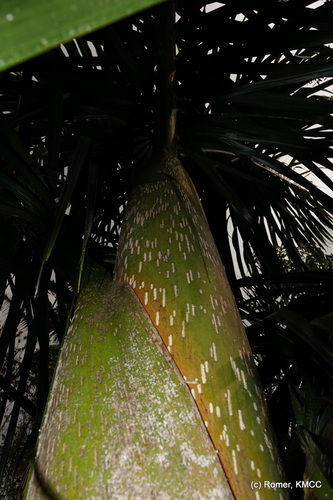
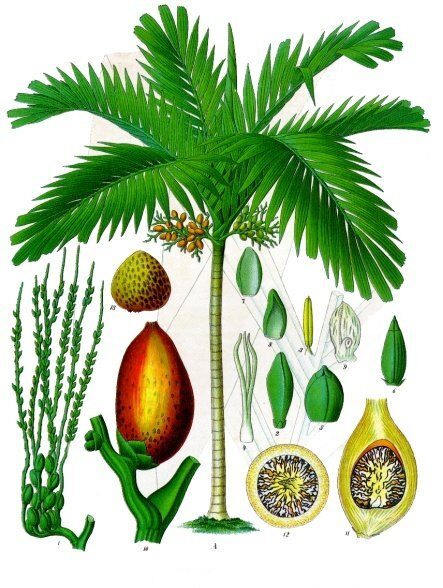
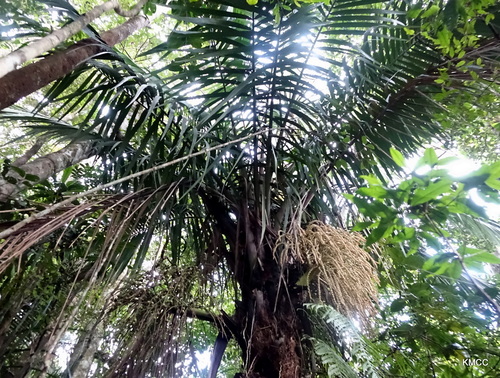
A tall slender palm with a single grey trunk reaching up to 30 m tall and 25 cm across, swollen at the base with leaf scars. It has feather-like fronds 2-3 m long with drooping silvery grey leaflets, and produces small cream-colored flowers followed by green fruits that turn red when ripe.
Edible Uses
The young terminal bud or heart can be eaten raw, though harvesting it kills the palm and is not normally practiced. The ripe red fruits can be cooked and eaten after processing.
Traditional Uses
The young bud or cabbage can be eaten raw. As this would kill the palm it is not normally done. The fruit can be cooked and eaten. They need processing.
Where It Grows
Cabbage, Palm heart, Fruit,
Cultivation
Plants are grown from fresh seed. They germinate in 3 months. Seedlings transplant easily. Seed germination is increased by soaking in water for 24-72 hours. It is also further improved by treating for 72 hours with 100 or 1000 ppm of gibberellic acid.
Production
Seedlings grow quickly.
Other Information
Arecaceae
Notes
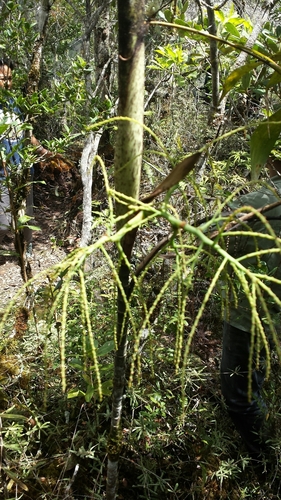
A tall slender palm. It has a single stem and feather like leaves. These fronds arch over and the drooping leaflets are silvery grey underneath. The trunk is grey and can be 30 m tall. It is 25 cm across. The trunk is swollen at the base and has rings of leaf scars on it. The leaves are 2-3 m long and 60-90 cm wide. The leaf stalk is smooth and has a sheathing base forming a 1 m long crown-shaft. The leaflets are 30-45 cm long and 2-5 cm wide. They are evenly and closely spaces and point forward. The central vein is yellow and raised on the upper surface. The flowering stalk is large and branched. The small branches hang downwards carrying flowers. The flowering stalk can be 40-80 cm long. It is immediately below the crown-shaft and it is yellow. The 2 large pale green pointed leaf-like bracts fall before the flowers open. The flowers have male and female flowers on the same stalk. They are cream and about 8 mm across. Fruit are green but turn red when ripe. They are oval and 10-15 mm long. They have a smooth waxy surface. They contain a single fibrous seed with a fleshy layer around it.
Synonyms
Also Known As
Bira mundtha, Palem aleksander
References (37)
- Balick, M.J. and Beck, H.T., (Ed.), 1990, Useful palms of the World. A Synoptic Bibliography. Colombia p 441
- Blomberry, A. & Rodd, T., 1982, Palms. An informative practical guide. Angus & Robertson. p 48
- Bodkin, F., 1991, Encyclopedia Botanica. Cornstalk publishing, p 96
- Brickell, C. (Ed.), 1999, The Royal Horticultural Society A-Z Encyclopedia of Garden Plants. Convent Garden Books. p 131
- Calvert, G., 2010, The Burdekin Delta Tree Guide. Lower Burdekin Landcare Association., Inc., Ayr p 17
Show all 37 references Hide references
- Cooper, W. and Cooper, W., 2004, Fruits of the Australian Tropical Rainforest. Nokomis Editions, Victoria, Australia. p 67
- Cronin, L., 1989, The Concise Australian Flora. Reed. p 204
- Cronin, L., 2000, Australian Palms, Ferns, Cycads and Pandans. Cronin Publications. p 14
- Cundall, P., (ed.), 2004, Gardening Australia: flora: the gardener's bible. ABC Books. p 174
- Dharani, N., 2002, Field Guide to common Trees & Shrubs of East Africa. Struik. p 283
- Elliot, W.R., & Jones, D.L., 1982, Encyclopedia of Australian Plants suitable for cultivation. Vol 2. Lothian. p 223
- Etherington, K., & Imwold, D., (Eds), 2001, Botanica's Trees & Shrubs. The illustrated A-Z of over 8500 trees and shrubs. Random House, Australia. p 101
- Gibbons, M., 1993, Palms. Compact study Guide and Identifier. Sandstone. p 16
- Gibbons, M., 2003, A pocket guide to Palms. Chartwell Books. p 35
- Greig, D., 1996, Flowering Natives for Home Gardens. Angus & Robertson. p 55
- Hearne, D.A., & Rance, S.J., 1975, Trees for Darwin and Northern Australia. AGPS, Canberra p 24, Pl 7 & Colour Pl 2
- Hiddins, L., 1999, Explore Wild Australia with the Bush Tucker Man. Penguin Books/ABC Books. p 126
- Hibbert, M., 2002, The Aussie Plant Finder 2002, Florilegium. p 31
- Jackes, B.R., 2001, Plants of the Tropics. Rainforest to Heath. An Identification Guide. James Cook University. p 42
- Jackes, B. R., 2010, Plants of Magnetic Island. 3rd Edition. James Cook University, Australia. p 27
- Jones D. L, 1986, Ornamental Rainforest Plants in Australia, Reed Books, p 326
- Jones, D.L., 1994, Palms throughout the World. Smithtonian Institution, Washington. p 57
- Jones, D.L., 2000, Palms of Australia 3rd edition. Reed/New Holland. p 76
- Linnaea 39:212. 1875
- Llamas, K.A., 2003, Tropical Flowering Plants. Timber Press. p 91
- Lord, E.E., & Willis, J.H., 1999, Shrubs and Trees for Australian gardens. Lothian. p 92
- Melzer, R., & Plumb, J., 2011, Plants of Capricornia. Belgamba, Rockhampton. p 40
- Molyneux, B & Forrester, S., 1997, The Austraflora A-Z of Australian Plants. Reed. p 46
- Nicholson, N & H., 1996, Australian Rainforest Plants 3, Terania Rainforest Publishing. NSW. p 9
- Plants of Haiti Smithsonian Institute http://botany.si.edu
- Price, S.H. & J.L., Wild Food, Medicine and useful plants of the Wet tropics. Kwik Kopy, Cairns. p 6
- Recher, P, 2001, Fruit Spirit Botanical Gardens Plant Index. www.nrg.com.au/~recher/ seedlist.html p 7
- Staples, G.W. and Herbst, D.R., 2005, A tropical Garden Flora. Bishop Museum Press, Honolulu, Hawaii. p 618
- Sukarya, D. G., (Ed.) 2013, 3,500 Plant Species of the Botanic Gardens of Indonesia. LIPI p 749
- Townsend, K., 1994, Across the Top. Gardening with Australian Plants in the tropics. Society for Growing Australian Plants, Townsville Branch Inc. p 86
- Tucker, R., 1988, The Palms of Subequatorial Queensland. Palm and Cycad Society of Australia, Milton, Queensland. p 50
- Wong, M., 2006, Edible Plants for Hawai'i Landscapes. College of Tropical Agriculture and Human Resources. Univ. of Hawai'i