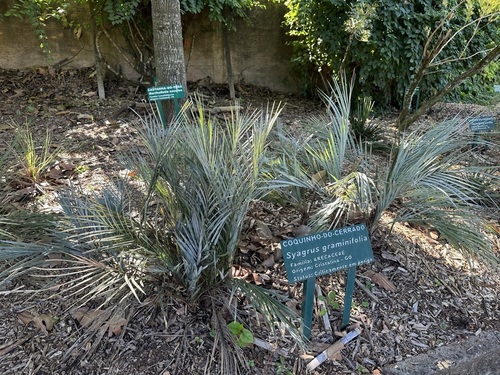
Dypsis mananjarensis
(Jum. & H. Perrier.) Beentje & J Dransf.
Mealy bug palm
iNaturalist· cc0
no rights reserved, uploaded by Romer N. Rabarijaona
iNaturalist· cc-by-nc
(c) felixromiguiere, some rights reserved (CC BY-NC)
iNaturalist· cc-by-nc
(c) felixromiguiere, some rights reserved (CC BY-NC)
Summary
Source: WikipediaDypsis mananjarensis is a species of flowering plant in the family Arecaceae. It is found only in Madagascar. It is threatened by habitat loss.
Description
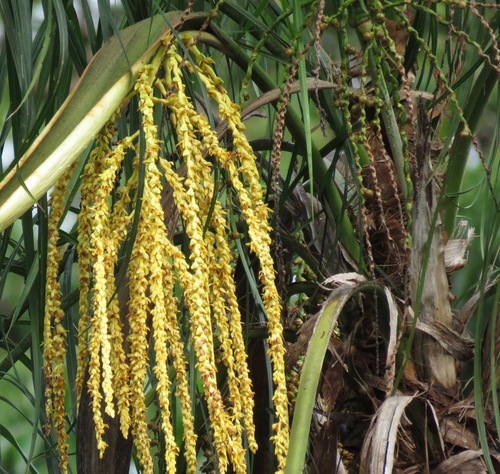
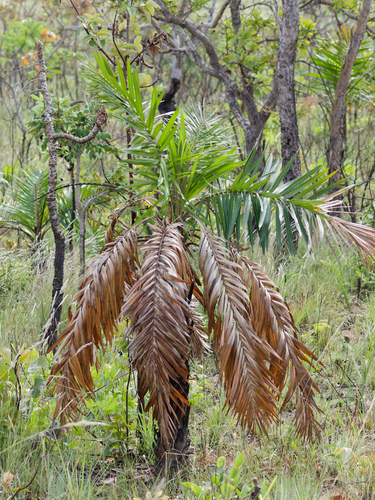
A solitary palm. It grows 6-25 m tall. The trunk is 14-29 cm across. There are rings of widely spaced leaf scars. The crown-shaft is 1.3 m long and covered with a waxy bloom. It has large waxy scales which can be green, yellow or orange. The crown-shaft bulges at the base. There are only a few leaves which form a half circle. The leaves are 3.1 m long and arranged in 3 layers. They are spreading but do not arch over. The leaflets are 1-1.3 m long are narrowly sword shaped. The leaves have a feathery appearance.
Edible Uses
The palm heart can be eaten as a vegetable, though this palm should only be harvested for food if grown from your own seed.
Medicinal Uses
The plant (parts not specified but probably the bark and/or the fruits) is used in the treatment of headaches, jaundice and hepatitis; and also as an aid to lactation.
Known Hazards
This palm should not be eaten unless grown from your own seed.
Distribution
A tropical plant. It grows in both dry and wet locations at low altitudes in Madagascar. It grows up to 200 m altitude. It cannot tolerate frost.
Where It Grows
Africa, East Africa, Madagascar*,
Cultivation
Plants can be grown from seeds.
Other Uses
The bark produces a fibre that was formerly much used by the local population. The wood is very hard and used for making planks for houses. Only the lower portion of mature trees are used for their timber, as the upper portions and the whole trunks of young plants are too soft to produce durable planks. This lower portion is cut in up to 3 sections, each 3 - 4 metres long. The sections are split in half, and the soft core is removed to produce 2 curved planks. The bark is scraped off, and the planks are tied together in bundles of 4 - 6.
Production
It grows quickly.
Other Information
This palm should not be eaten unless grown from your own seed.
Notes
There are 140 Dypsis species.
Synonyms
Also Known As
Laafa, Lakatra, Ovodaafa
References (6)
- Balick, M.J. and Beck, H.T., (Ed.), 1990, Useful palms of the World. A Synoptic Bibliography. Colombia p 121 (As Chrysalidocarpus nananjarensis), 334 (As Chrysalidocarpus fibrosus),
- Dransfield, J. & Beentje, H., 1995, The Palms of Madagascar. Royal Botanical Gardens, Kew and The International Palm Society. p 162
- Grubben, G. J. H. and Denton, O. A. (eds), 2004, Plant Resources of Tropical Africa 2. Vegetables. PROTA, Wageningen, Netherlands. p 291
- Johnson, D.V., 1998, Tropical palms. Non-wood Forest products 10. FAO Rome. p 114
- Riffle, R.L. & Craft, P., 2003, An Encyclopedia of Cultivated Palms. Timber Press. p 331
Show all 6 references Hide references
- World Checklist of Useful Plant Species 2020. Royal Botanic Gardens, Kew