Schismatoglottis calyptrata
(Roxb.) Zoll. & Moritzi
Drop tongue
iNaturalist· cc-by-nc-sa
(c) 106611639464075912591, some rights reserved (CC BY-NC-SA), uploaded by 106611639464075912591
iNaturalist· cc-by-nc
(c) 王錦堯(Ong Jin Yao), some rights reserved (CC BY-NC)
iNaturalist· cc-by-nc
(c) 王錦堯(Ong Jin Yao), some rights reserved (CC BY-NC)
Description
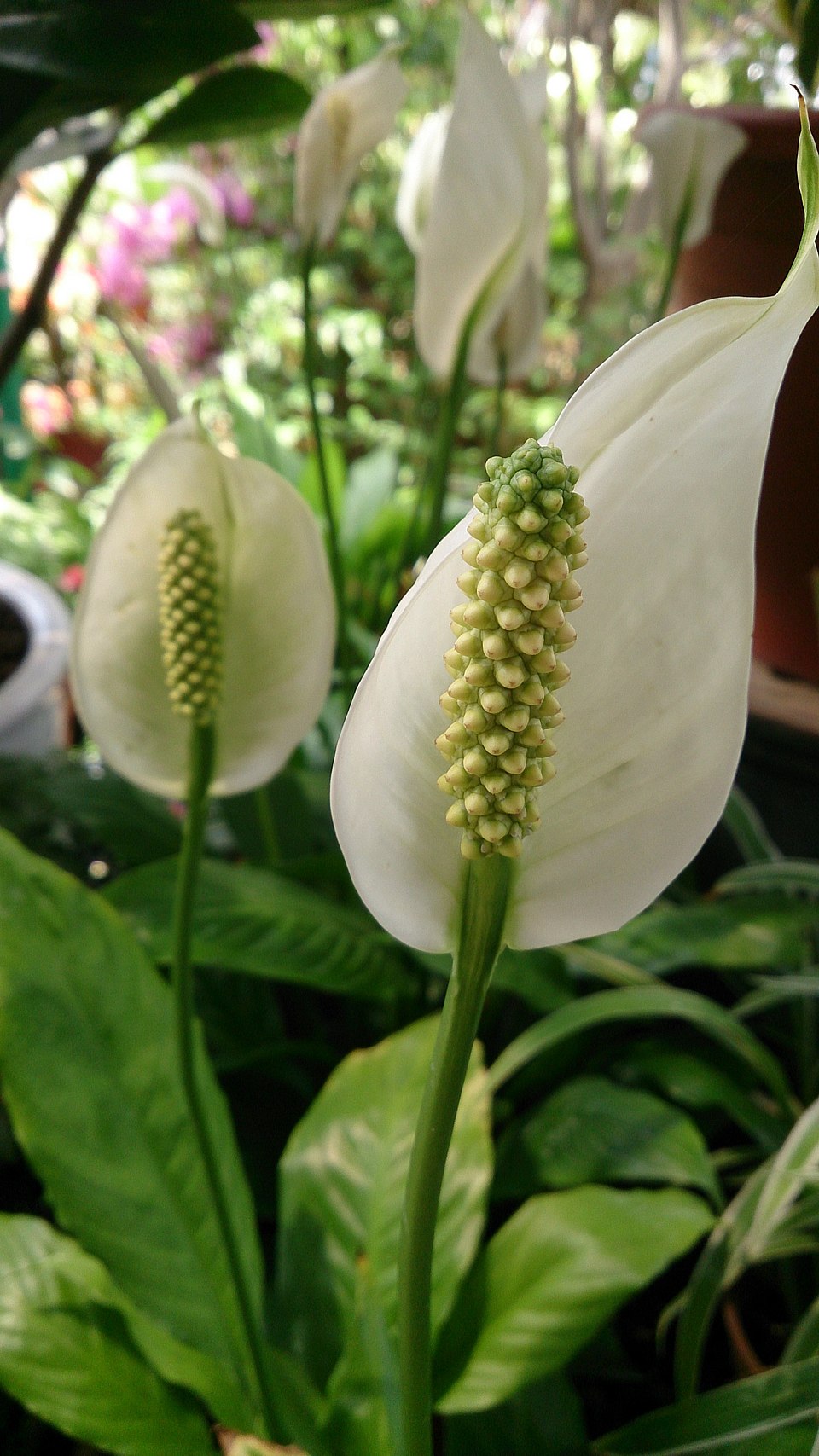
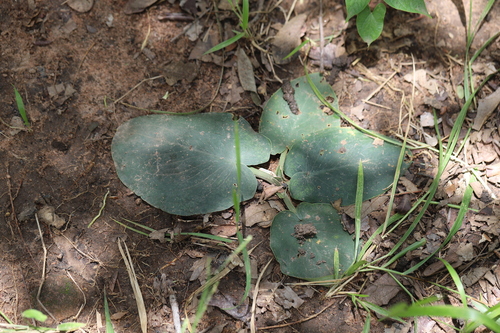
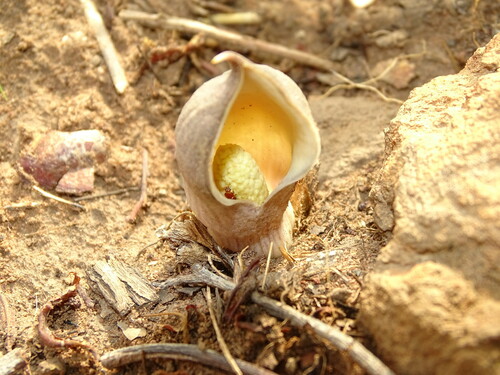
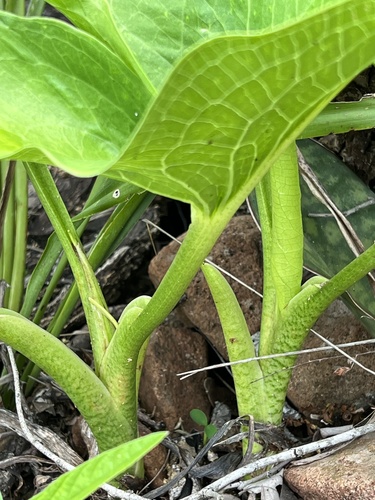
A herb. It is a taro family plant without stems but a long, stout rhizome. It is 30-60 cm high. The leaves are oval with heart shaped bases. The leaf is 20 cm long by 13 cm wide. It has up to 20 pairs of side veins. The leaf stalk is 30 cm long. It has a sheath near the base. The large leaf like structure around the flower is 6-7 cm long. It is constricted at the middle. The flower stalk is almost equally divided between male and female flowers. After maturity the male part falls off.
Edible Uses
The tubers are boiled, sometimes in a second boiling with coconut milk. The leaves, flowers, and berries are all cooked and eaten.
Traditional Uses
The tubers are boiled twice. Sometimes the second boiling is in coconut milk. The leaves are also cooked and eaten. The flowers can be cooked and eaten. The berries are cooked and eaten.
Distribution
A tropical plant. It is common in humid places in Papua New Guinea. It occurs in sago-palm mangrove locations. It suits shady places. It grows in dense tropical forests, under forest or on rocks between 740-880 m in China. It grows along streams. In Java it grows up to 1,500 m above sea level.
Where It Grows
Asia, China, India, Indochina, Indonesia, Malaysia, Myanmar, SE Asia, Pacific, Papua New Guinea, PNG, Philippines, SE Asia, Singapore, Taiwan, Vanuatu, Vietnam,
Cultivation
Plants can be grown from sections of the rhizome or underground stem. They can also be grown from seeds.
Notes
There are 100-120 Schismatoglottis species.
Nutrition
| Part | Moisture | kJ | kcal | Protein | Vit A | Vit C | Iron | Zinc |
|---|---|---|---|---|---|---|---|---|
| Leaves | — | — | — | — | 11 | — | — | — |
Synonyms
Also Known As
Alapayi, Guang xi luo yan, Lidah jatuh, Mon doc, Mon vout, Njampon, Nyampon, Pikaw, Salimpar, Solempat, Wewehan
References (20)
- Altschul, S.V.R., 1973, Drugs and Foods from Little-known Plants. Notes in Harvard University Herbaria. Harvard Univ. Press. Massachusetts. no. 124
- Ambasta S.P. (Ed.), 2000, The Useful Plants of India. CSIR India. p 556
- Bodner, C. C. and Gereau, R. E., 1988, A Contribution to Bontoc Ethnobotany. Economic Botany, 43(2): 307-369
- Borrell, O.W., 1989, An Annotated Checklist of the Flora of Kairiru Island, New Guinea. Marcellin College, Victoria Australia. p 17, 157
- Burkill, I.H., 1966, A Dictionary of the Economic Products of the Malay Peninsula. Ministry of Agriculture and Cooperatives, Kuala Lumpur, Malaysia. Vol 2 (I-Z) p 2009
Show all 20 references Hide references
- Heyne, K., 1927, p 422
- Johns, R.J. & Hay, A., 1976, Monocotyledons of Papua New Guinea. Part 1 , Forestry College Bulolo, PNG p 73
- Kuo, W. H. J., (Ed.) Taiwan's Ethnobotanical Database (1900-2000), http://tk.agron.ntu.edu.tw/ethnobot/DB1.htm
- Li Heng, Araceae, Flora of China
- Lim, T. K., 2015, Edible Medicinal and Non Medicinal Plants. Volume 9, Modified Stems, Roots, Bulbs. Springer p 75
- Maghirang, R. G., et al, 2018. Ethnobotanical Studies of Some Plants Commonly Used as Vegetables in Selected Provinces of the Philippines. Journal of Nature Studies. 17(2), 30-43. (As Schismatoglottis sp.)
- Martin, F.W. & Ruberte, R.M., 1979, Edible Leaves of the Tropics. Antillian College Press, Mayaguez, Puerto Rico. p 176
- Mot So Rau Dai an Duoc O Vietnam. Wild edible Vegetables. Ha Noi 1994, p 186
- Ochse, J.J. et al, 1931, Vegetables of the Dutch East Indies. Asher reprint. p 60
- Ogle, B. M., et al, 2003, Food, Feed or Medicine: The Multiple Functions of Edible Wild Plants in Vietnam. Economic Botany 57(1): 103-117
- Peekel, P.G., 1984, (Translation E.E.Henty), Flora of the Bismarck Archipelago for Naturalists, Division of Botany, Lae, PNG. p 70, 71
- PROSEA handbook Volume 9 Plants yielding non-seed carbohydrates. p 189
- A. Moritzi et al., Syst. Verz. 83. 1846
- Sukarya, D. G., (Ed.) 2013, 3,500 Plant Species of the Botanic Gardens of Indonesia. LIPI p 1134
- World Checklist of Useful Plant Species 2020. Royal Botanic Gardens, Kew