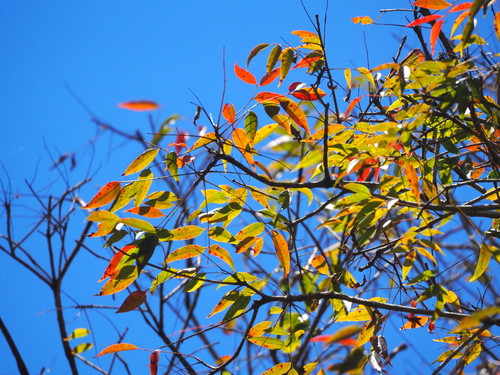
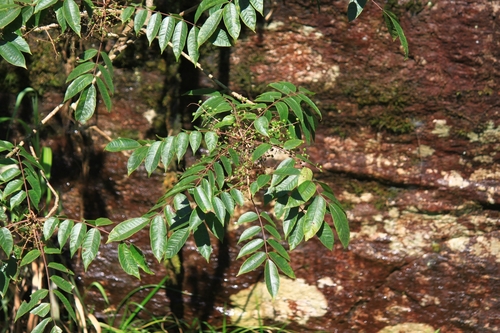
Schinus molle
L.
Peruvian mastic tree, Peruvian peppertree
iNaturalist· cc-by-nc
(c) altagray, some rights reserved (CC BY-NC)
iNaturalist· cc-by-nc
(c) lacystring, some rights reserved (CC BY-NC)
Summary
Source: WikipediaSchinus molle (Peruvian pepper, also known as American pepper, Peruvian peppertree, escobilla, false pepper, rosé pepper, molle del Peru, pepper tree, peppercorn tree, California pepper tree, pirul, Peruvian mastic, anacahuita or aguaribay and pepperina) is an evergreen tree that grows to 15 m (50 ft). It is native to an area from the Peruvian Andes to southern Brazil. The bright pink fruits of S. molle are often sold as "pink peppercorns", although it is unrelated to black pepper (Piper nigrum). The word molle in Schinus molle comes from mulli, the Quechua word for the tree. The tree is host to the pepper-tree moth, Bombycomorpha bifascia.
Description
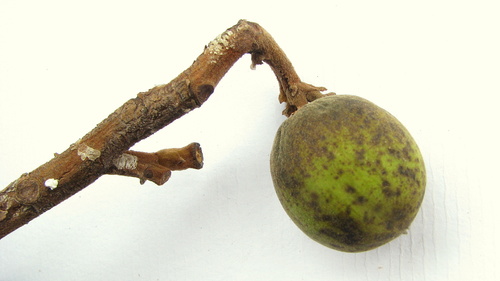
A small shrubby evergreen tree. It grows 4-8 m high but can be 15 m tall. It spreads about 2-5 m across. The trunk is short and 25-35 cm across. The crown is spreading and the branches hang downwards. The bark is dark brown and peels off. If the bark is damaged a very sticky fluid is produced. The leaves are narrow and spiky. They hang down and look like feathers. They are compound leaves up to 30 cm long with many (19-41) narrow leaflets up to 7 cm long. The leaves have a peppery smell if crushed. Trees are separately male and female. The flowers are small and produced in clusters at the ends of branches. They are green-yellow. The fruit are small and berry like. They hang on female trees and vary between green, red and black. The hanging flower stalks are 8-20 cm long. They are edible.
Edible Uses
The dried and roasted berries work well as a pepper substitute, though some caution is advised regarding toxicity. An essential oil distilled from the fruit is used to flavour baked goods and candy. The fruits can be pulverised and stirred into cooling drinks known as 'horchatas' in South America. Wine is made both from the twigs and from the berries separately. A gum that exudes naturally from the bark is used for chewing.
Traditional Uses
The leaves and fruit have a peppery taste. They are used to make a drink. The dried, roasted berries are used as a peppery substitute. An oil distilled from the fruit is use as a spice. CAUTION: There are some reports that the peppercorns are harmful. They contain an alkaloid. They should not be eaten in large amounts. The fruit are used to make wine.
Medicinal Uses
A resinous gum obtained from the bark has been used in folk medicine to treat digestive disorders. A purgative known as 'American Mastic' is also obtained from the tree, a report likely linked to the same gum preparation.
Known Hazards
The seed contains an allergenic substance that can irritate the mucus membrane. In large quantities, they can be toxic. The leaves can cause contact dermatitis. The gum-resin found in the bark can give rise to contact dermatitis. The pollen, either on contact or when inhaled, can cause dermatitis and asthmatic reactions.
Distribution
It grows in tropical and subtropical regions. It suits warm dry climates. It is damaged by frost. It needs temperatures above 10°C. It prefers well drained soils but will grow in most soils. It can grow in sandy soils. It is very drought resistant. It will grow in areas with less than 1,000 mm rainfall. It does best in a sunny position. In the tropics it grows at higher elevations. It can tolerate alkalinity and salinity. In Ethiopia it grows from sea level to 2,400 m altitude. It can grow in arid places. It suits hardiness zones 9-11. Arboretum Tasmania.
Where It Grows
Africa, Algeria, Andes, Argentina, Asia, Australia, Bolivia, Botswana, Brazil*, Canada, Cape Verde, Central America, Chile, Colombia, Cuba, Dominican Republic, East Africa, Ecuador, Egypt, Eritrea, Ethiopia, Europe, France, Gambia, Greece, Haiti, Hawaii, India, Iraq, Israel, Italy, Jamaica, Kenya, Lesotho, Libya, Malawi, Mediterranean, Mexico, Middle East, Myanmar, Namibia, New Zealand, North Africa, North America, Pacific, Pakistan, Paraguay, Peru*, Portugal, SE Asia, Slovenia, Somalia, South Africa, Southern Africa, South America, Spain, St Helena, Sudan, Tanzania, Tasmania, Turkey, Türkiye, Uganda, Uruguay, USA, Venezuela, West Africa, West Indies, Yemen, Zambia, Zimbabwe,
Cultivation
Plants are grown from seed. There are 30,000 to 40,000 seeds per kg. They germinate reasonably well. Seed can be stored. Because branches tend to fall from mature trees they should not be put close to buildings.
Propagation
Sow seed in a warm greenhouse in mid spring. Prick out seedlings into individual pots once large enough to handle and grow on in the greenhouse for at least their first winter before planting out in early summer. Cuttings of almost ripe wood, 8cm with a heel, taken August to early September and rooted in a frame give a fair to good success rate.
Other Uses
An oil derived from the leaves reduces the surface tension of water. The plant is also noted for its scented qualities.
Production
It is a fast growing tree. Trees reach maturity in about 20 years. Trees can be topped or pruned.
Other Information
The fruit are eaten especially by children. It is cultivated.
Notes
Because the pepper corns are very oily they can clog the pepper grinder. There are about 30 Schinus species. This is an alternative host to black citrus scale.
Also Known As
Aguaribay, Aroeira-salso, Brazilian mastic tree, Californian pepper, Hucchu menasina mara, Lažni poprovec, Mirimiri, Mpilipili, Muelle, Mugaita, Mulli, Peperboom, Pepper tree, Peppercorn, Pimiento Falso, Pink peppercorns, Pirul, Qundo
References (55)
- Ambasta S.P. (Ed.), 2000, The Useful Plants of India. CSIR India. p 556
- Barwick, M., 2004, Tropical and Subtropical Trees. A Worldwide Encyclopedic Guide. Thames and Hudson p 368
- Bekele-Tesemma A., Birnie, A., & Tengnas, B., 1993, Useful Trees and Shrubs for Ethiopia. Regional Soil Conservation Unit. Technical Handbook No 5. p 408
- Blamey, M and Grey-Wilson, C., 2005, Wild flowers of the Mediterranean. A & C Black London. p 128
- Bodkin, F., 1991, Encyclopedia Botanica. Cornstalk publishing, p 914
Show all 55 references Hide references
- Brack, P., et al, 2020, Frutas nativas do Rio Grande do Sul, Brasil: riqueza e potencial alimentício. Native fruits of Rio Grande do Sul, Brazil: richness and potential as food. Rodriguésia 71: e03102018.
- Brickell, C. (Ed.), 1999, The Royal Horticultural Society A-Z Encyclopedia of Garden Plants. Convent Garden Books. p 942
- Burkill, H. M., 1985, The useful plants of west tropical Africa, Vol. 1. Kew.
- Chamorro, M. F., & Ladio, A., 2020, Native and exotic plants with edible fleshy fruits utilized in Patagonia and their role as sources of local functional foods. BMC Complementary Medicine and Therapies. 20:155
- Cruz, I. M., et al, 2015, Edible fruits and seeds in the State of Mexico. Revista Mexicana de Ciencias Agricolas. Vol. 6. Num. 2 pp 331-346
- Cundall, P., (ed.), 2004, Gardening Australia: flora: the gardener's bible. ABC Books. p 1322
- Dharani, N., 2002, Field Guide to common Trees & Shrubs of East Africa. Struik. p 155
- Duarte, M. C., et al, 2022, Diversity of Useful Plants in Cabo Verde Islands: A Biogeographic and Conservation Perspective. Plants 2022, 11, 1313 p 8
- Ertug, F., 2004, Wild Edible Plants of the Bodrum Area. (Mugla, Turkey). Turk. J. Bot. 28 (2004): 161-174
- Ethiopia: Famine Food Field Guide. http://www.africa.upenn.edu/faminefood/category3.htm
- Facciola, S., 1998, Cornucopia 2: a Source Book of Edible Plants. Kampong Publications, p 10
- Flora of Pakistan. www.eFloras.org
- Grandtner, M. M. & Chevrette, J., 2013, Dictionary of Trees, Volume 2: South America: Nomenclature, Taxonomy and Ecology. Academic Press p 592
- Hall, N. et al, 1972, The Use of Trees and Shrubs in the Dry Country of Australia, AGPS, Canberra. p 395
- Hemphill, I, 2002, Spice Notes. Macmillan. p 293
- Hibbert, M., 2002, The Aussie Plant Finder 2002, Florilegium. p 288
- http://www.botanic-gardens-ljubljana.com/en/plants
- Katende, A.B., Birnie, A & Tengnas B., 1995, Useful Trees and Shrubs for Uganda. Identification, Propagation and Management for Agricultural and Pastoral Communities. Technical handbook No 10. Regional Soil Conservation Unit, Nairobi, Kenya. p 552
- Kermath, B. M., et al, 2014, Food Plants in the Americas: A survey of the domesticated, cultivated and wild plants used for Human food in North, Central and South America and the Caribbean. On line draft. p 788
- Kinupp, V. F., 2007, Plantas alimenticias nao-convencionais da regiao metropolitana de Porto Alegre, RS, Brazil p 58
- Kinupp, V. F. & Bergman, I., 2008, Protein and minerals of native species, potential vegetables and fruits. Cienc.Tecnol. Aliment. Vol. 28 No. 4 Campinas Oct/Dec.
- Kiple, K.F. & Ornelas, K.C., (eds), 2000, The Cambridge World History of Food. CUP p 1811
- Lazarides, M. & Hince, B., 1993, Handbook of Economic Plants of Australia, CSIRO. p 212
- Llamas, K.A., 2003, Tropical Flowering Plants. Timber Press. p 59
- Lord, E.E., & Willis, J.H., 1999, Shrubs and Trees for Australian gardens. Lothian. p 72
- Low, T., 1992, Bush Tucker. Australia’s Wild Food Harvest. Angus & Robertson. p 185
- Lulekal, E., et al, 2011, Wild edible plants in Ethiopia: a review on their potential to combat food insecurity. Afrika Focus - Vol. 24, No 2. pp 71-121
- Martin, F. W., et al, 1987, Perennial Edible Fruits of the Tropics. USDA Handbook 642 p 79
- Mbuya, L.P., Msanga, H.P., Ruffo, C.K., Birnie, A & Tengnas, B., 1994, Useful Trees and Shrubs for Tanzania. Regional Soil Conservation Unit. Technical Handbook No 6. p 432
- Paczkowska, G. & Chapman, A.R., 2000, The Western Australian Flora. A Descriptive Catalogue. Western Australian Herbarium. p 144
- Quintana, C. M., 2010, Wild Plants in the Dry Valleys Around Quito Ecuador. An Illustrated Guide. Publicationes del Harbario, QCA p 61
- Roa, J. A. G. & Boada, D. S. G., 2018, Fundación para el Fortalecimiento de la Fruticultura y Plantas Alimenticias no Convencionales en Colombia.
- Royal Botanic Gardens, Kew (1999). Survey of Economic Plants for Arid and Semi-Arid Lands (SEPASAL) database. Published on the Internet; http://www.rbgkew.org.uk/ceb/sepasal/internet [Accessed 28th March 2011]
- Ruiters-Welcome, A. K., 2019, Food plants of southern Africa. Ph.D. thesis. Univ. of Johannesburg p 14
- Schuler, S., (Ed.), 1977, Simon & Schuster's Guide to Trees. Simon & Schuster. No. 168
- Segura, S. et al, 2018, The edible fruit species in Mexico. Genet Resour Crop Evol (2018) 65:1767–1793
- Solomon, C., 2001, Encyclopedia of Asian Food. New Holland. p 278
- Sp. pl. 1:388. 1753
- Staples, G.W. and Herbst, D.R., 2005, A tropical Garden Flora. Bishop Museum Press, Honolulu, Hawaii. p 106
- Thomas, E., et al, 2008, The Relationship Between Plant Use and Plant Diversity in the Bolivian Andes, with Special Reference to Medicinal Plant Use. Hum Ecol (2008) 36:861–879
- Thomas, E., et al, 2009, The relation between accessibility, diversity and indigenous valuation of vegetation in the Bolivian Andes. Journal of Arid Environments. 73:854-861
- Torre, de la L., et al, 2008, Enciclopedia de las Plantas Útiles del Ecuador. Herbario QCA. Pontificia Universidad Católica del Ecuador. p 159
- Ugalde, P. C., et al, 2020, 13,000 years of sociocultural plant use in the Atacama Desert of northern Chile. Vegetation History and Archaeobotany. Springer
- van Wyk, B, van Wyk, P, and van Wyk B., 2000, Photographic guide to Trees of Southern Africa. Briza. p 278
- Villagran, C., et al, 1999, La Tradicion Altiplanica: Estudio Etnobotanico en Los Andes de Iquique, Primera Region, Chile. Chungara, volumen 31 No. 1 pp 81-186
- Welcome, A. K. & Van Wyk, B.-E., 2019, An inventory and analysis of the food plants of southern Africa. South African Journal of Botany 122 (2019) 136–179
- Wiersema, J. H. & Leon, B., 2013, World Economic Plants. A Standard Reference CRC Press. 2nd Ed. p 618
- Woodson, R. E. et al, 1967, Flora of Panama. Part 6. Family 101. Anacardiaceae. Annals of the Missouri Botanical Gardens, Vol. 54, No. 3 p 361 (Drawing)
- World Checklist of Useful Plant Species 2020. Royal Botanic Gardens, Kew
- www.worldagroforestrycentre.org/treedb/