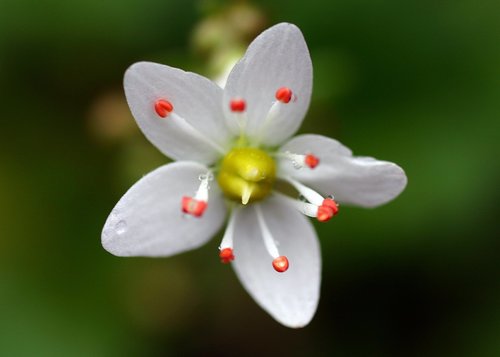
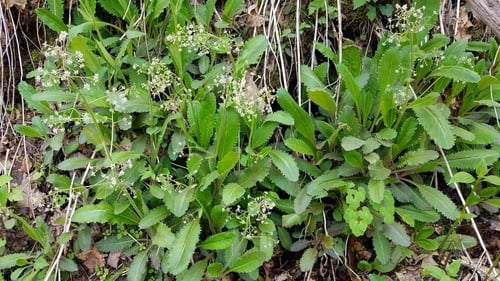
Saxifraga stolonifera
Meeburgh
Strawberry saxifrage, Creeping Saxifrage
iNaturalist· cc-by-nc-nd
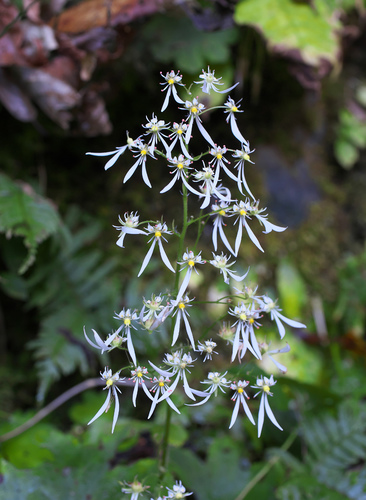
(c) James Gaither, some rights reserved (CC BY-NC-ND)
iNaturalist· cc-by-nc
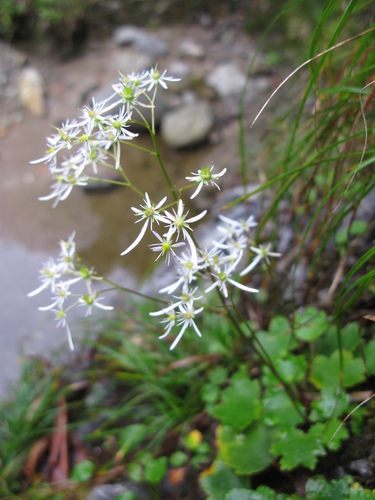
(c) gg_copen, some rights reserved (CC BY-NC)
Summary
Source: WikipediaSaxifraga stolonifera is a perennial flowering plant known by several common names, including creeping saxifrage, strawberry saxifrage, creeping rockfoil, Aaron's beard, mother of thousands, roving sailor, and strawberry begonia or strawberry geranium, though it is neither a true begonia nor a geranium; both these latter plants belong to different families.
Description
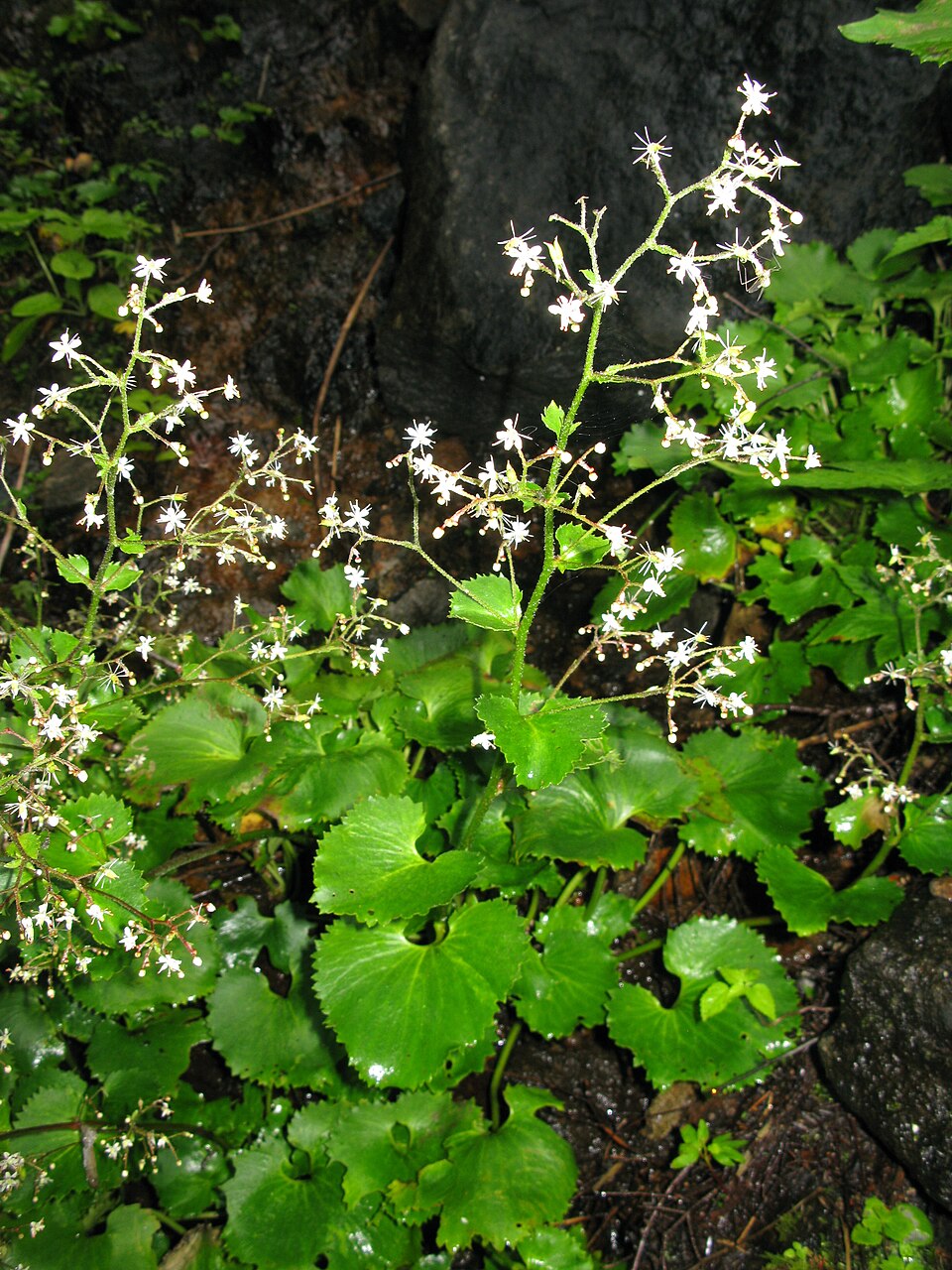
A herb which keeps growing from year to year. It grows 40 cm high and spreads 30 cm wide. It has long thin stolons or runners. The leaves are round or kidney shaped. They are reddish underneath and the veins are silvery above. It has panicles of white flowers. These are spotted with red or yellow. The flower stalks are 40 cm long.
Edible Uses
Leaves can be eaten raw or cooked and are especially popular in Japan parboiled or fried and used in salads. The flowering stem is said to be tasty when salted.
Traditional Uses
The leaves are fried or parboiled and used in salads. They are eaten in tempura in Japan. They are pounded and used in chutney. The flower scapes are salted and eaten.
Medicinal Uses
The plant has antibacterial and antiphlogistic properties, and the leaves contain growth-promoting substances. The whole plant is depurative, febrifuge, and suppurative, promoting the drainage of pus. A decoction is used to treat boils, abscesses, poisonous snakebites, otitis media, acute convulsions, and haematemesis. Leaf juice is applied externally to aching ears, abscesses, and inflammations.
Distribution
It is a temperate to subtropical plant. In China it grows between 400-4,500 m above sea level. It suits hardiness zones 5-10. In XTBG Yunnan. In Sichuan.
Where It Grows
Asia, Australia, Britain, China*, Europe, Hawaii, India, Indonesia, Japan*, Korea, Northeastern India, Pacific, SE Asia, Sikkim, Singapore, USA,
Cultivation
Prefers a cool position in a moist humus-rich soil. Prefers an acid soil. Thrives on heavy soils in the milder areas of the country. Usually thrives in a poor soil with a northerly aspect. Grows well in light woodland or in a shady position in a rock garden. The plant is hardy to about -10°c. The leaves and the flowers, however, are liable to be damaged by autumn frosts. A very ornamental plant, it is sometimes grown as a house plant. A polymorphic species, it is closely related to S. cortusifolia, differing in having runners. An evergreen. A clumping mat former. Forming a dense prostrate carpet spreading indefinitely.
Propagation
Sow seed in a cold frame in spring. Surface sow or barely cover the seed, keeping the compost consistently moist. Prick seedlings into individual pots once large enough to handle and grow on in a greenhouse or cold frame through their first winter. Plant out in late spring after the last expected frosts. Divide in spring; larger divisions can go straight into permanent positions. Smaller divisions are best potted up and grown on in a lightly shaded cold frame, then planted out once well established in summer.
Other Uses
Suitable as ground cover in a shady position, with plants spaced approximately 45 cm apart in each direction.
Notes
There are about 440 Saxifraga species.
Synonyms
Also Known As
Huercao, Mother of thousands, Strawberry begonia, Strawberry geranium, Tiger's ear plant, Yuki-no-shita
References (13)
- Chen, B. & Qiu, Z., Consumer's Attitudes towards Edible Wild Plants, Ishikawa Prefecture, Japan. p 24 www.hindawi.com/journals/ijfr/aip/872413.pdf
- Cundall, P., (ed.), 2004, Gardening Australia: flora: the gardener's bible. ABC Books. p 1318
- Facciola, S., 1998, Cornucopia 2: a Source Book of Edible Plants. Kampong Publications, p 229
- Flora of China @ efloras.org Volume 8
- Heo, B., et al., 2009, Antiproliferative Activity of Korean Wild Vegetables on Different Human Tumor Cell Lines. Plant Foods for Human Nutrition. 64:257-263
Show all 13 references Hide references
- Jackes, D. A., 2007, Edible Forest Gardens
- Levy-Yamamori, R., & Taaffe, G., 2004, Garden Plants of Japan. Timber Press. p 352
- Philos. Trans. 64:308, t. 2541. 1774 - (As Curtis)
- Plants for a Future database, The Field, Penpol, Lostwithiel, Cornwall, PL22 0NG, UK. http://www.scs.leeds.ac.uk/pfaf/
- Savita, et al, 2006, Studies on wild edible plants of ethnic people in east Sikkim. Asian J. of Bio Sci. (2006) Vol. 1 No. 2 : 117-125 (As Saxifraga ligulata Wall.)
- Staples, G.W. and Herbst, D.R., 2005, A tropical Garden Flora. Bishop Museum Press, Honolulu, Hawaii. p 521
- Tanaka,
- Valder, P., 1999, The Garden Plants of China. Florilegium. p 382