Sauromatum venosum
(Aiton) Kunth
Voodoo lily
iNaturalist· cc-by-nc
(c) Shiwalee Samant, some rights reserved (CC BY-NC), uploaded by Shiwalee Samant
iNaturalist· cc-by
(c) Ramnarayan K, some rights reserved (CC BY)
iNaturalist· cc-by
(c) Ramnarayan K, some rights reserved (CC BY)
Summary
Source: WikipediaSauromatum venosum is a species of plant in the arum family (Araceae). It is native to Asia and Africa, where it grows in forests and riparian meadows. It is grown as an ornamental plant. Its common names include voodoo lily and monarch of the East.
Description
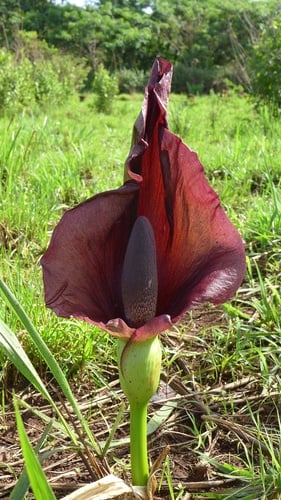
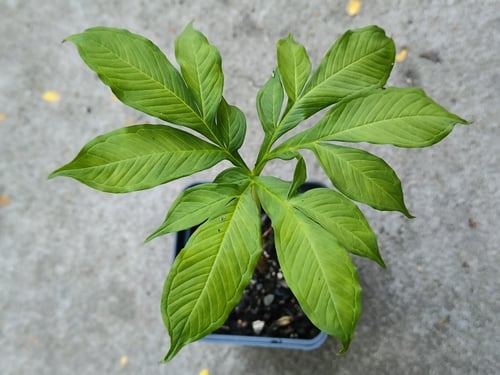
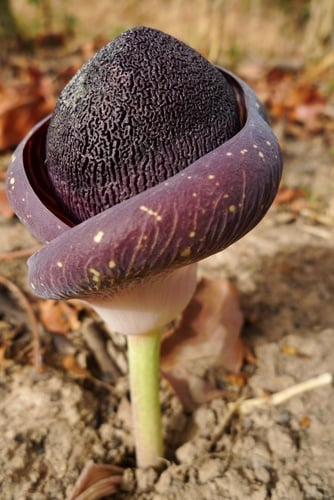
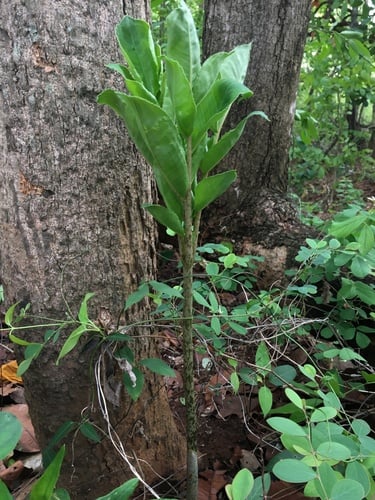
A herb which forms tubers. The corm can be 13 cm across. The leaf stalk is mottled black. It forms leaves after flowering. The leaf occurs singly and has 7-15 variable lobes. The interior of the spathe is speckled. The flower stalk or spadix is finger-like. The fruit are red berries. The seeds are oval and 1.8 mm across. The flower has a bad smell. The leaves appear after flowering.
Edible Uses
The tuber is traditionally processed through boiling, cutting, and leaching in running water before cooking and eating whole or as flour. The leaves and stems are also used as vegetables, cooked for consumption. It serves as a famine food.
Traditional Uses
CAUTION: The tuber is toxic. It must be carefully processed. The tuber is boiled then cut into pieces and leached in running water. It is then cooked and eaten whole or processed into flour. The leaves are used as a vegetable. The stems are cooked.
Known Hazards
The tuber is toxic and must be carefully processed through boiling, leaching in running water, and cooking before consumption.
Distribution
A subtropical plant. It grows in primary evergreen forests, meadows by river, secondary thickets, pathsides between 1350-2030 m in southern China. In Yunnan.
Where It Grows
Africa, Asia, Australia, China, Bhutan, East Africa, Ethiopia, Himalayas, India, Indochina, Myanmar, Nepal, Northeastern India, Pakistan, SE Asia, Sikkim, Slovenia, Tibet,
Other Information
It is a famine food.
Notes
There are 2-6 Sauromatum species.
Synonyms
Also Known As
Bhasma-kand, Bukki-bu're, Dhey, Diva kand, Diva, Kidachali, Lapra, Loth, Ninkerowly, Nurki, Pindi, Wenut
References (15)
- Ambasta S.P. (Ed.), 2000, The Useful Plants of India. CSIR India. p 552
- Brickell, C. (Ed.), 1999, The Royal Horticultural Society A-Z Encyclopedia of Garden Plants. Convent Garden Books. p 936
- GAMMIE (As Sauromatum guttatum)
- Herb., E. A., 1981,
- Hibbert, M., 2002, The Aussie Plant Finder 2002, Florilegium. p 287
Show all 15 references Hide references
- http://www.botanic-gardens-ljubljana.com/en/plants
- Li Heng, Araceae, Flora of China
- Lim, T. K., 2015, Edible Medicinal and Non Medicinal Plants. Volume 9, Modified Stems, Roots, Bulbs. Springer p 75
- Masoodi, H. U. R. & Sundriyal, R. C., 2020, Richness of non-timber forest products in Himalayan communities—diversity, distribution, use pattern and conservation status. Journal of Ethnobiology and Ethnomedicine 16:56
- Morley, B. & Everard, B., 1970, Wild Flowers of the World. Ebury press. Plate 125
- Nilegaonkar, S., et al, 1985, Nutritional Evaluation of some wild food plants from the Pune and Nieghbouring districts, Maharashtra state: Part 1. J. Econ. Tax. Bot. Vol. 6 No. 3 pp 629-635 (As Sauromatum pedatum)
- Peters, C. R., O'Brien, E. M., and Drummond, R.B., 1992, Edible Wild plants of Sub-saharan Africa. Kew. p 12
- Sina, B. & Degu, H. D., 2015, Knowledge and use of Wild Edible Plants in the Hula District of the Sidama Zone. International Journal of Bio-resource and Stress Management 6(3):352-365
- World Checklist of Useful Plant Species 2020. Royal Botanic Gardens, Kew
- Yimer, A., et al, 2021, Ethnobotanical study of wild edible plants used by Meinit Ethnic Community at Bench-Maji Zone, Southwest Ethiopia. Research Square. p 5